MAN ES DEMONSTRATES NEW OTTO CYCLE ME-GA ENGINE PLATFORM
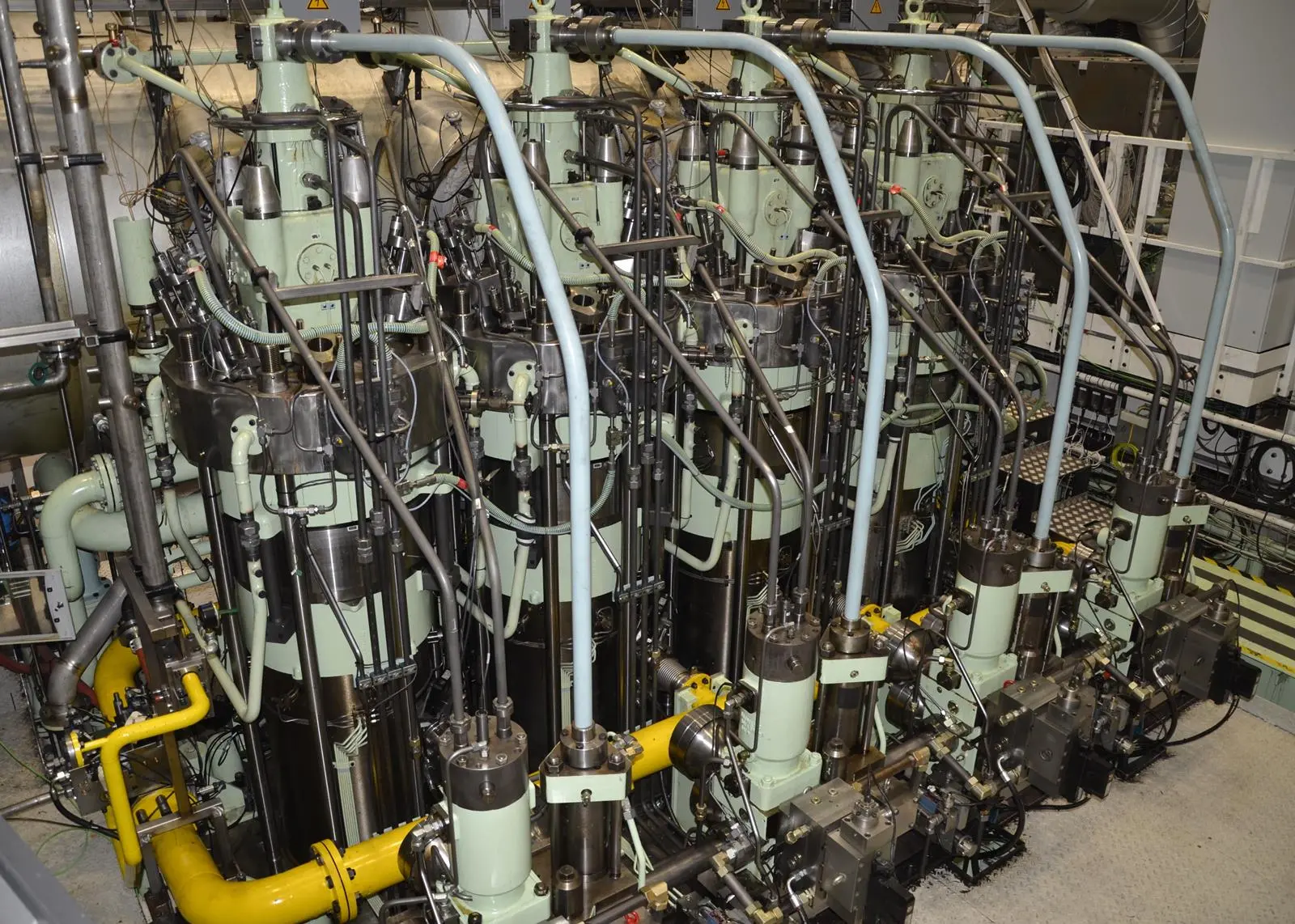
Bjarne Foldager, Senior Vice President and Head of Two-Stroke Business, revealed the ME-GA engine had already been specified in several LNG carrier newbuilding projects. The details of the first of the projects will be revealed by mid-April.
The timeline for the commercial launch of the Otto Cycle engine has remained largely unchanged, despite the disruptive effects of the Covid-19 pandemic on collaboration with engine licensee HHI-EMD and with Hyundai Heavy Industries’ shipyard division.
The testing of the first, commercial ME-GA design is expected to begin by the end of 2021, with the first engine delivery following in early 2022.
The response from other shipyards in Korea and East Asia had also been encouraging, Foldager noted.
This was no surprise, as the new engine platform had been designed with commercial as well as technical requirements at its heart. The 700mm bore design retains the same outline and footprint as a G70ME-C10.5 engine. The five cylinder version of the 700mm bore G70ME-C10.5-GA is explicitly aimed at the LNG carrier market, where twin five-cylinder 700mm bore engines are frequently specified.
Shipyard considerations were also reflected in the choice of a high-pressure EGR solution. The solution could be integrated into existing engine-room designs, while the EGR unit itself does not change the engine footprint.
However, the MAN B&W ME-GA engine is also being aimed at other vessel types and applications, where low capital outlay is a priority. These include Aframax tankers, for example. The company plans to add a 500mm bore version of the engine – S50ME-C-GA – to its engine programme alongside its existing 700mm bore G70ME-C10.5-GA and 600mm bore G60ME-C10.5-GA options.
Wayne Jones OBE, Chief Sales Officer, told The Motorship that the company was considering developing other engine sizes.
Foldager noted that the company had no plans to develop a larger 950mm bore version of the ME-GA. The technical challenge of developing a 950mm-bore Otto Cycle engine was significantly greater than simply scaling up a 700-bore engine. He added that as MAN ES’s ME-GI high-pressure dual-fuel engine was frequently specified by shipyards for ultra large container vessels newbuildings, there was little commercial demand for such a development.
Tier III compliant options
The presentation confirmed many of the details released during earlier stages of the product development cycle. As previously reported, the engine will be Tier III compliant in gas mode without emissions abatement equipment.
Meanwhile, specifying the exhaust gas recirculation (EGR) option would ensure the engine met Tier III requirements in both fuel oil and gas modes without additional aftertreatment. The exhaust gas recirculation aftertreatment option would lower the engine’s methane emissions by between “30-50%”.
The company reports that EGR will enable the ME-GA to reduce specific gas consumption by around 3%, and specific fuel-oil consumption by 5%.
The EGR aftertreatment option offers particular advantages for fuel consumption at part-loads within the load range.
Thomas S. Hansen, Head of Two Stroke Promotion & Customer Support, noted that this improvement was seen in the engine for both specific fuel oil consumption and for specific gas consumption. Hansen cited the MAN B&W MAN B&W G70ME-C10.5-GA, which lowered SFOC by 7.4g/kWh to 170.1g/kWh at 50% load in Tier II mode, compared with the low-pressure SCR version. A similar reduction of 5.6g/kWh was seen at 75% load.
Comparable reductions in SGC were seen, with gas consumption lowered by 6.8g/kWh to under 134g/kWh at 50% load in Tier II mode, compared with the low-pressure SCR version. A similar reduction of 5.1g/kWh was seen at 75% load.
One particular area of focus has been the pilot fuel oil consumption, given its connection with NOx emissions in gas mode for Otto Cycle engines. In gas mode, the ME-GA engine required no more than 0.5% pilot fuel consumption.
The ME-GA design also included a microbooster system, which allowed high sulphur fuel oil to be used for pilot fuel injection in Tier II gas mode, Hansen confirmed during the presentation.
Hansen added that several of the ME-GA’s design features offered opportunities to bear down on CAPEX costs during the newbuilding process. He gave the example of the separation of the Gas Valve Unit from the Gas Regulating Unit within the design. By locating the GVU outside the gas safe area, this eliminated the need to install a cofferdam box in the engine room, as the unit did not need to be specified to comply with gas safe area rules.
Hansen also identified the ME-GA’s purging concept as an area where the application of ME-GI concepts led to CAPEX reductions. Rather than injecting nitrogen from the GVU, the nitrogen is applied at the engine end, and the purged volume is carried along existing piping. The simplified solution reduced the amount of pipework and components, and significantly lowered the volume, reducing nitrogen consumption, Hansen noted.
Hansen noted that the engine also employed a safe gas admission valve, placed on the manifold and exhaust side of the cylinder. By being located close to the cylinder, it minimises the potential volume that could enter under the piston case in case of a release. The valves also have a window valve function.
Hansen confirmed that the standard 3 piston-ring package used on ME-GI engines was being applied to the ME-GA design. MAN had gained considerable experience with the CERMET coated ring pack concept in service on existing G70 engines.
Hansen noted that the ME-GA engine was expected to have similar cylinder oil requirements as the existing ME-GI engine. While MAN ES would recommend the use of a BN40 Category II cylinder oil as soon as one became available, it would currently recommend a BN100 Category II cylinder oil.
PRINCIPAL PARTICULARS – MAN B&W ME-GA engine
|
Engine |
MAN B&W G70ME-C10.5-GA |
MAN B&W G60ME-C10.5-GA |
|
Bore |
700mm |
600mm |
|
Stroke |
3,256mm |
2,790mm |
|
Stroke/bore ratio |
4.65 |
4.65 |
|
Power per cylinder, L1 rating |
2,830kW @78rpm |
2,080kW @91rpm |
|
Power/cyl, L2 rating |
2,260kW @78rpm |
1,660kW @91rpm |
|
Power/cyl, L3 rating |
2,400kW @66rpm |
1,760kW @77rpm |
|
Power/cyl, L4 rating |
1,920kW @66rpm |
1,410kW @77rpm |
|
Mean effective pressure, L1 rating |
17.4 bar |
17.4 bar |
|
Engine versions, cylinder numbers |
5, 6 |
5, 6, 7, 8 |
|
Power range(SMCR), 5cyl model |
9,600-14,150kW |
7,050-2,080kW |
|
Power range(SMCR), 6cyl model |
11,520-16,980kW |
8,460-12,480kW |
|
Power range(SMCR), 7cyl model |
9,870-14,560kW |
|
|
Power range(SMCR), 8cyl model |
11,280-16,640kW |