MAN ES sees VLOCs as next market for 800mm bore ME-GI engine
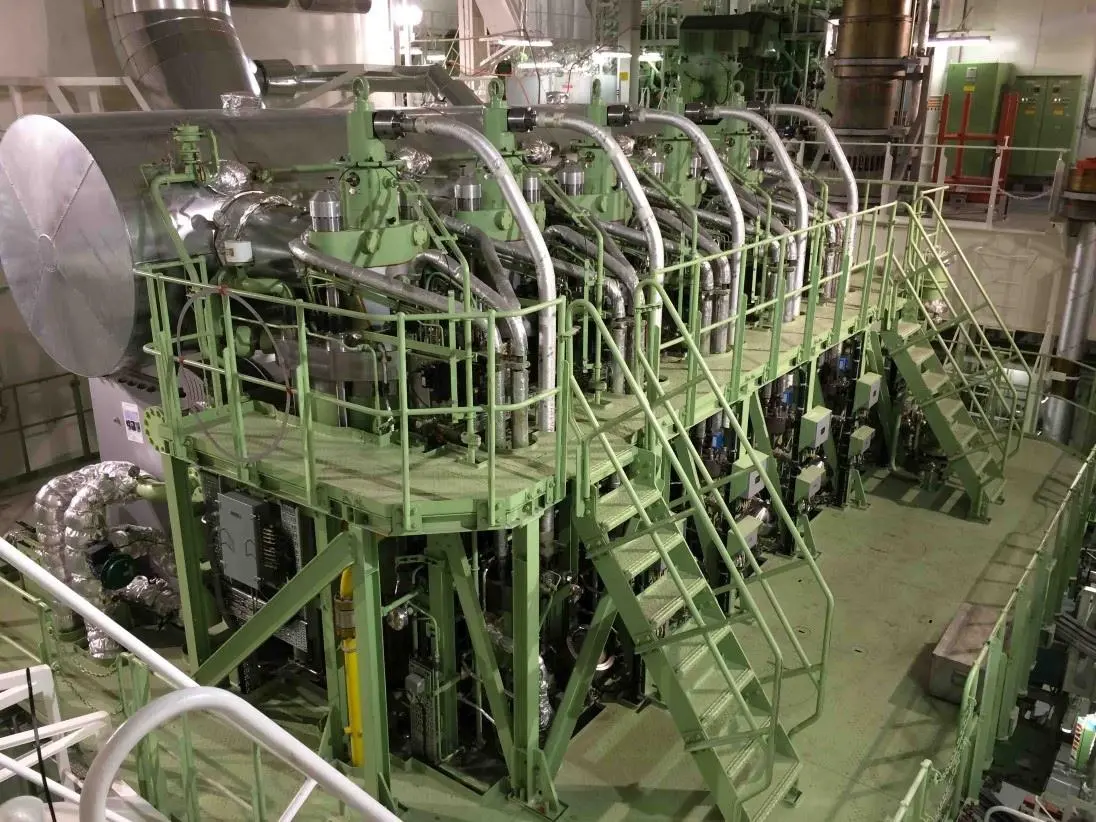
In just three months, MAN Energy Solutions has seen orders for its G80ME-GI engine increase from an initial order in March, as one of 10 seven-cylinder Mk9.5 models to be installed in VLCCs for three shipowners, to stand at 17, all for VLCCs, as at 15 June.
As The Motorship reported on 24 March, that first group of orders marked the ME-GI’s arrival in the VLCC segment but now the same 800mm-bore model is being spoken of in connection with potential expansion into another market sector: very large ore carriers (VLOCs), such as the 400,000dwt Valemax segment, popularised by Brazil’s Vale.
MAN Energy Solutions has already claimed that its ME-GI engines are the market standard for dual-fuel bulk carriers, most recently when it announced orders for three 6G70ME-GI engines for a trio of 210,000dwt Newcastlemax bulkers for Eastern Pacific Shipping, as mentioned in The Motorship on 27 May.
Yet this move into bulk carriers was not originally in the company’s dual-fuel development plans. “All of a sudden, something happened, which we didn’t really foresee,” MAN ES’s head of promotion and customer support Thomas Hansen told The Motorship.
That surprise was “very strong interest [in dual-fuel engines] from mining companies,” he explained. These companies have identified that Scope 3 emissions from their transport operations represent an obvious area where GHG emissions can be cut, making dual-fuel engines attractive, especially for ships serving dedicated trades, such as Australia or Brazil to China.
High-spec engines
This benefit justifies investing in high-spec dual-fuel engines and their associated auxiliaries, even though bulk carriers are generally viewed as low-spec and low-speed vessels, Mr Hansen said. Instead, their operators were attracted to the ME-GI engine because “it has the lowest methane slip and best consumption in the market for both gas and conventional fuel,” he said.
For the same reasons, scaling up from 210,000dwt to 325,000dwt, for which a six-cylinder model is anticipated, or a 400,000dwt Valemax, which would use the same seven-cylinder engine as the VLCCs, also justifies a dual-fuel power plant: the GHG savings will be larger and, as a percentage of the ship’s cost, the extra expense of supplying and installing the higher spec engine is a lower proportion of the ship’s total cost. In addition, with the 800mm-bore ME-GI engine now established in the VLCC market and also suitable for container ships of up to about 7,000TEU, VLOCs provide a viable additional market for the design, even though annual orders for Valemax ships may be few in number.
In fact, Vale already operates a number of ships on charter that were ordered about 10 years ago as dual-fuel ready vessels, so could be converted to use LNG. Their design includes space above and around the engine and sufficient strength to accept additional auxiliary machinery.
Whether any of these ships will be upgraded is not known; the cost would include not only the engine conversion kit and extra machinery, there is the yard time and off-hire to consider, pushing the upgrading cost beyond the premium to incorporate a dual-fuel arrangement into a newbuilding, Mr Hansen pointed out.
Fuel would follow
If Vale were to support dual-fuel Valemax vessels, there is little LNG marine fuel available in Brazil at present – its first LNG bunker vessel, Avenir Accolade, went into service in March. But this need not be an issue, Mr Hansen pointed out, since major energy suppliers would certainly make it available if there were demand from a number of VLOCs operating from the country on long-term charters, he said.
Globally, LNG is now widely available and offers reductions of 20-25% in carbon emissions compared with conventional fuels when combusted via the diesel principle, but “you don’t get GHG-neutrality by using LNG, we must admit that,” he said.
But because the ME-GI engines use the diesel principle, they can “combust nearly any fuel with a high efficiency,” he said, “so our engines can be retrofitted to use one of the other fuels.” With this flexibility, an operator choosing the engine could operate it initially on LNG “but they are not locked with that decision.”
Green fuels, such as methanol or ammonia created using green energy could be used in them in future if the ship is prepared in advance with space above the engine to change the injection system. There will be a cost to that, he agreed, but the bigger the ship, the bigger its residual value and the better the business case for conversion, he argued.
Ultimately, the decision to invest in dual-fuel for large bulk carriers is now an environmental one, he suggested. “The owner or charterer wants to be able to demonstrate that they are transporting their goods as environmentally-friendly as possible,” especially if they have ambitions to be zero-carbon-emission companies, he said.