MAN ES targets 30-50% methane slip reduction with ME-GA EGR option
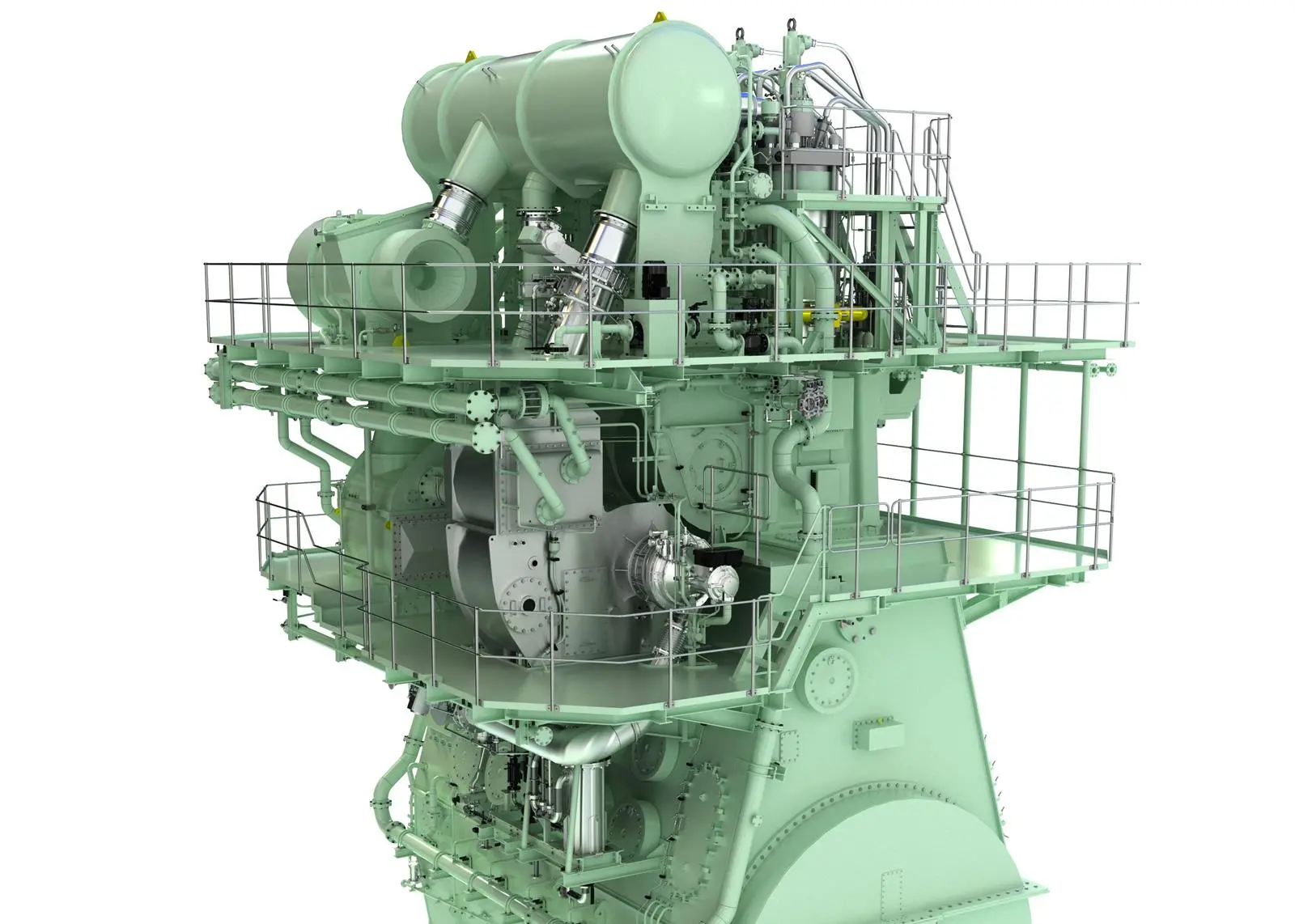
While the final headline methane emissions reduction was yet to be confirmed, it was expected to be “30 to 50 percent”, while EGR version would lower specific gas consumption by around 3 percent and lowering the specific fuel oil consumption in diesel mode by 5 percent. Importantly, the EGR version would allow the ME-GA to meet Tier III requirements in both fuel oil and gas modes without additional aftertreatment.
MAN ES plans to make the EGR option available from late 2021, to the same schedule as the basic and SCR versions of the ME-GA. The technical details of the new version will be available on MAN ES’s CEAS Data platform in October, Hansen said.
The ability to bring the new solution to market in such a compressed timescale partly reflected the fact that MAN ES has extensive experience with designing and delivering low-pressure and high-pressure EGR versions.
“We have 33 EGR engines in operation and 211 engines on order. Our licensees are familiar with our solutions.”
EGR design
Unlike other two-stroke manufacturers’ Otto cycle low-speed engine aftertreatment options, MAN has opted for a high-pressure EGR system. While the HP EGR system introduced requirements for a blower and a small associated parasitic load increase, it meant that the system could be integrated into existing engine room designs.
“We can place the EGR on the engine – with the exception of the water treatment system – and the limited volumes of the solution, compared with LP EGR solutions, means it does not require any modification to existing engine room designs.”
The HP EGR to be used with the ME-GA was very similar to the design of EGR systems used with ME-C engines although the material specifications would be adjusted to reflect the properties of VLSFO and LNG, rather than HSFO. This was likely to lower the price point of the ME-GA EGR version, Hansen noted.
Around 30 to 50 percent of the exhaust gas from the engine is drawn into the EGR receiver, where it passes through a pre spray to lower its temperature, before passing through a cooler spray step.
After passing through the EGR cooler stage, and a subsequent water mist catcher, the gas is passed through a blower to increase pressure back up to scavenging air pressure, before being fed back into the compressor and the engine.
The advantages of employing an HP EGR solution also extended to the volume requirements of the system. The solution required less pipework than LP EGR solutions and had a smaller footprint, while a number of design features minimised space requirements.
One such example was the application of an innovative purging concept from the ME-GI Mark II design. Rather than purging the engine by injecting nitrogen from the GVU, returning the gas via the return pipe to the GVU, we simply apply nitrogen at the engine end.
By reversing the flow, the existing piping can carry the purged volume. This lowers the cost of piping, reduces the required components on the engine, and “ultimately we expect it to lead to higher reliability”, Hansen added.
Combustion
While MAN ES’ engineers were initially conducting research into Otto cycle engines, they focused on maximising the fuel efficiency of the process.
“We knew that the engine would require Tier III abatement systems for fuel oil mode, and our abatement experts told us that this technology held out the potential for improvements while they were looking into different solutions.”
However, we found that introducing an EGR solution improved the stability of the combustion process, Hansen added.
A second phase of research into the potential of the technology was underway, examining how the circulation of larger percentages of scavenged air than typically used in EGR versions for diesel engines affected engine operations. “We are currently exploring how far can we lower methane slip while maintaining a good equilibrium with recirculation,” Hansen said.
What was clear was that introducing “a few percent” of the fuel-air mixture in the combustion chamber with recycled inert gases lowered slowed the rate of combustion, and also slowed the rate of pressure rise.
“Adding the inert gases to the fuel-air mixture, lowers the pressure rise rate (dP/dT) of the combustion process,” Hansen noted. “Lowering the maximum pressure, while maintaining the same mean efficient pressure, allows us to ignite the fuel-air mixture a little sooner after Top Dead Centre (TDC) with a pilot flame,” Hansen said, “without exceeding the maximum permissible pressure within the cylinder”.
The earlier ignition leads to the significant improvement in fuel economy, as the efficiency of the combustion process is improved.
Hansen noted that the injection also led to more uniform combustion within the combustion chamber. It also reduced mechanical stresses on components within the combustion chamber, as combustion temperatures were lowered and the combustion process became more homogenous.
Operating window
The solution also offers additional benefits for ship owners and operators, Hansen noted. In common with other Otto cycle engines, the ME-GA needs to maintain a lean air-fuel mix to ensure it remains within an ‘operational window’, as too rich a mix can cause it to self-ignite before pilot fuel injection, (‘knocking’) while too lean a mix can cause combustion instability (‘misfiring’).
“We are looking for the sweet spot between knocking and misfiring,” Hansen explained.
The ability to adjust the gas pressure at the engine inlet offered another means of controlling the combustion process in addition to injection timing. In practical terms, this means that the operating window for ME-GA engines will be widened.
This offered significant advantages in terms of managing engines with SMCR above 15 bar mean effective pressure, particularly when the engines are running at high engine load.
The solution will also increase the engines’ tolerance for nitrogen content in LNG, as well as improving their ability to operate in hot ambient conditions without additional equipment, Hansen noted.
Methane slip
In common with other Otto cycle engines, the new ME-GA engine releases a limited amount of unburnt fuel. While MAN ES’s engineers originally focused on maximising the fuel efficiency of the engine, the engineers are currently focused on a second round of tests to reduce methane slip.
The proportion of scavenged air being recirculated via the EGR system was currently being finalised. “We are looking at circulating higher percentages than our current HP EGR systems for two-stroke engines,” Hansen added. The question was discovering how far methane slip can be lowered while maintaining a good equilibrium with fuel efficiency.
Although the exact methane slip reduction has not been published, Hansen noted that it would be “extremely substantial”, and MAN ES engineers were looking at achieving savings of 30 to 50 percent.
The EGR solution would help to lower methane slip via improvements in combustion efficiency. The earlier ignition is also likely to lead to a reduction in unburnt gas within crevices and other volumes within the combustion chamber, The Motorship notes.
The recirculation of unburnt methane back through the combustion process would also lead to a reduction of methane emissions, Hansen noted.
ME-GA components
Apart from the EGR, the ME-GA also employed a number of solutions. The ME-GA design features a location of the gas regulating unit on the engine. This offers the use of gas pressure to improve the engine’s dynamic response, in addition to admittance timing.
By designing the gas regulating unit for installation on the engine from the outset, it allows the GVU to be located outside the gas safe area, eliminating the need to install a cofferdam box in the engine room.
Meanwhile, the engine also employed a safe gas admission valve, placed on the manifold and exhaust side of the cylinder. By being located close to the cylinder, it minimises the potential volume that could enter under the piston case in case of a release. “As each valve has a window valve function, you have double safety,” Hansen noted, “all but eliminating the risk of burst discs in the scavenging air receiver.”
Adaptive cylinder control and Triton
The ME-GA engine platform is also being launched with MAN ES’s new Triton engine management system. This system is being integrated with all new ME-GA engines, along with ME-GI engines. “Triton is being integrated with all new engine types being developed from now on,” Hansen said.
The solution includes an Adaptive Cylinder control function, which is an integral part of the Triton system. The adaptive cylinder control function allows the system to automatically manage the combustion process on each individual cylinder, without any user interaction at all times.
The system constantly monitors the maximum pressure, the compression pressure and the mean efficient pressure on each cylinder, and automatically adjusts them if they deviate from shop test results.