



MAN READY TO SERIALISE ADDITIVE MANUFACTURED TURBOCHARGER PARTS
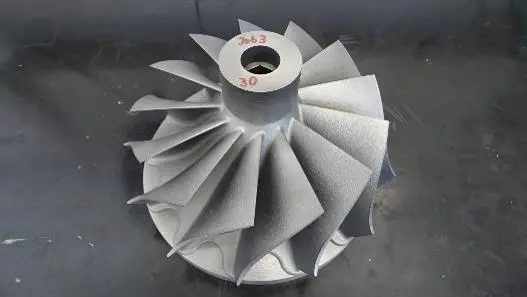
Additive manufacturing has become a natural part of prototype building and is an integral part in product development for innovative designs, says Claudius Wurm, Turbocharger Engineering Validation at MAN. Development periods as well as production times have been reduced with the support of 3D print. “We benefit from this especially in the production of precision castings like the turbine.”
The use of 3D print technology enables the production of more sophisticated structures. “This breaks completely new ground in product design, especially with regards to lightweight design, integral components, functional integration and bionics. In the best case scenario, we don’t need to store spare parts which involves high capital lock-up. Thus, you may speak of ‘manufacturing on demand’.”
He attributes MAN’s current success in 3D printing to a strong network involving teams working across multiple locations which have accelerated the use of metallic 3D print heavily. the MAN ES 3D manufacturing centre in Oberhausen, Germany, has also contributed.
ELECTRIC TURBOCHARGERS WILL BE INCREASINGLY IMPORTANT FOR FUEL CELLS
Turbocharger manufacturers will play a key role in the de-carbonisation of shipping and power plant industries, as turbocharging can increase the power density of fuel cells, like it does for combustion engines.
Lutz Aurahs, Head of Calculation & R&D at MAN Energy Solutions sees potential for electric driven compressors to gain importance in the future. “The missing gas enthalpy of fuel cells in the entire charging process can be compensated with electric engines,” he says.
MAN’s portfolio already features a compressor directly coupled to a high speed electric motor – the Electrical Turbo Blower (ETB) was released to market in 2015. It was originally designed to raise the exhaust-gas pressure in order to overcome the pressure difference between exhaust gas and scavenging receiver. The ETB can be used in all applications which feature similar volumetric flows and need a similar pressure ratio. Potential applications for this include two-stage or sequential turbocharging.
“Yet an electric driven charging is only meaningful to a limited extent due to response behaviour (as we know from turbocharging in the automotive area), which leads to high systems costs in order to provide the required high electrical power of large engines,” says Aurahs. “From our perspective, however, alternative systems, like Jet-Assist or an optimized polar moment of inertia of the turbocharger, are preferred options.”
In 2018, MAN launched an ETB for exhaust gas recirculation (EGR). The blower raises the exhaust-gas pressure in order to overcome the pressure difference exhaust gas and scavenging air receiver. The blower actively controls the recirculated exhaust gas flow during the EGR flow by varying the blower speed. The desired EGR operating conditions are achieved using a high-speed electric motor directly coupled to the compressor wheel and speed controlled by a frequency converter.
Related Articles
 2-STROKE & 4-STROKE
 TURBOCHARGER
 TURBOCHARGER