MAN REVEALS TIMELINE FOR FOUR-STROKE METHANE SLIP SOLUTIONS
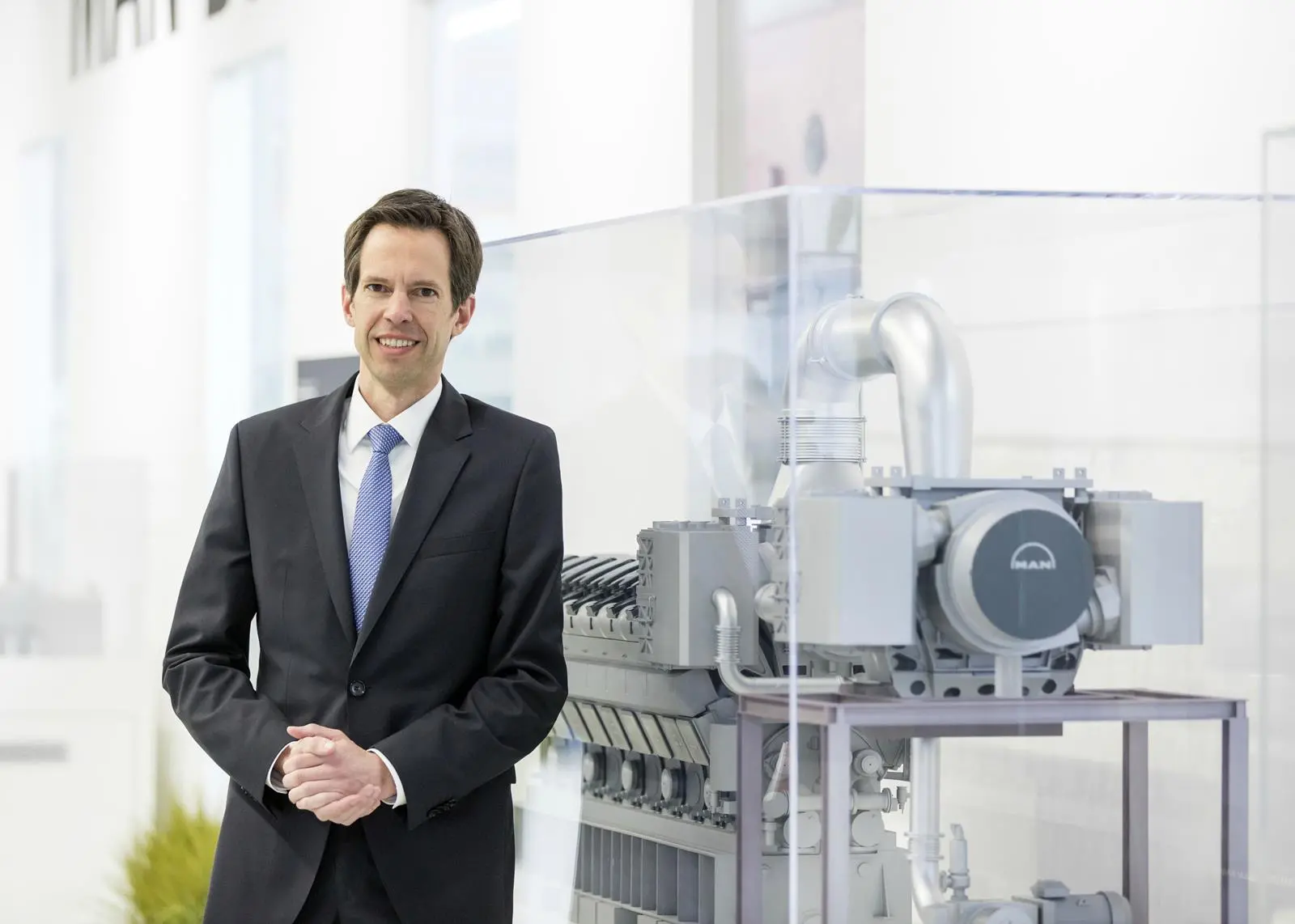
On-going improvements in engine design have enabled MAN to reduce methane slip by around 50% since it first introduced four-stroke dual-fuel engines to market in the mid-2000s. The development of new methane oxidation catalysts (oxicats) is anticipated to reduce this even further, to 70%. A first, fundamental research project on possible catalyst technologies finished in September 2020, says Dr. Gunnar Stiesch, Senior Vice President, Head of Engineering Engines at MAN, speaking exclusively to The Motorship. This fundamental research included development of sulphur-resistant oxicats which he says hold great promise for dual-fuel operations.
The research has been undertaken as part of the “IMOKAT” project which received financial support from the German Federal Ministry for Economic Affairs and Energy. The project has already achieved a methane slip reduction of 70% on both spark-ignited (SI) and dual-fuel engines using synthetic exhaust gas under laboratory conditions.
Oxicats are not an option for two-stroke engines due to the lower exhaust gas temperatures associated with these engines. All oxicats today need high temperatures of more than 500°C to promote methane reduction, says Stiesch. Therefore, the oxicat delivery system must be positioned before the turbocharger on four-stroke engines. “Temperature control is critical to ensure performance,” he says. “Methane-reduction performance will decrease rapidly once the desired temperatures can no longer be met. Therefore, engine controls need to be thoroughly adapted to ensure the necessary boundary conditions for the oxicat.”
Stiesch revealed the future project timeline where this will be addressed: “We will investigate catalyst-engine interaction between 2021 and 2023. This also includes the installation of a field test system on board a vessel. We think that the technology could be ready for market launch by 2025.”
Concurrently with this research, MAN is working to reduce methane slip by over 90% with the introduction of the direct gas injection technology already used on ME-GI two-stroke engines to its four-stroke dual-fuel engine range. This change from Otto to Diesel combustion will be tested and validated in conjunction with future fuels such as methanol and ammonia. MAN’s engineers are already assessing the feasibility of direct gas injection on four-stroke gas engines and will be able to apply the technology when the market demands it.
In the Otto combustion process, gaseous fuel is pre-mixed with air before ignition. The mixture is compressed and ignited by a spark plug or liquid pilot fuel and is thus in the cylinder for all of the induction and compression strokes and for part of the power stroke. Four strokes rely heavily on gas exchange at the inlet and exhaust valves in the Otto process, so there is increased opportunity for the gaseous fuel to evade combustion, leading to methane slip.
Converting to the Diesel combustion principle means that, as with ME-GI two-stroke dual-fuel engines, the gaseous fuel will be injected with the diesel pilot into the compressed charge-air at around top dead centre. This will prevent methane from escaping during the four-stroke cylinder scavenging process.
Smaller fuel injectors need to be developed to suit four-stroke engine sizes, and because of size restrictions and higher rpm, a four-stroke application will in general need a somewhat higher injection pressure than a two-stroke application, says Stiesch. This necessitates the installation of compressors that allow for acceptable injection duration at rated power. The additional cost of this equipment is offset by the lower fuel consumption achieved and hence lower CO2 emissions attainable with Diesel dual-fuel combustion.
Currently, MAN’s four-stroke 48/60 and 51/60 engines can be retrofitted to run on LNG. MAN’s on-going research goals anticipate that synthetic, carbon-neutral fuels will pave the way for a future of climate-neutral shipping. Meeting the 2050 goals set by the IMO will mean large parts of the existing global fleet will need to be retrofitted from liquid fuel to dual-fuel liquid/gas operation.
MAN sees LNG as the first step in preparing engines for the broader use of a range of synthetic fuels, and a dual-fuel engine brings the option of using synthetic natural gas either as a drop-in fuel or a total fuel solution as it becomes available. An addition to the business case for retrofitting engines to be dual-fuel is the potential for significant performance upgrades as a result of more modern engine technology and the addition of the latest electronic controls. This, says Stiesch, makes dual-fuel operation a future-proof investment.