More compact than a Swiss Army knife
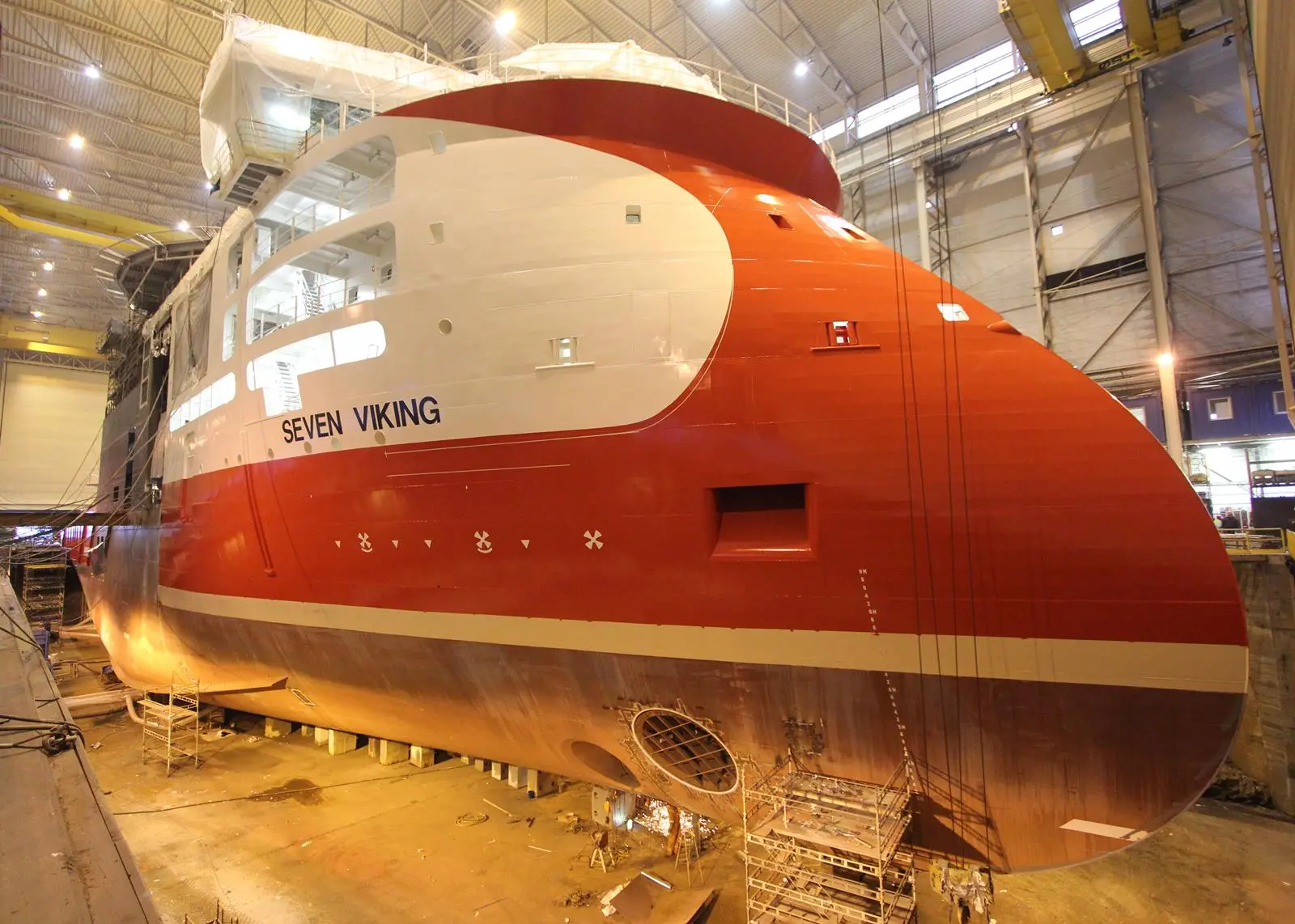
This prototype Inspection, Maintenance and Repair (IMR) vessel is an ICE-C class vessel co-owned by Eidesvik Offshore and Subsea7 under orders from Statoil. To help with stability in the North Sea’s potential five metre swells it also incorporates Ulstein’s X-Bow hull. However, Seven Viking won’t be limited to IMR duties as one requirement was that it could also handle scale treatment and well stimulation operations.
The interesting point is that Ulstein’s SX148 design is both nimble, with a top speed of 16 knots, and compact – measuring ‘just’ 106.5 metres long and 24.5 metres wide. This allows Seven Viking to manoeuvre in confined spaces such as between platform structures, accessing difficult to reach areas.
The whole project is a very careful response to very specific Statoil requirements which, Mr Stave adds, have “been evolving over the last decade”.
This ‘evolution’, he says means it carries a litany of essential subsea tools and personnel. “We knew we had to shoe-horn a lot of different functions into a very small space,” says Mr Stave, “But we also knew we would be onto a winner if we managed it.”
This wasn’t always straightforward: The biggest functional challenge was that it had to be compact, while still able to stand a variety of different duties. “To be honest, fitting in the descaling plant was one of the more challenging aspects,” he says. The mixing system has no less than four, big high pressure pumps pushing through very aggressive acids, carefully preheated to 90°C at a rate of 2,800 litres per minute at 345 bar.
Part of the challenge was that this section wasn’t entirely pinned down when Ulstein signed the contract as the vessel is a prototype. “So, as we had a fixed and agreed budget we knew we were taking a risk,” says Mr Stave. “Although we had created a scale treatment plant area for the initial stages, the final design saw it moved around several times.”
“All I can say is that it has been really tough, but our design engineers, customer and our co-vendors have shown immense creativity about the available space, and been willing to adapt their applications to fit,” he says. “Between them they have done a tremendous job.”
Of course the ship had to be safe for deckhands while operating 24/7 in really harsh weather conditions as far north as the Barents Sea while other issues push the envelope in different directions, for example, the average module’s weight has increased from between 20 to 30 tonnes to the 70 tonne mark.
The solution was a hangar on the aft deck. This is arranged so that the module handling takes place inside: a customised module handling and skidding system, “actually something like a miniature railway station” moves pallets going in and out of the aft cargo deck. The tools for the particular job in hand may be refurbished inside, in a relatively dry, weatherproof environment before they are moved out for deployment by the ship’s 130 tonne crane.
The moonpool too is arranged inside the hangar which gives it 10 metres of free height overhead. This moonpool has a module handling system designed to deploy 70 tonnes at 2,000 metres depth and, like the other systems onboard, both it and the ROV can cope with 5 metres of significant wave height.
“It’s the safest kind of working area, there is a controlled atmosphere and lighting and workers are shielded from severe weather conditions, there’s no sea spray either,” says Mr Stave. There’s also minimal noise levels in the hangar because the builders have opted for electric winches for the ROVs, the MHS and other utility equipment. Furthermore, to minimise risk when working at heights and manual handling, man-riding baskets and utility cranes have been installed in the hangar haven. The vessel also has a higher freeboard than usual, which provides additional safety for the deck crew during operations.
It also helps that the offshore project management and operations room have panoramic windows overlooking the working areas so any issues get a fast response time.
Another characteristic is that the design tries to maximise the craft’s working days by potentially carrying out more personnel transfers via helicopter. “We found that the needed extra stability was gained through changing the relative positions of the helideck and the bridge, moving the helideck further back and the bridge forward,” says Mr Stave. “After all, you don’t need the bridge very far aft, the captain and navigators really need to look out the front when in transit, and then while holding position they can take care of safety and the DP systems and maintain the vessel as a carrier.”
He points out that the bridge area is actually costly per square metre to construct as it has a number of sensitive systems and has to have, for example, a degree more fire insulation. “Therefore it was worth treating it as more simply as a navigators area, not public space,” says Mr Stave, and being a little smaller in footprint meant it gave a saving that was passed onto other areas.
The ship has been developed to exceed DNV’s comfort class COMF-V(3) by quite some way. Statoil wanted the noise and vibrations levels kept down to that of the class requirement while running the thrusters at 80% power with the main equipment operating as well, instead of the simple 40% thrusters power required to pass muster.
However, there are other ‘operational’ pointers that came from Eidesvik and Subsea7. It was clear that they wanted a break from the traditional segregation approach to the crew with the officers separated from the technicians and other workers in mess and canteens.
Mr Stave explains: “They wanted ‘one team’ so the public areas are common areas. After all, it’s delicate work, so you want one ship, one mission, one tool.” Although he admits some people will love football and some won’t, and this might occasionally divide the crew…
The propulsion and power plant solution involves three parallel sections each feeding an azimuthing 3MW thruster in the stern, together giving a total of 9MW of propulsion. This systems architecture means reduced risk to put back to shore if one section fails. “The boat could carry out most relevant offshore operations quite happily with one third of the 12,5MW power plant out of duty, but this has helped increase the safety and operational envelope, says Mr Stave.
Further, in the bow there’s one resiliently mounted 1,700kW super-silent thruster plus a Brunvoll combination drop-down and azimuthing unit with a power of 1,400kW. The reason for this is actually that although the ship is fine mid ocean, it presents quite a large wind area. It was possible to feel a bit uncomfortable in a tight harbour and fairway especially in shallow water, where the forward azimthing combi unit comes into its own to keep the ship well away from the sides and other craft if the tunnel thruster is out of action.
Several notable environmental initiatives have been taken when designing the vessel, which also carries the Clean Design notation. These include the diesel electric propulsion, NOx reducing catalyst for exhaust gases, while the ship’s electrical winches mean there will be absolutely zero emissions of hydraulic oil from these systems.
Long-term charterer Subsea 7, working under contract with Statoil, is now looking forward to the delivery of Seven Viking this December.
By Stevie Knight