New developments promise easier corrosion protection
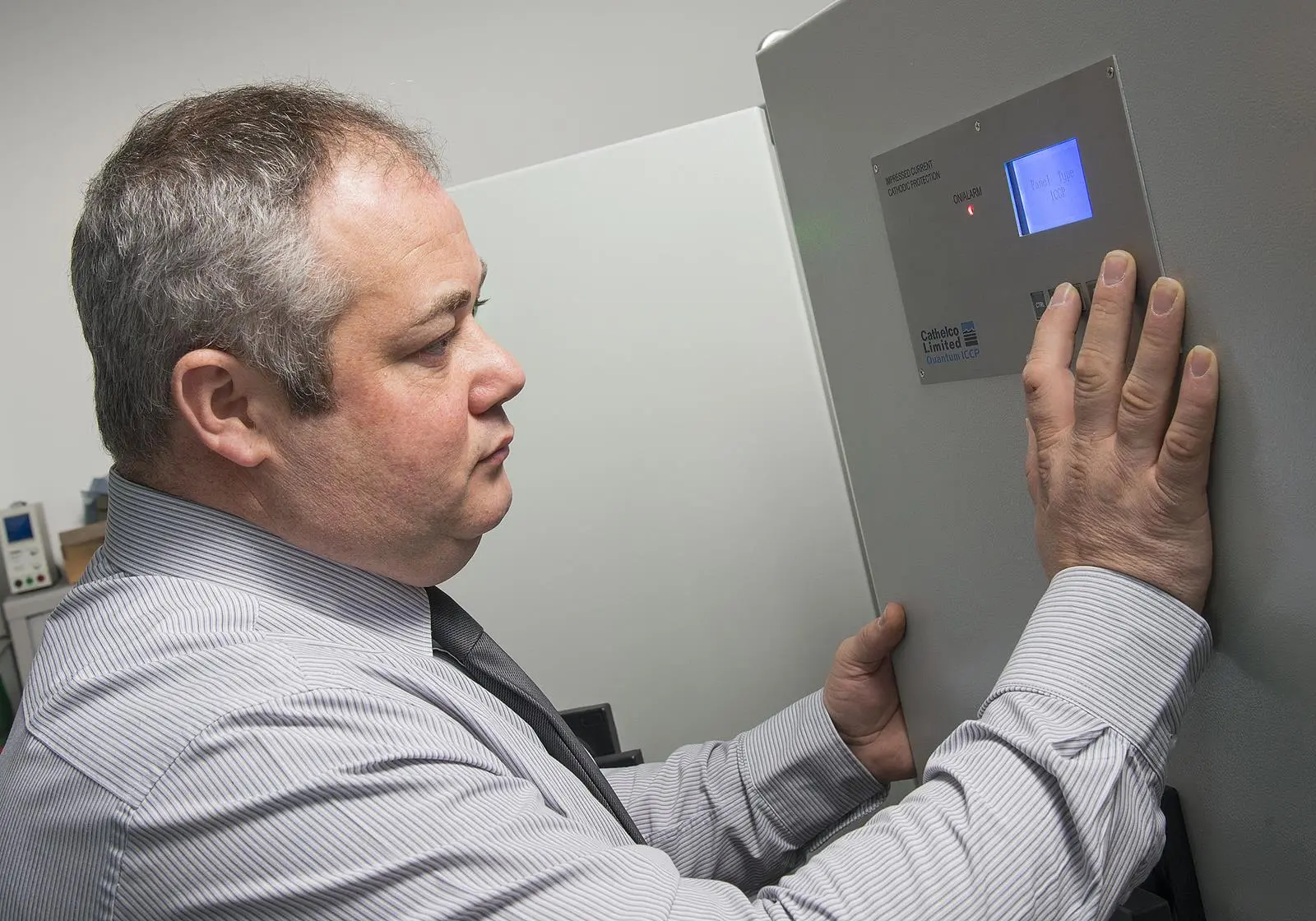
Cathelco has introduced a new series of Quantum control panels for the company’s impressed current cathodic protection (ICCP) systems. The new thyristor panels provide a number of benefits, but the most significant breakthrough is claimed to be the ease with which the systems can be controlled and monitored, combined with much more comprehensive information about system performance.
The main principle behind the design of the new control panels is greater connectivity. They produce an RS485 signal which enables the systems to be governed from a more convenient location such as a control room or the ship’s bridge computers. “The Quantum project has been driven by the fact that manning levels on ships have decreased in recent years which means that there is less time for crew members to check individual items of equipment on a daily basis. We have responded with control panels which record more data and make it instantly available”, said Peter Lindley, who has headed the project at Cathelco.
The majority of larger vessels have forward and aft ICCP systems with separate control panels which are often a considerable distance apart on the ship. However, with the new Quantum ICCP control panel, the two systems can be operated in a master and slave relationship. “It means that the forward ICCP system can be controlled from the aft panel and that information about the whole system can be viewed in one location. This is much more convenient for the engineer who does not have to walk from one end of the ship to the other,” Mr Lindley commented. If the ship has been equipped with a Cathelco sea water pipework anti-fouling system, this can also be monitored and controlled from the aft ICCP control panel.
The Quantum ICCP master panel stores comprehensive data about the configuration of the system which can be monitored through a series of displays. It logs data covering output voltage, output current, potential readings, percentage output and the alarms. All of the configuration and performance data can be uploaded to a USB memory stick and viewed on a standard PC. The information can then be e-mailed to Cathelco, replacing the task of filling out ICCP log sheets.
“The Quantum control panels provide customers with a number of useful features at no extra cost. It also means that commissioning is greatly simplified and if issues arise at any time in the future, the ability to access data from a USB sticks means there is a much stronger likelihood of resolving problems without the customer incurring the cost of sending a Cathelco engineer,” concluded Peter Smith, Cathelco’s sales director.
Cathelco is supplying ICCP systems for two cruise ships for Carnival and Holland America Line which are being constructed by the Italian shipbuilder Fincanteri. The Holland America ship is scheduled for delivery in late 2015, whilst the new Carnival cruise ship will enter service in the winter of 2016. Both ships will have 200A forward ICCP systems and 400A aft systems using arrangements of C-Max diver changeable disc anodes and reference electrodes. It is likely that these vessels will be the first cruise ships to be installed with the latest Cathelco Quantum ICCP control panels.
When Royal Caribbean’s new generation of Quantum class cruise ships is launched this year, Cathelco equipment will be protecting the hull and seawater pipework systems. Quantum of the Seas and Anthem of the Seas, being built by Meyer Werft, have 20 sea chests each, serving equipment such as freshwater evaporators, reverse osmosis systems, air conditioning chillers and sea water cooling pumps. The Cathelco system will also protect a number of fire fighting pumps and their associated pipework.
In another technology development, a natural electro-chemical coating has been proposed for shipboard applications. It is expensive and difficult to apply conventional coatings to existing corroded structures, says Barry Lamb, manager of engineering at BAC Corrosion Control, and in some cases, a calcareous film, a deposit of calcium carbonate (CaCO3) and magnesium hydroxide (Mg(OH)2) produced on steel structures has been proven to be an effective and an inexpensive substitute for a conventional corrosion control coating. When deposition conditions are appropriately controlled, such a deposit provides corrosion protection for steel in seawater, he says.
BAC, Mott MacDonald and the University of Manchester have developed a patented treatment LATreat to generate a coating in these situations. Although it has so far only been used on jetties, it is just as applicable to ships, says Mr Lamb. LATreat is an electro-chemical process which works in a similar way to cathodic protection and using the seawater and electricity to generate all the necessary active agents. The treatment comprises three optimised stages: cleaning, sterilisation and coating using a pulsed current technique.
Following lengthy studies, the endurance of the calcareous film has been evaluated the treatment is now commercially available. Mr Lamb claims it is cheaper than alternative solutions as there is no permanent equipment or associated cost. It requires a short time to implement – around 100 hours for treatment per unit area. The treatment is also environmentally friendly, as the chlorine generation is short term and controlled.