



New-Generation Dredger For The Tees
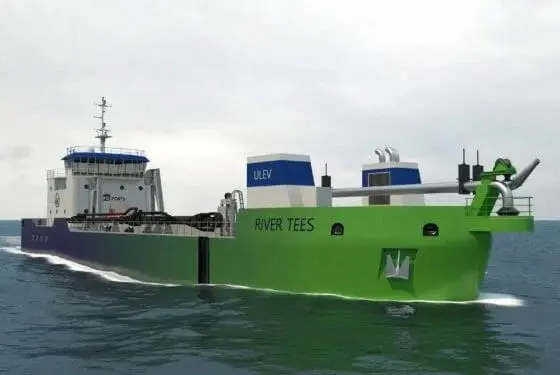
Scheduled to be ready for service with PD Ports on the River Tees in mid 2024, the 71m newbuild will feature a battery pack, machinery capable of running on non-carbon fuels, and adaptability for future power technology upgrades.
Neptune has subcontracted hull construction to a yard in Poland. Completion and commissioning will take place in the Netherlands, from where the £23m ($28m) vessel, as the Emerald Duchess, will be handed over for duty throughout the Port of Tees and Hartlepool, known collectively as Teesport.
Designed with a load capacity of 2,000m3 or 2,500t, the new trailing suction hopper dredger will be the replacement for the 70.5m, 1,458m3 Cleveland County, which has worked the river since delivery from IHC Verschure in the Netherlands 50 years ago. PD Ports’ other dredger used to maintain a safe and consistent passage for shipping on the Tees, the UK’s fifth largest port, is the 1979-built, 1,500m3 Heortnesse.
PD Ports owns and operates multiple ports and terminals, predominantly along the UK’s east coast. Its activities on the Tees include the company’s role as statutory harbour authority, overseeing traffic management and conservancy, maintaining channel depths up to 17m for ships conveying the port’s diversified, industrially-orientated trade.
The company has a commitment to achieving carbon-neutrality at its Tees-based landside operations by 2027, and this has led to a drive to examine investments across-the-board from the standpoint of sustainability and ultimate carbon neutrality. In the latter context, the specification for Emerald Duchess is characterised by a number of bespoke design features.
Fitted with an innovative, intelligent power management system, the Emerald Duchess will be able to swap between power from a battery pack (“equivalent to 10 Tesla cars”) and fuel made from hydrotreated vegetable oil (HVO), also known as renewable diesel. The vessel will also be prepared for future innovation whereby the power units can be adapted to use ‘green’ methanol or ethanol, or swapped out for modern fuel cells as the technology matures, using ‘green’ hydrogen fuel. Hatches above the engine room will facilitate such conversions.
Power management to run stop-start for the ship’s three main generator sets will be integrated with the battery hybrid system, and battery charging will be effected from the main machinery while under way or potentially directly from ashore when alongside.
Recourse to computational fluid dynamics (CFD) techniques has been made in arriving at hull lines optimised for the service profile on the 12-mile river channel, seaward fairway and coastal waters, while minimising power requirements in all load conditions.
The engine room in the new dredger will be arranged forward, resulting in a design that obviates the need for water ballast. Operational flexibility will be conferred by three modes of discharge, be it via bottom doors, or over-the-bow ‘rainbowing’, or by low-volume discharge through a connection to the shore.
The method of removing sediment brought into the river by the tides and undertaking discharge into designated areas off the coast is closely monitored by the Marine Management Organisation using a process that has been in place for more than 50 years.
Related Articles
 ELECTRIFICATION AND BATTERY HYBRIDS
 ELECTRIFICATION AND BATTERY HYBRIDS
 ELECTRIFICATION AND BATTERY HYBRIDS