NEW MULTI-FUEL INJECTORS READY FOR FUTURE FUEL FLEXIBILITY
Originally designed for high-speed engines, the new injectors can easily be adapted to medium-speed engines, says Woodward L’Orange, enabling them to run in diesel only or dual-fuel mode with a range of gas or liquid fuels including LNG, LPG, methanol and ammonia. These fuels, when produced from regenerative electrical energy (power-to-X), are expected to help meet IMO’s 2050 greenhouse gas ambitions, but with uncertainty around cost and supply, the new injectors offer the flexibility to switch fuels during an engine’s lifetime whilst still providing diesel-like power densities and dynamic performance.
Where Woodward L’Orange’s existing GD-series injectors are designed for engine bores of over 320mm, the new injectors are targeted at bores of 170mm. The new injectors have a nozzle tip diameter of 25mm and use diesel as a sealing oil rather than engine oil. They are compact and can be fitted to most engine configurations.
High Pressure Injection
Today’s emissions limits can be readily achieved by learn-burn gas engines with spark ignition or diesel pilot ignition, says Hartmut Schneider, Senior Manager Advanced Development at Woodward L’Orange. However, Woodward L’Orange chose diesel pilot ignition because lean burn engines cannot use three-way catalysts and therefore produce significant volumes of unburnt methane.
He says the new high pressure gas direct injection and diesel pilot injection technology ensures low methane slip and eliminates knocking. Cylinder outputs typical of diesel engines can be attained without throttling, and diesel-like efficiencies and transient responses are also achievable.
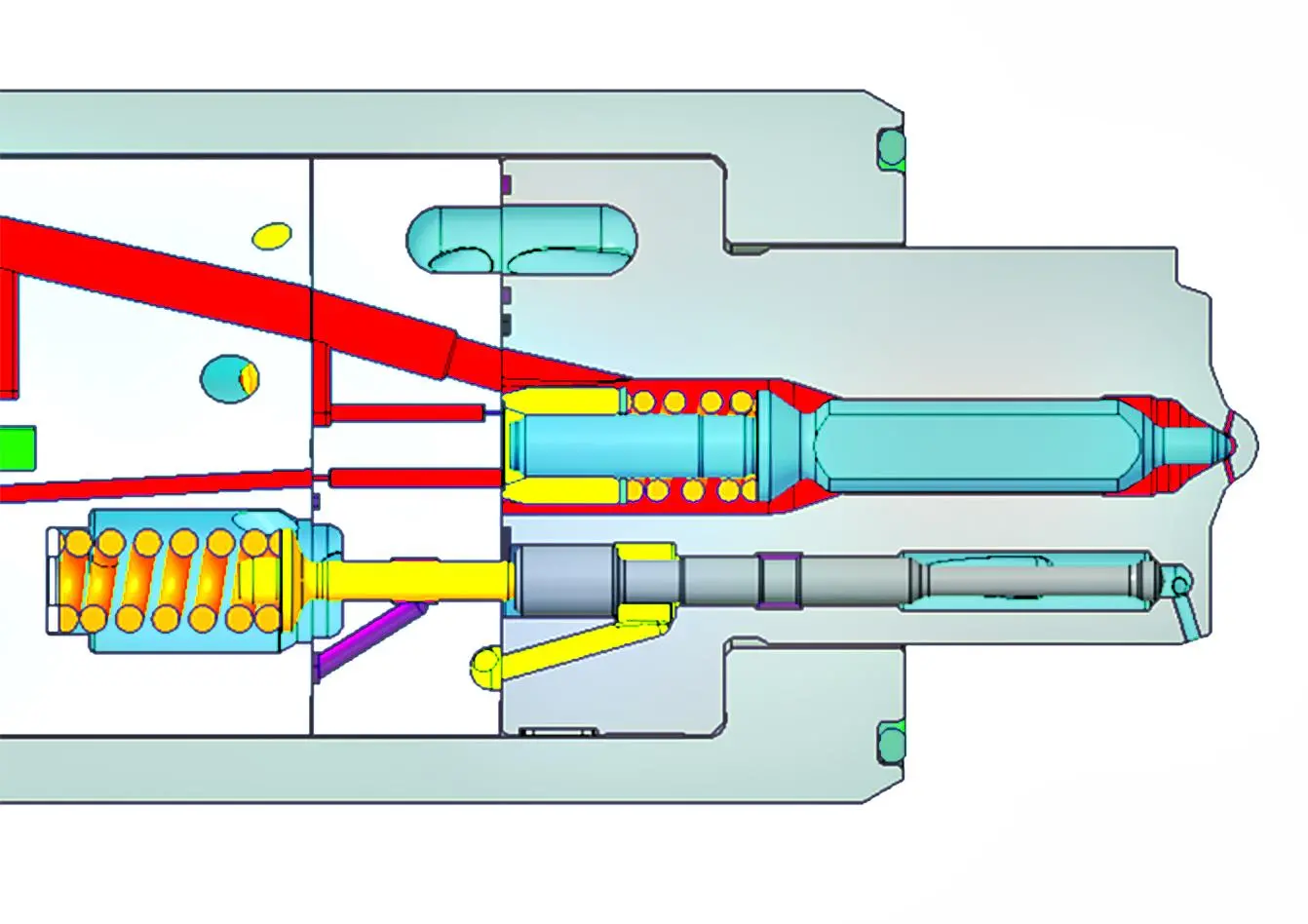
The diesel side of the new injectors is almost the same as a common rail injector and capable of supplying an injection pressure of 2,200 bar to ensure fully optimised combustion. However, the accumulator volume has been reduced to make room for the gas side components.
Low Caloric Value Fuels
Pilot-ignited, high pressure direct injection also suits combustion of low caloric value fuels even though they require greater injection quantities, and because those quantities are fairly similar, even external components, such as the fuel tank or high pressure pump are similar for some of the fuels.
The standard configuration has three gas needles around one single diesel nozzle – a configuration with one diesel and only one gas needle is also possible. For liquid fuels such as methanol, a separate accumulator is integrated into the design.
The gas injection jets are positioned concentrically around the diesel pilot and provide gas at injection pressure of 500 bar, up from 350 bar in the GD series. This allows super-critical gas flow with pressure ratios greater than two even at peak cylinder pressures of around 250 bar and ensures mass flow is not sensitive to engine back pressure.
Accumulation volumes in the injector are optimised to provide as much gas as possible close to the needle seats. Pressure losses inside the injector were analysed using CFD simulation and reduced to a minimum. Less than 10 percent of the rail pressure is lost from the injector inlet down to the sac-hole as a result of large flow cross sections inside the injector.
Diesel-Only Mode Performance
For diesel-only mode, the springs connected to the gas needles are forced to seal by tightly guided spring spindles. This ensures the needles seal reliably during peak cylinder pressures in the absence of pressurised gas. The main fuel needles are actuated by an independent hydraulic valve which is placed on top of the injector to save space.
A key feature of the injectors is their installation flexibility, and Woodward L’Orange has already, for example, provided a side-feed and a top-feed version of the injector. “As every cylinder head and air inlet/outlet valve actuation is different on every engine, a different solution is needed for every engine,” says Schneider. “One solution is to use the existing diesel connection of today’s injection valve and either press or screw the quill pipe into the injector housing, but it is still necessary to connect the power-to-X fuel and the sealing oil. This requires additional quill pipes going through the cylinder head either at the same height and a different angle or at the same angle but different heights. If there is not sufficient access or installation space available in the cylinder head itself, the connections can form a ‘crown’ at the top end of the injector. The fluids enter the injector at the top and are guided in internal bores to the nozzle.
“There might also be a combination of all measures with connections in and above the cylinder head, as typically such a project does not start from scratch on a white sheet of paper, but rather as a retrofit to an existing engine.”
The injectors have undergone high pressure methane tests at several German research facilities. Hundreds of hours of engine running time have confirmed that methane slip occurs at negligibly low levels. Selective catalytic reduction exhaust after-treatment is required to meet IMO Tier III standards.
Future Fuel Choices
“We see fossil methane as a popular fuel for the next years, but only as a ‘bridge fuel’, as it reduces CO2 emissions by approximately 25 percent only,” says Schneider. “If the IMO goal of CO2 emission reductions of 50 percent by 2050 is to be reached, it has to be a zero-CO2 fuel instead. This might be for example green methane, which is expensive, or ammonia as it does not contain any carbon at all. On the other hand, storing of ammonia is not as convenient as for example methanol, which could also be produced green.” Tests with methanol are currently on-going.
Schneider says that although hydrogen seems very popular at the moment, Woodward L’Orange views it as another bridge fuel, as large fuel cells will likely replace hydrogen combustion engines beyond 2030.
“The race is not decided between the different options,” says Schneider. “It is still not clear which fuel and which engine technology offer the most future-proof investment.” He says the new injectors provide a technology that is ready for most power-to-X future fuel options currently under discussion.