New Showcase For Spanish Ocean Research
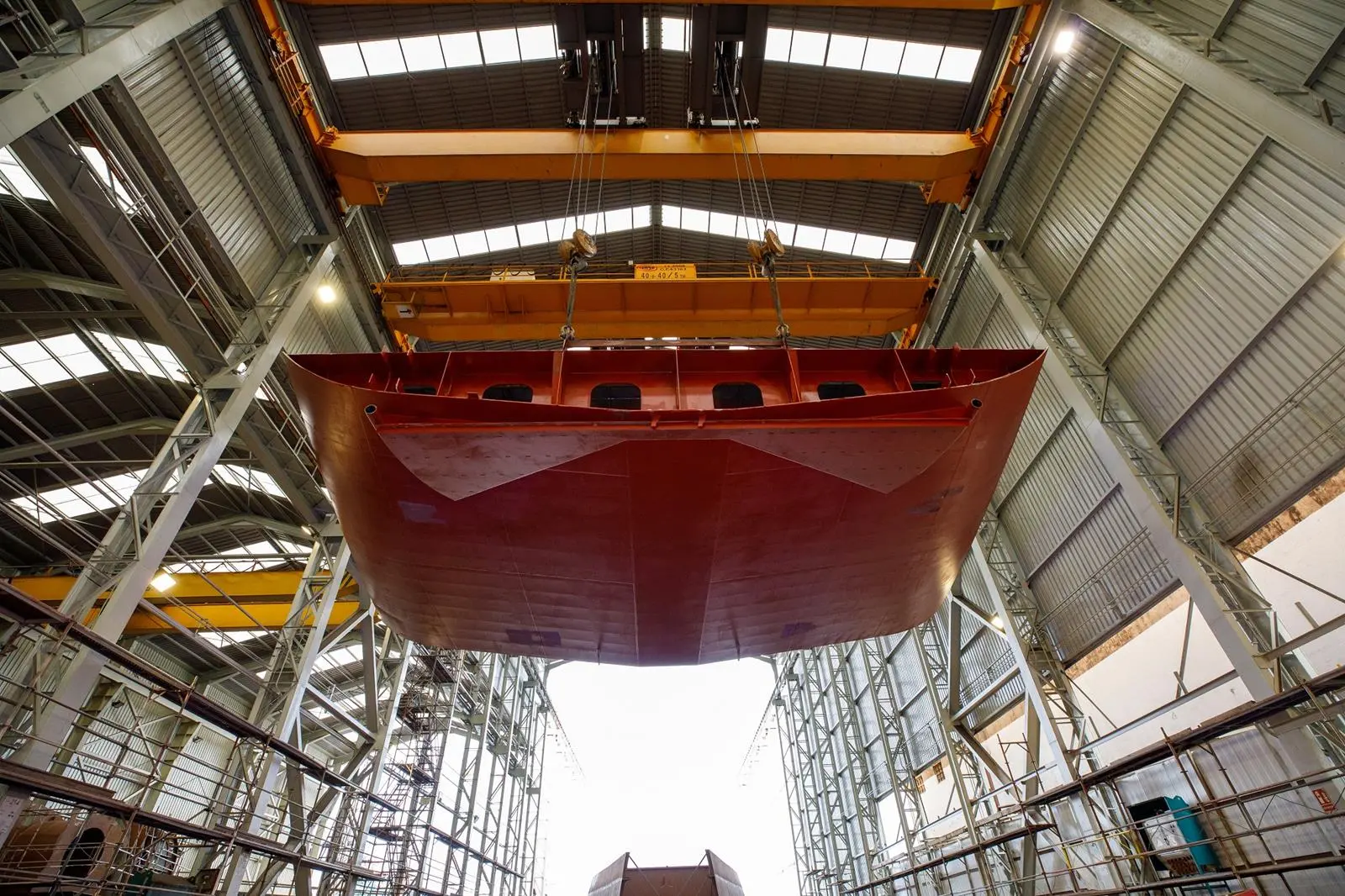
The new, dual-fuel vessel will allow scientists to study ecosystems, habitats and seabeds in all the world’s oceans, including the polar areas, and at depths to around 6,000m. The multidisciplinary role and outfit will also enable assessments of fishery resources. Designed for an endurance of some 50 days, the ship will be equipped with 500m2 of laboratory space and the full array of acoustic detection technology, trawling gear, and underwater vehicles.
Scientific missions in the southern polar region will be accompanied by a logistical function, entailing personnel exchange and replenishment for Antarctic research bases. Together with the requisite ice-going performance, the vessel’s substantial storage capacity and provision for container transport on deck provides the wherewithal for such a support role.
Key facets of the engineering of the ship include arrangements necessary to ensure silence while conducting research investigations, the adoption of an LNG dual-fuel power and propulsion system so as to reduce environmental impact, and DP2 dynamic positioning. In terms of quiet operations, fundamental to the effectiveness of the research instruments and accuracy and tally of work carried out, the standard sought is DNV’s Silent R notation.
IEO put down a requirement for a maximum speed of 14 knots, and an ability to run wholly on LNG for up to eight days at up to nine knots, given a favourable sea state. The flexibility that has to be conferred by the power installation, and which is invariably met by diesel-electric plant in research ships, is such that an anticipated 38% or thereabouts of time on duty will be spent on station or navigating at speeds of no more than two knots.
Odon de Buen will extend Spain’s global reach in terms of marine science, since IEO’s current vessels are deployed on a regional basis. The ship will operate out of Cadiz, facilitating coverage of the South Atlantic and Canary Islands, and access to the Indian Ocean and Pacific Ocean via the Suez Canal.
Productivity is an important factor given the capital intensity and costs of such vessels. She will be able to undertake five to seven research campaigns every year, amounting to 240 days of scientific activity at sea plus the time absorbed in transits to the various locations and regions.
Long in gestation, the project for the newbuild was cleared by the Spanish Government in 2020, leading to invitations to tender, and the eventual contract award during October 2021 to Astilleros Armon Vigo, in final-round competition with Freire Shipyard, also of Vigo. The investment was facilitated by an 80% contribution (EUR68.4m) to the overall EUR85.5m cost of the newbuild from the EU’s European Regional Development Fund.
Construction in Vigo, one of the economic and industrial engines of Galicia and the centre of the maritime cluster in northwest Spain, is further affirmation of the local shipbuilding sector’s European prominence in the research vessel segment.
IEO accounts for six of Spain’s current nine-strong research fleet. Its most recent vessels, the 47m sisters Angeles Alvarino and Ramon Margalef, are also products of the industry in Vigo, having been handed over by Armon in 2011 and 2012, respectively. Each has a fully Spanish-derived diesel-electric plant, using Indar electric propulsion and Guascor diesel-driven generators.