ORC INSTALLATION ECONOMICS DEPEND ON COMPONENT TRADE-OFFS
LNG-fuelled ships offer extra potential for waste heat recovery compared to ships running on heavy fuel oil, as there is a reduced need for fuel pre-heating with LNG and therefore a reduced requirement for waste heat from engine exhaust gases to be used to generate service steam. This extra potential was examined in a study undertaken by DTU Mechanical Engineering, MAN Energy Solutions, Fjord Line, Alfa Laval and Lloyd’s Register Marine. The researchers examined potential heat sources and sinks for a vessel powered by a 7G95ME-C9.5 MAN Energy Solutions dual fuel two-stroke engine with low pressure selective catalytic reduction tuning. Their study considered the economics of four theoretical configurations: main engine exhaust gas and jacket cooling water as heat sources and seawater or LNG pre-heating as the heat sink and jacket cooling water as the only heat source and seawater or LNG Pre-heating as the heat sink.
The combination of exhaust gas and seawater was the optimal configuration, leading to fuel savings of 6.9% if the electricity was used for propulsion and 8.5% if used for auxiliary generators. The use of jacket cooling water provided fuel savings of under 1%. The use of LNG pre-heating as a heat sink resulted in similarly low savings, even when the estimated efficiency of using exhaust gases as a heat source reached 35%. This was attributed to the limited mass flow rate of the LNG that needs to be pre-heated.
The performance of optimised ORC systems was then evaluated against the operating profile of a slow-steaming container ship operating in Tier II areas and a container feeder operating in Tier III areas. The container ship case study evaluated a 23,000kW MAN 6S80ME-C9.5-GI engine operating for 6,500 hours annually. The feeder case study evaluated a 10,500kW MAN 7S60E-C10.5-GI engine with an exhaust gas recirculation unit, operating for 4,380 hours annually. The ORC working fluid considered was cyclopentane.
The study predicts annual main engine fuel savings of 6.5% for the container ship and 8.4% for the feeder if the energy is used to replace that from an auxiliary generator. The payback for the ORC system on the container ship was six years and for the feeder it was nine years: for the feeder, the ORC’s boiler was divided in two so that one of the parts recovered heat from the exhaust gases recirculated in the EGR unit. This added to installation costs which were estimated at $1,784/kW for the container ship and $2,542/kW for the feeder.
The study also considered options for retrofitting. The optimal ORC configuration for the container ship required a volume of 17m3 for the heat exchangers. Reducing this to 10m3 reduced fuel savings by 10%. For the feeder, the optimal ORC configuration required a volume of 13.5m3 for the heat exchangers. Reducing this to 7m3 reduced fuel savings by 13%.
The installation of an ORC unit on the exhaust line of a marine engine imposes an increase in the back pressure on the engine resulting in a decrease in engine performance and variation in the available waste heat. Further work conducted at DTU proposed a method for the optimal design for the systems based on performance maps for the engine and numerical models for the ORC unit and the waste heat recovery boiler.
For a hypothetical LNG-fuelled container ship, overall system fuel consumption can be reduced by 0.52 g/kWh to 1.45 g/kWh by allowing higher back pressure levels on the engine. For a fixed power output of the ORC system, the space requirement for the waste heat recovery boiler can be reduced by up to 35% when increasing the maximum allowed engine back pressure from 3kPa to 6kPa.
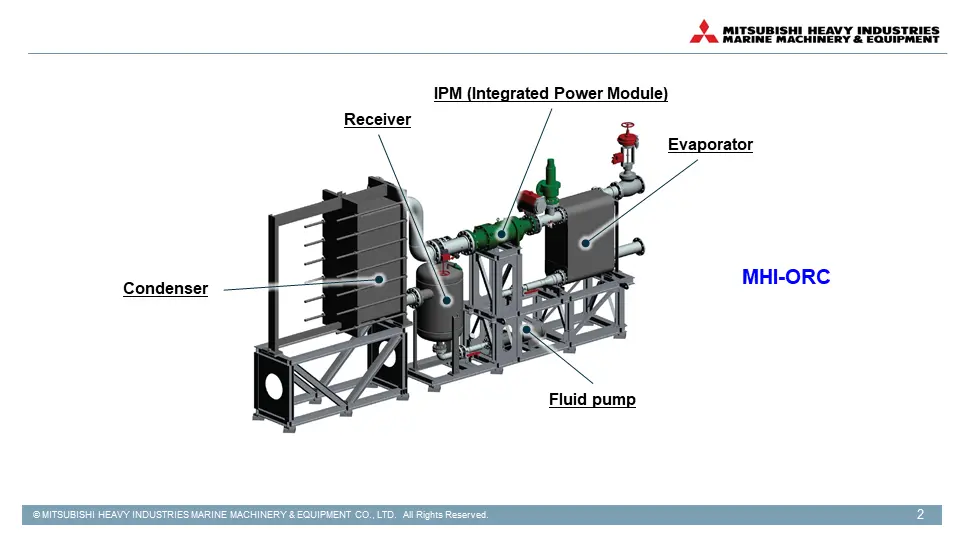
The work follows a number of earlier studies – including an onboard trial on a container ship. The 2016 installation of a 125kW Calnetix/Mitsubishi Heavy Industries Marine Machinery & Equipment (MHI) ORC system on the container ship Arnold Maersk proved the working concept for having an ORC using engine jacket water as a heat source. The system used heat of less than 100oC from the engine jacket water of the vessel’s Wärtsilä 12RTA96C engine.
The ship sailed through northern latitudes and equatorial regions, and the variation in seawater temperature had an impact on the power output of the ORC system, but modelling indicated that integrating ORC units within the service steam circuit could achieve payback periods of five to 10 years assuming 6,500 operating hours per year and that the electricity produced replaced that from an auxiliary generator.
The retrofit took about a month to complete and required cutting the ORC frame into pieces and then reassembling it in a space that had been designed to house an extra diesel generator. The ORC system took up approximately 9.2m x 2.7m x 4.4m and was accessible via two small hatches (1m x 2m).
The system installed on the Arnold Maersk included a newly-developed radial turbine from MHI integrated within a high-speed permanent magnet generator. The “Hydrocurrent” module requires no cooling or lubricating systems and does not require sealing from the external environment. MHI says the result is both compact and highly efficient.
The company is now developing MHI STAR – a hybrid Mitsubishi steam turbine and advanced organic Rankine cycle hybrid system targeted at LNG-fuelled vessels. For high sulphur fuel oil, heat from engine exhaust gases is recovered within a limited temperature range to prevent boiler corrosion that can occur as a result of sulphuric acid formation. In contrast, as a low sulphur fuel, the use of LNG means that waste heat recovery boiler design is simplified, and the temperature range of recovered heat can be extended and exploited with greater efficiency by the two sub-systems in the hybrid configuration. The steam Rankine cycle can be optimised to boost efficiency at high engine loads, and the organic Rankine cycle system, taking advantage of MHI’s radial turbine technology, can be optimised to boost efficiency at lower loads.
Wide variations in engine load are generally considered sub-optimal for ORC systems. However, another study by researchers at Newcastle University examined the potential fuel savings for an 88.8-metre, 5,200dwt multi-purpose offshore support vessel operating 350 days a year. The vessel’s operating profile, carrying supplies to offshore rigs in Malaysia, meant that the four two-stroke Wärtsilä 6L26 engines burning marine gas oil were not operating at high load much of the time. The analysis included a range of operating modes including four engines running at 75% load, two engines running at 85%, 75% or 50% load, and one engine running at 50% or 25% load.
Four ORC system designs were considered: a simple system, the addition of a recuperator between the expander outlet and the evaporator inlet to improve thermal efficiency, a simple system with two heat sources (exhaust gas and engine cooling water) and a simple system with intermediate heating. The working fluids modelled were cyclopentane, n-heptane, n-octane, methanol and ethanol.
The researchers calculated annual fuel savings of between 5% and 9% for installation costs between $5,000/kW and $8,000/kW for a system with net work output between 90 kW to 165kW using engine exhaust gases as the heat source and seawater as the heat sink. Engine loads of 75% and 85% accounted for about 90% of the fuel savings. A simple system using methanol offered the shortest payback time – approximately 10 years with assumed fuel cost of $610/ton.
The cost of the systems varied by around 20%, with the system using a recuperator being the most expensive. However, the system with the recuperator offered the highest fuel savings at around 9%. The expander accounted for 60% to 70% of the total cost. The heat exchangers (evaporator, condenser, pre-heater and intermediate heater) each account for about 10%, and the fluid pumps accounted for less than 5%.
Ongoing research at Newcastle Research & Innovation Institute in Singapore (NewRIIS) aims to create a model-based system engineering methodology using the commercial off-the-shelf engineering program called Amesim from Siemens. The researchers aim to model the performance of ORC components such as heat exchangers and fluid machinery to optimise system performance, especially for ships that have a varying waste heat output due to their operational profile.
Several other studies have evaluated different vessel types including a 2017 study where a 20kW system was installed on the fishing vessel Orizzonte, powered by a four-stroke engine. The system achieved estimated fuel savings of 5%. Equipment manufacturer Enogia says its patented hermetic, high-speed micro-turbine technology is the key to efficient heat recovery by the expander. The turbine blades and working fluids for its ORC modules are adapted to suit the specific waste heat temperature ranges onboard, and the system is compact and modular to facilitate installation. Fuel savings and payback time depend on the individual project.
New fuels are expected to change ORC economics, and a 2018 DTU study noted that alcohols improve combustion due to the presence of oxygen in their molecule, leading to a decrease in engine heat loss and exhaust gas temperature. The use of hydrogen as fuel could make it challenging to find the space to integrate an ORC onboard, as the storage tanks of compressed hydrogen require around six times more space than those of heavy fuel oil.