ORCs: waste heat recycled
As Carmelo Cartalemi of WinGD explains, “back in the mid 2000s you had container ships running at 25kn or 26kn for most of the time, which suited steam turbine WHRS”. But with the increasing of the fuel price and the consequent slow down, “the picture gets a lot more complicated – especially for generating power from steam” he explains. However, Cartalemi adds that by contrast, “Organic Rankine Cycle systems may offer a lot more flexibility”.
Essentially, they utilise a similar principle. Both pressurise and evaporate a working fluid using a heat source, then run it through a turbine or other energy harvesting device before cooling and condensing it: this helps suck more hot vapour through and readies the fluid for another cycle.
However, swap water for an organic compound and the design is no longer tied into steam-generation temperatures as the boiling point can be tailored for the heat that’s available. Cartalemi explains WinGD’s gas engine has a lower exhaust output temperature than its HFO counterpart, so “with an ORC you can recover more of the exhaust’s waste heat than you can with a steam WHRS”.
Although the system’s own thermal processes and working cycle keeps the maximum energy return below 10%, “it is carbon-free power that would otherwise disappear into thin air”, points out Marcel Flipse of Orcan.
Maria E Mondejar of TU Denmark’s Department of Mechanical Engineering worked on the PilotORC project (coordinated by Ass Prof Fredrik Haglind) that’s helped nail some of the challenges – and possibilities. ORCs may hold promise for box ships “since a very slow steaming containership may frequently be running at only 30% of its installed power”, she explains. Accordingly, a vessel’s operational profile “has a big impact on which type of waste heat stream you can use”.
High temperature scavenge air initially seems to be a strong contender, “but it isn’t that suitable as the heat decreases rapidly with the engine load – and that varies with the business case”, explains Mondejar. As a result, a scavenge-coupled ORC on a containership will tend to suffer more from off-design inefficiencies, although this stream could still be a possibility for tankers, bulkers or other ships with a more uniform operation. Surprisingly, when it comes to the exhaust gases a hypothetical steam WHRS fitted onboard a containership could deliver 2.13GWh across the year, while an ORC was calculated to come in 21% above this, around 2.70GWh per year.
On the other hand jacket water is gaining far more attention than its modest, 80°C to 90°C output would suggest: it generally runs at a far more even temperature with less engine load variation, and – most importantly – there’s quantity along with the continuity as there’s a higher mass flow.
Following the study, the Wärtsilä 12RTA96C main engine onboard the Arnold Maersk containership was fitted out with a 125kW output prototype Calnetix/MHI ORC, exploiting jacket water between 85°C-95°C with a 264 m3/h flow. According to Christopher Sellers of Calnetix/Upwing, the returns averaged between 110kW and 115kW during open ocean travel legs on the long US-Europe-Asia hauls: some particulars impacted energy conversion, for example, seawater a few degrees hotter than the expected 27°C.
Still, there were a few gains: the Maersk installation showed that the ORC’s cold flow could be directed straight to the auxiliary cooling loop as it was more effective than the existing installation, improving overall net power production.
A little holistic thinking could deliver further returns. Many newer fuels don’t need quite so much pre-heating so 150°C-plus thermal oil systems “can in many cases be liberated and redirected to run an ORC”, explains John Buckingham of BMT, adding the location may permit a direct heat transfer, avoiding extra pipework and associated losses.
Having said that, intermediary pipework allows for flexible positioning of the ORC and as Flipse explains “the hot water loop dampens out sudden thermal fluctuations, so we can follow dynamic behaviour and regulate it”. He points out: “We even have mini-ORC systems running in automotive trucks without any problem.”
However, don’t expect a single ORC recover everything as these different heat streams usually require both different working fluids and configuration. Common refrigerants may do the trick for lower temperature flows despite facing a growing list of banned substances, while for hotter sources, hydrocarbons are efficient “but they’re also flammable” points out Mondejar, with fluorine-based chemistries currently being the main contender. Prospective buyers should therefore check that the favoured working fluid isn’t going to be taken off the menu.
OEMS
The potential has been noted by the bigger engine manufacturers: Cartalemi admits WinGD “is looking for partners” while MAN Energy Solutions is already cooperating with Orcan to offer an ‘add-on’ for both onboard and land-side power generation.
Recent fuel changes are also broadening potential ORC applications. “Before, you had to think about how much heat you could take out before you created sulphuric acid in the exhaust flow,” says Buckingham. “But ships running VLSFO don’t have to worry about that.” At the same time, LNG operation may also raise the temperature of the jacket water, a characteristic being put to good use by Climeon on Viking Line’s latest cruise ship.
This may well also apply to more innovative fuels, although the picture is generally less certain. For example, hydrogen and alcohols burn more efficiently, reducing the waste heat at the exhaust but there may still be enough flow from the jacket water. On the other hand, although ammonia has a lower combustion temperature than that of hydrocarbons, a higher waste heat total (from increased fuel throughput) could still make it worthwhile.
TWEAKS
As with most technology, efficiency comes at a price and developers need to be careful about which advantages they’re chasing. As Mondejar points out, an ORC tuned to a higher expansion ratio – a bigger jump between hot and cold – may achieve a better energy conversion, but it could require a turbine with more stages and higher production costs.
Certainly, an Avid, BMT and Black & Veatch collaboration – part of the Vessel Technology Assessment System (VTAS) project – has a fairly ambitious onboard efficiency target of 8%, but it’s sticking to a “simple and scalable” mantra, says Steve Wood of Avid Technology.
Still, there are tweaks to the approach. Orcan has collaborated with refrigeration and aircon specialist, Bitzer SE on a fully enclosed screw expander “which exhibits a flatter efficiency line, not a curve, regardless of the load point” he says. It’s also maintenance free, he adds, “and won’t need opening before it’s reached around 120,000 running hours, reducing maintenance to an absolute minimum”.
On the other hand, Enogia’s developed its own turbine “which we optimise for the specific running condition of the application”, says Karl Terral. He is in favour of a design in which temperature and therefore pressure variations can be regulated by altering the organic fluid flow rate. Further, an early decision was taken to reject oil as a lubricant, “as it can mix with the working fluid and decrease efficiency after a year or so”. Instead, the lubrication is provided by the working fluid itself.
Climeon’s approach is somewhat different again as it utilises direct condensation, which allows for a smaller, low-pressure design. Anyone who’s played around with a garden hose in hot weather will understand the principle: a small amount of the working fluid is chilled to -35°C before being sprayed back into the condensing chamber: the resulting droplets yield a huge thermal reaction surface. Climeon claims that it results in a larger power return, even taking into account the energy hived off for the extra chilling process.
There are innovation crossovers, Calnetix is utilising magnetic bearings: it may increase the initial investment but according to Venky Krishnan, “with one moving part and no physical bearing contact”, the systems gain reliability and “a very small footprint”.
Weaving various flows can yield advantages: Flipse also points out that another approach is to take a fraction of the jacket cooling water to pre-heat the working fluid before the application of a high temperature source: “You can combine all kind of waste heat, whether exhaust gas, thermal oil or jacket water,” he adds.
SPACE – THE FINAL FRONTIER
However, ORC’s appeal has arguably been dented by space issues, and manufacturers have been keen to address the problem. Therefore, Orcan’s 100kW Energy Efficiency PACK “is only the size of a shower cabinet, taking up just 1.45m2 of engine room floor”, says Flipse, and a collaborative project between Enogia and Avid has resulted in an 180kW marine unit measuring around 2m-a-side.
It’s taken effort: “One the biggest issues was simply getting a megawatt-plus of thermal energy into the refrigerant as that requires large heat exchangers,” explains Wood. For similar reasons the system utilises ‘pancake’ motors and an in-house inverter design promises to bring down the total installation volume even further.
INSTALLATION
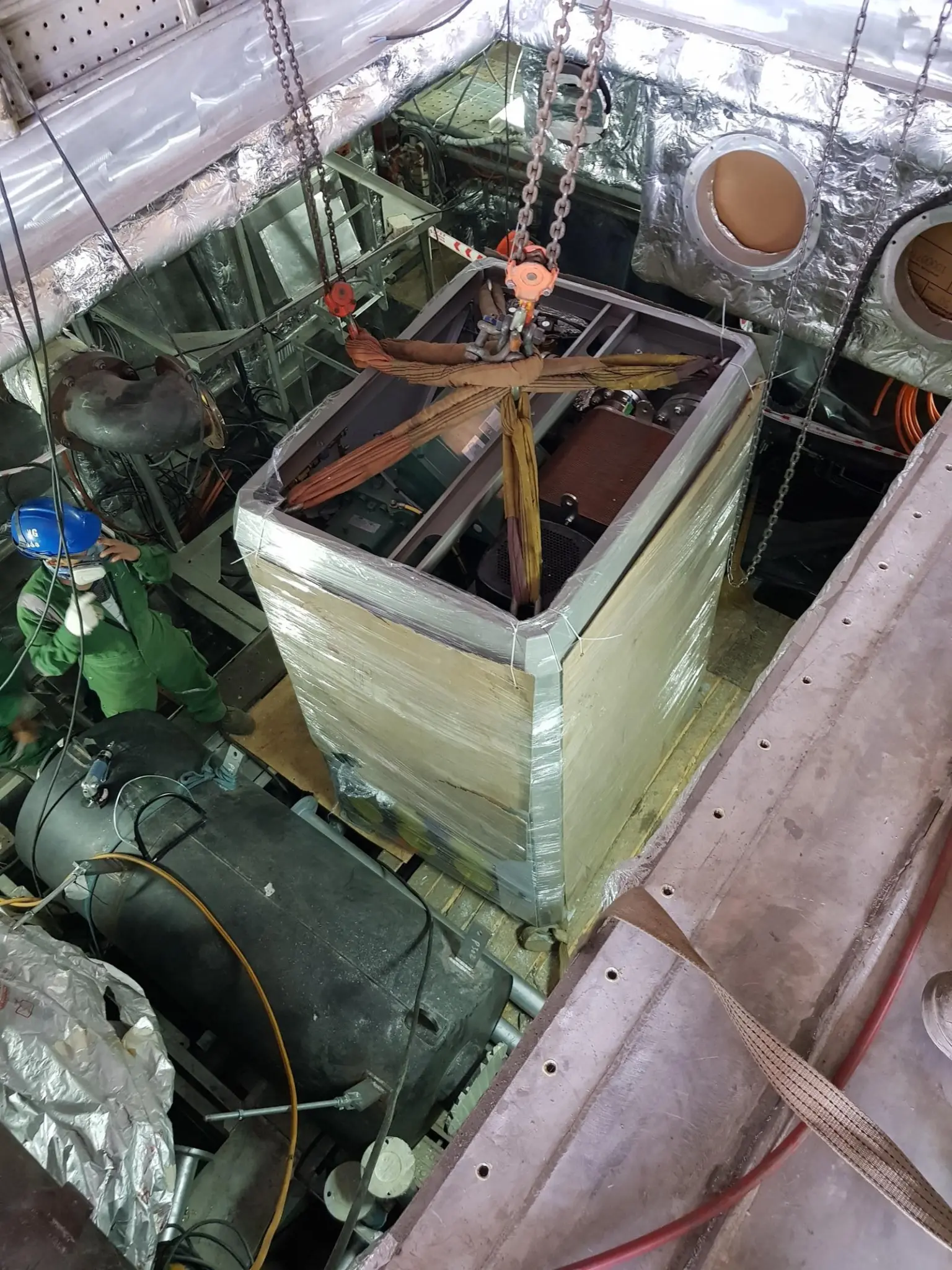
While it is plausible, (and in some cases desirable), to split the whole thing up and fit it into the available area, having an all-in-one package is still an attractive proposition, especially if “it can be brought in via ordinary access gangways without making a hole in the hull”, he adds.
Despite the challenges presented by the units themselves, “a big part of the problem is physically getting into the onboard machinery,” says Mondejar. The Arnold Maersk had a convenient space next to the main engine, but access was through a pair of small hatches; in future, Calnetix will likely design a modular, containerised system says Sellers.
However, Mondejar points out “a practical retrofit solution” could be integrating the ORC units to run in parallel with the existing service steam distribution.
Enogia is currently considering coupling it even closer to the boilers: “These generally run at temperatures over 200°C, so installing the ORC nearby reduces heat losses and avoids a lot of piping – but the biggest constraint is available space,” says Terral.
Certainly, it’s easier to gain access and combine heat sources on a newbuild. In fact, Climeon is doing just that onboard Viking Glory – a highly integrated Heat Power system will pump up the returns from exhaust heat, jacket cooling water, and even steam turbines to support around 40% of the cruise passenger’s power demand.
INTO MARINE
There are other challenges: ORC manufacturers are generally looking to cross the technology over from landside power generation to typically harsher, more constrained and more dynamic vessel installations, explains Wood, adding that a marine-ready design has to appeal to “a very mixed playing field”.
He also points out that cargo vessels are by no means the only audience: “Ro-ro and cruise ships tend to be more interested in sustainable energy,” he says. Not only are passengers increasingly aware of the environmental impact of their transport but further, he adds “owners also pay their own fuel bill”.
Usefully, ORCs also offer flexibility around how the returned power is utilised. “About 90% of our customers want to put electrical energy back into their grid,” says Flipse: “But some vessels can’t use all that, so we can take it directly to the crankshaft on a PTI, giving it an extra push.”
RETURNS
Flipse underscores the savings can be significant: a ro-ro equipped with a pair of MAN’s 6300kW, 6L51/60DF engines “can, at the given sailing profile, achieve 5% fuel savings on both main engines and 1,700t of CO2 per year with our Efficiency PACK”, he explains. Interestingly, he adds that feeding back power in parallel to the auxiliaries can cut their consumption by 25%.
While Flipse adds there’s a good argument for installing ORCs in a stack configuration and running each closer to its design point, “even if waste heat is free, ORC’s have tended to cost quite a bit”, says Buckingham, Cartalemi adding this aspect has, so far, weakened uptake.
Still, investment partly depends on scale, says Terral: “Larger systems can be half the price of smaller ones per kW hour.”
Orcan has made an art of cost shaving, “picking up off-the-shelf” mass produced parts with proven, marine reliability says Flipse. This is “a deliberate choice”, he underlines: “The big problem for ORCs has been investment price: shipowners want payback between two and four years, fall outside that and you can’t sell your technology. So, admittedly our 100kW marine systems may not achieve the highest efficiency theoretically possible, but we’ve purposely designed for the best OPEX to CAPEX ratio.”
It may prove to be a technology whose time has – finally – come. “Although difficult to predict, cleaner fuels may command a higher price, raising the cost savings of ORC technology,” says Flipse.
“To be honest, interest in these systems has been limited till now, but it’s changing,” says Cartalemi: “The cost of fuel is increasing, and a carbon price seems likely,” he says, adding that a strengthened EEDI may also provide owners with more reasons for considering energy recovery devices.