Pirates foiled by propeller arrestor – and weather
MMWC, founded in 2009 by a group of ex-military maritime and security experts, is currently focusing on the increasingly prevalent problem of piracy. It claims to do this through research, development and delivery of comprehensive information, effective non-lethal countermeasures and training.
MMWC has developed partnerships in the merchant maritime industry, and is engaged with military and maritime insurance organisations in order to create a recognised authority on merchant maritime security. An ultimate aim is the creation of a code of practice for merchant maritime security.
MMWC envisages that its Code will arm shipowners and masters with the knowledge to make an informed decision on how best to protect the vessel; assist in establishing an effective, non-lethal layered defence system; and cultivate and encourage a legacy workforce in the maritime industry capable of defending themselves against terrorism and piracy through training and knowledge.
MMWC hopes to increase the awareness in the industry of appropriate training in security measures and ‘vessel hardening’ – i.e. making the ships themselves more secure against attack. The centre hopes that this will eventually deter piracy from taking place by making it a difficult, unattractive and unsuccessful business, thus restoring safe passage for crews everywhere.
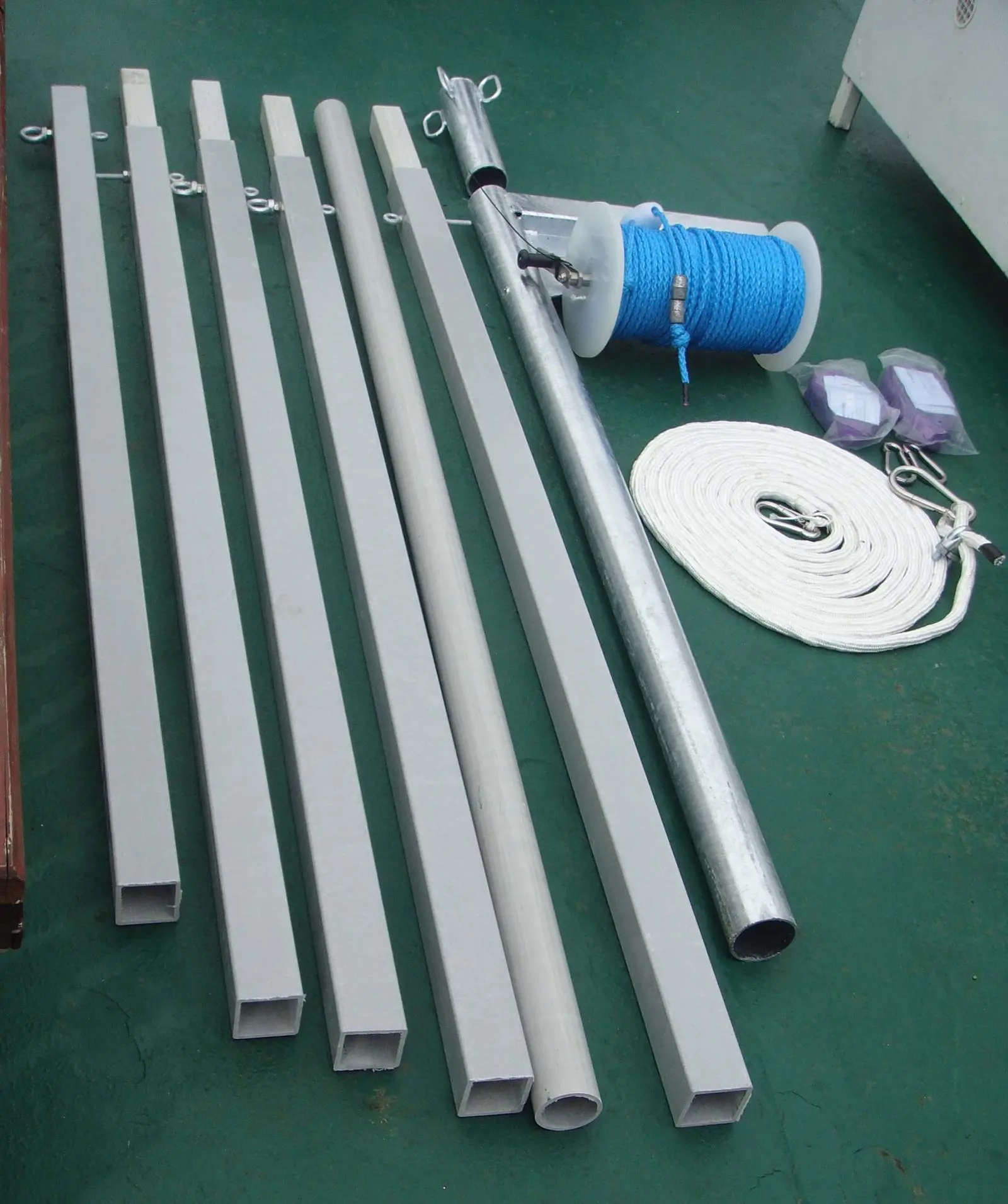
MMWC laid on a demonstration of its propeller arrestor system. This is a simple, but effective system of booms and lines. The 10m booms are delivered as a kit of parts that can be assembled and fitted or removed and disassembled at will; they are fitted either side of the vessel; either one, two or three per side depending on the length of the ship. They can be swung out, and lines deployed when a threat is detected. Similar lines can also be deployed from the stern.
The lines are buoyant polypropylene rope, each about 100m long, intended to create a near-invisible security perimeter on each side of, and aft of, the ship. Any attempt to cross these lines with a small outboard-powered boat will entangle the propeller and cause the engine to stop immediately. The ropes are designed with ‘weak links’ which break when strained, so the propeller of the attacking craft is simply, but totally, fouled. So although the attacking boat will be stopped, usually sharply, and maybe swung round or even capsized, the system is basically safe with no danger to life.
MMWC says that the system is simple to use and deploy, non-lethal, cost-effective, can be attached to any type of ship, carrying any cargo, deployed in any weather conditions, has a negligible riskof entanglement in the ship’s own propellers, and is re-usable with the only maintenance being replacement of any broken rope.
For the purposes of the demonstration a part of the Solent, on the English south coast, was designated as the ‘Gulf of Aden’. Therein lay the first problem: the weather conditions were totally non-Aden-like, overcast, with moderate to strong sea conditions that would have kept all but the most desperate pirates onboard the mother ship. However, that did not deter the acting pirates, who gave chase as planned. And once again the weather was in our favour. Despite the ship chosen for the attack being a 1955-built, steam-powered ship (the SS Shieldhall) with a service speed of all of 9 knots, the pirates’ fast outboard-powered skiff was prevented by the waves from achieving any worthwhile speed differential.
Nevertheless, the pirates eventually caught up with the ship. When some 60m or so astern, we heard the ‘ping’ of a rope breaking as it was crossed by the skiff, and although it did not actually stop the pirate boat, the fouled propeller drastically reduced its speed further, so the pirates suffered the indignity of being unable to keep up with a 55-year-old 1,000 ton ship powered by two 800hp triple-expansion reciprocating steam engines. Shieldhall was forced to slow from her normal 9 knots at 86 rpm so the pirate boat could be recovered.
MMWC was, despite the attack being somewhat less realistic and less spectacular than hoped, pleased that the propeller arrestor had done its job.
A second, newer, development, was additionally being shown by MMWC. This is a close-range broadband security radar, designed to be fitted to ships to supplement the normal S-band and X-band navigational radars. Unlike the long-range radars, the broadband unit is mostly unaffected by sea and rain clutter, and even a small target like a pirate skiff will show strongly. The unit has been developed by MMWC in cooperation with Simrad and its parent company Navico. Simrad was, of course, formerly part of Kongsberg, and Kongsberg still retains the name for fishing electronics, but Simrad’s navigational electronics (including some professional small craft products) are now part of Navico, as Simrad Yachting.
The broadband radar is, therefore, a development of a high-end small craft radar which, MMWC says, in conjunction with its compact enclosed scanner, will provide security surveillance for larger vessels at up to 4-6 mile range, at very low cost. Rather than pulsed high-power signals generated by magnetrons, the broadband radar is all solid-state, and sends a continuous transmission wave with linear increasing frequency. This technology is said to provide superior target detection at low energy levels.