Poles apart: magnetic gearing offers efficiency improvements
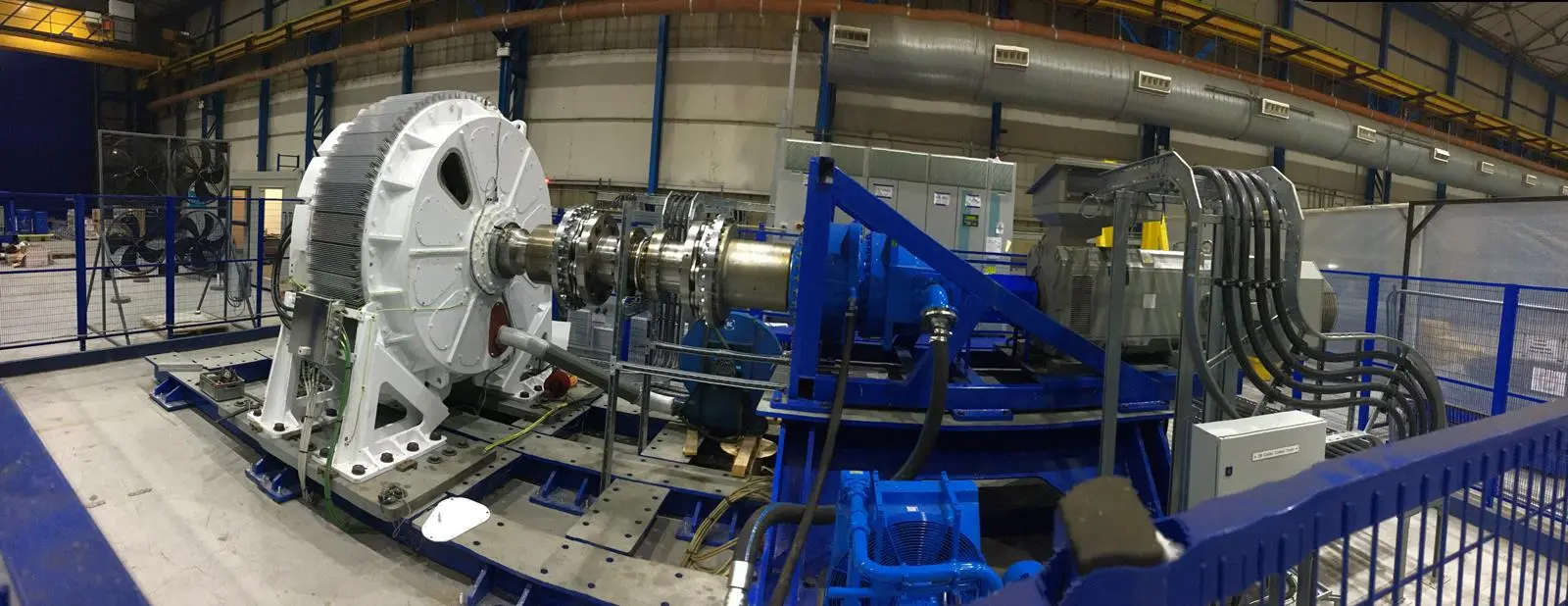
It’s possible to gain high-torque, direct drive at medium or slow speeds where traditionally a motor and gearbox combination would have been necessary. How? By adding permanent magnets to the machine instead of gears.
And without metal touching metal – the engaging elements stay just a few millimetres apart – it avoids normal friction issues “so you have very low losses” explains David Latimer of Magnomatics, adding “neither do they wear out”.
Surprisingly, despite the air gap these motors can yield a continuous torque density several times greater than their straightforward permanent magnet counterparts. Possibly most interesting for marine applications is that replacing metal teeth with magnets builds a certain ‘forgiveness’ into the system: unlike mechanical gears, magnetic fields have a damping effect on both electromagnetic ripples and sudden torsional loads.
So, how does it work?
First of all, take two concentric rings of permanent magnets with alternating poles, the innermost being connected to the output shaft. Rotating either one at this point would just move the other at the same speed – they’re simply locked together.
“If you then put electrical windings round the outside to create a stator, you’d have a permanent magnet motor turning in step with the field circulating around the coils” explains Latimer.
However, the all-important next step in creating a Pseudo Direct Drive (PDD) is to sit another circle containing electrical steel segments (called pole pieces) between these two rings: this modulates the field on the inner shaft.
Putting it simply, these act a little like a stroboscope: “If you could see the field from a vantage point on the hub, the impression would be similar to old films where wagon wheels appear to be slowly turning backwards”, says Latimer. The result is a lower speed rotation on the output shaft – and as in the movies, it’s in the reverse direction.
Further, it can be tailored in interesting ways because the number of magnets on each circle, combined with the number of pole pieces, defines the gear ratio.
While deepsea ROVs may sit at the smaller end of the scale, the results have been dramatic: “Our thruster motors for remotely operated underwater vehicles are around 92% efficient,” says Latimer: “This is more than double than that of the hydraulic thrusters they replace.” Moreover, it answers one subsea operation concern around deeper waters: the drive’s characteristics make it suitable for depths of 6,000m.
But what about larger applications? The technology is already being trialled “up a pole in the middle of the sea in dynamic conditions” says Latimer, explaining that the latest 10MW-plus wind turbines are on course to be the first large-scale implementation. What grabbed the sector’s interest were initial results indicating very high efficiency for moderately low-ratio systems: Magnomatics’ PDD comes out a substantial 7% to 10% ahead of the current tech at full load, reaching a huge 98% efficiency on a 10MW output drive. Although these work to translate the shaft rotation from the slowly turning propellers into electrical energy, he points out “the principle is much the same… and so is the size”.
THRUSTERS AND PODS
Even the most efficient of vessels have a problem when it comes to thruster operation, as though it’s an electrical drive, physical loads still have an impact explains Milinko Godjevac of Future Proof Shipping.
The power generation usually necessitates a 90deg translation through a bevel gear, and the result for azimuthing thrusters “is around 5% loss even in design conditions”, says Godjevac. However, it can worsen given off-design loads, because the effect is to subtly change the geometry of the meshing teeth.
A proportion of that efficiency can be regained by replacing that bevel gear with a PDD. But podded propulsors face yet another challenge: “The gears are often almost submerged in lubricant,” Godjevac explains. This oil bath is far more viscous than air and the machinery within has to churn through it. By contrast, the PDD’s negligible lubrication demand sidesteps most of the issue.
Further, the compact size of these magnetic machines can substantially reduce a pod’s outline. A design collaboration focusing on a 2.5MW unit – which saw Magnomatics partnering with Rolls-Royce and Wolong Laurence Scott – showed it could significantly reduce the diameter and lower hydrodynamic resistance: taken together, Latimer predicts “an improvement of between 7% and 10% in fuel consumption over current technology”.
FUTURE
But these are just the first few steps into the industry, and the field is wide open for all kinds of exploration.
At the moment this lies in the realm of speculation, but it is possible that with work, magnetically geared PM motors might just prove suitable for larger, power take off (PTO) applications: these are gaining more interest of late, as large two strokes can produce power far more effectively than starting up the onboard gensets. Certainly, the neat footprint of these magnetic motor-generators could make it attractive for retrofits. But most importantly, PTOs have to cope with a variety of difficult conditions – including sudden torsional loads and “hammering from shaft and engine interaction”, says Godjevac.
Given this, magnetic gear machines possess a very interesting characteristic: they are somewhat elastic in nature and so the gears are naturally imbued with vibration damping and torque protection, slipping and then automatically realigning without damage either to themselves or other components. Moreover, these characteristics can be further tailored to suit a particular application.
SPLITTING
A twist of this magnetic transmission technology might even be further developed to help maritime engines stay inside their own particular happy place. While the MAGSPLIT was first developed for the automotive market, it appears to have crossover potential.
This replaces the PDD’s fixed ratio gear with something that can be altered on the hoof, enabling a variable speed output – right down to the more problematic partial loads where normal gearing losses tend to be amplified.
It works by adapting that three ring system. Firstly, by reducing the number of magnets on the outer circle to four, and secondly, by allowing it to rotate at a variable speed, controlled by altering the flow around the stator. The engine rotation is tied to the pole-piece set, and the output to the shaft.
It’s a very neat trick. If the outer ring is stationary, the device will revert to its baseline gear ratio which, (like the PDD), is defined by the number of pole pairs to pole pieces.
But when the outer is rotated in the reverse direction, say by half the rpm of the engine, the effect is to halve the input speed. This changes the relative gearing: take the example of a 1,800rpm engine hitched to a device with an intrinsic ratio of 3:1 (normally reducing the speed to 600rpm). Running the outer ring at 50% against the engine rotation leaves it with an output of 300rpm: an effective ratio of 6:1. Likewise, moving the outer ring faster than the engine has the opposite effect, increasing shaft speed.
Despite the parasitic load from the stator, the fact that it can change ratios – smoothly – without the losses associated with multiple mechanical gear combinations makes it an extremely useful alternative for all kinds of onboard installations, including pumps and other variable speed applications. But there may also be potential for allowing a greater propulsion control range than is normally comfortable for main engines.
Further, there’s an added bonus. The MAGSPLIT can divide the power between different mechanical and electrical pathways, raising efficiency for hybridised systems.
Essentially, the same three ring process transfers a variable proportion of the energy to the shaft, while the rest of the power flows around the circuit to a second motor generator, some being diverted to or released from the battery depending on charge and demand. This could allow the (occasionally painful) gaps to be filled between various operational modes: instead of distinct boundaries and load steps between battery and engine or main and auxiliary power, this kind of magnetic device would create a smooth transition – and even potentially open up new ways of combining available energy sources at the shaft.
On the whole, it seems it is not a question of ‘if’ PDD systems will be utilised in the marine industry, but when… and where.