



Portsmouth sets a sea change in motion
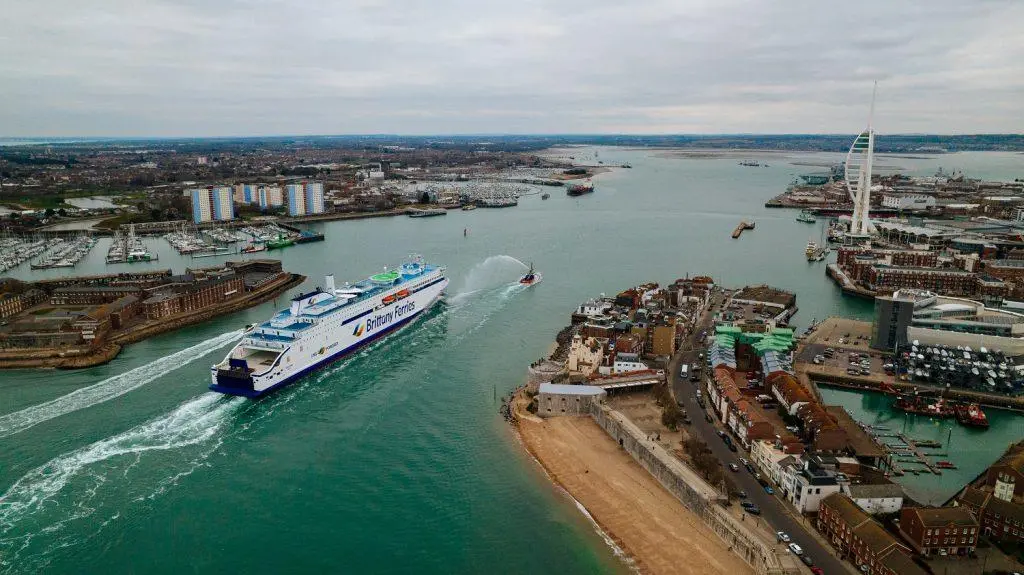
Dubbed the Sea Change project, the scheme will allow ferries and cruise vessels to draw ‘green’ electricity from the grid when alongside in the Portsmouth International Port complex, obviating the need to run shipboard generators with the attendant atmospheric pollution. The investment will allow cold-ironing at the three busiest berths.
While long-term in its strategic intent, the initiative is immediately apposite to the impending introduction of new LNG/electric hybrid ro-pax vessels by major customer Brittany Ferries, which maintains a network of services to France and Spain out of Portsmouth. The French company strengthened its 48-year business association with the council-owned, south coast port last month by signing a further 20-year contractual commitment to Portsmouth.
Both parties have been to the fore in their respective sectors as regards environmental policy, currently expressed both in fleet renewal by Brittany Ferries and in the 2022-2042 Masterplan laid down by Portsmouth.
In looking to have the first phase operational from the spring of 2025, construction of the system began in early November. The connection between the berths and the onshore grid will be made by a 600-metre, 33kV underground cable, to utilise an extra 15MVA capacity secured by the port from Scottish & South Energy in 2023. The entire electrical supply will be generated from renewable sources. Engineering works will take place on the three berths involved, with the installation of a flexible cable management system that will enable ships of different sizes and configuration to plug in.
The project has been funded with £19.8m from the UK Department of Transport and £4.6m from Portsmouth City Council, which has also spent £3m to secure the requisite power for the system. Brittany Ferries, which has invested é550m in five newbuilds over recent years, is also a member of the Sea Change consortium, and will be the largest single customer using the shore power system. The Portsmouth setup will be the first of its kind in the UK, allowing multiple vessel to take power and charge shipboard battery packs, and at multiple frequencies at the same time.
The Sea Change collaborative endeavour, which teams academia and technology specialists with the port and Brittany Ferries, will not only realise the shore power-readiness of the latter’s new ro-pax vessels but will also serve other ferries and the port’s growing traffic in cruise ships. The system is expected to save 20,000t of carbon emissions per annum from 2027, chiming both with corporate goals as well as the aim of improving air quality for Portsmouth residents.
Sea Change is part of the UK government-sponsored Zero Emission Vessels and Infrastructure(ZEVI) competition announced in February 2023, delivered through Innovate UK. Project partner the University of Portsmouth is lending academic expertise in data science, smart power grids and environmental impact analysis to the endeavour, while B4T will provide new smart sensors, and UK firm Swanbarton will supply the control software for energy storage. London-based IOTICS is developing a digital twin ecosystem to allow participants to select and share data securely.
As a city-owned port, located within the community, responsibility to the local population and customers alike is reflected in its Masterplan-containing statement as to accountability: “To make sure our plans have an impact, we will be open and transparent with our air quality monitoring data. This means investing in the latest technology to capture what is happening at the port and what is having an effect. We have teamed up with scientists and academics to turn the port into a living laboratory to trial the latest in environmental power prototypes.”
Brittany Ferries already deploys three chartered Stena E-Flexer ro-pax vessels, two of which have LNG dual-fuel main machinery. The two further E-Flexer newbuilds set to enter service signal a further advance in environmental engineering, and have also been long-term chartered from Stena RoRo. The Saint-Malo is due to commence on the Saint-Malo/Portsmouth run in February 2025 and the Guillaume de Normandie is to enter the Ouistreham(Caen)/Portsmouth route during April, both replacing existing ships.
Through a combination of LNG and electric power, the latest vessels will take the company closer to what it describes as “a more sustainable future”. The specification in each case of an 11.5MWh Leclanche battery installation breaks new bounds in the maritime industry as a whole. The hybrid arrangements enable crossings to be made on LNG fuel, switching to LNG-electric and full-electric mode on port approaches, manoeuvring and at the quay.
The ships’ plug-in capability will enable shore power supply and battery recharging to be effected using the new energy infrastructure planned at Portsmouth and at the French terminals. Investment by fleet operators in such connections has an added benefit, since the emission of CO2 in port while a vessel is stationary harms a ship’s carbon intensity indicator (CII) rating, as it is not being offset by miles travelled.
Constructed by Chinese builder CM Jinling Weihai, Saint-Malo and Guillaume de Normandie each have two Wartsila 13,740kW main engines of the 46DF dual-fuel series, ensuring sailings at an average speed of 23 knots. The electrical and energy storage system will allow for peak shaving, so that the propulsion machinery can be run at optimum settings, and the flexibility and scope of the arrangements is heightened by PTO/PTI units on each of the two shaftlines.
Related Articles
 ELECTRIFICATION AND BATTERY HYBRIDS
 ELECTRIFICATION AND BATTERY HYBRIDS
 ELECTRIFICATION AND BATTERY HYBRIDS