



Prompting EV fire response strategies
With a large vested interest in the sector as a classification and technical body, Korean Register (KR) has issued a report addressing fire safety on such vessels transporting EVs.
KR hosted a hazard identification (HAZID) workshop earlier this year, drawing in experts from various fields, not least shipowners and shipbuilders and the National Fire Research Institute, to discuss fire safety management of EVs on vehicle carriers.
The resulting publication outlines EV fire characteristics, identifies risks, and provides safety recommendations based on HAZID analysis, for consideration in ship design and construction as well as in operation.
The Paris-based International Energy Agency (IEA) has calculated that the EV share of global new car sales has risen from less than 5% in 2020 to 9% in 2021, 14% in 2022, reaching 18% last year, and the expectation is that the 2024 figure will exceed 20%. The expanding import and export activity reflects in volumes transported by PCTCs, and industry sources forecast an accelerating growth trend in the coming years.
KR acknowledges that there is no evidence that EVs are more of a cause of fires than conventionally-powered vehicles with internal combustion engines (ICE). For instance, statistics indicate that while the rate of EV fires in South Korea is increasing, this remains approximately 30% lower than the rate of ICE vehicle fires.
Nonetheless, a fire involving the lithium-ion battery pack in an EV has distinct characteristics, markedly different from fires in conventionally fossil-fuelled cars, and which can lead to substantial property damage and potentially also loss of life. Given the implications for cargo, ship and crew safety, it is essential to understand the issues and prepare safety strategies addressing these unique risks in maritime transport.
Aside from the claimed environmental benefits of EVs, the incorporated li-ion batteries offer high energy density and other advantages. However, such batteries present extra challenges in dealing with fire outbreak, control and extinguishment. The central problem is the propensity for a fire event starting a chain reaction known as thermal runaway, where the heat generated during a fire is greater than that being dissipated, further increasing heat production, and perpetuating the phenomenon.
Thermal runaway can occur when the battery temperature rises due to impact, overheating or overcharging, and starts in a single cell. Thermal propagation creates a domino effect, spreading from cell to cell. Once thermal runaway has been initiated, the fire can self-sustain through the release of heat, flammable materials and oxygen from the battery itself, and is not dependant on external oxygen supply, possibly leading to an explosion.
Limitations in the effectiveness of standard, shipboard firefighting measures and equipment, the release of battery off-gas during a fire, the rapidity of the fire’s development, prolonged fire suppression time, and the potential for re-ignition, create particular difficulties in dealing with such fires at sea. The task is compounded by access restrictions on vehicle decks, the ship stability implications of taking aboard substantial volumes of water for firefighting, and relatively small crew complements.
Battery fires and thermal runaway are closely related to the battery’s state of charge (SoC), such that KR’s HAZID study recommendations highlight close attention to the SoC of batteries in EVs being loaded as one of the most critical factors in curbing fire risk. When the SoC is below 30%, the likelihood of thermal runaway is significantly reduced. However, SoC levels in EV shipments are currently typically up to 50%. The battery charge factor, which is said to be under discussion at the IMO in relation to amendments to the IMDG Code, is thus a key to enhanced safety, although implementing change requires cooperation from vehicle manufacturers.
Other operational measures advocated in the KR report include providing dedicated loading areas for EVs, and avoiding transportation of EVs on uppermost decks when sailing in high-temperature regions. Procedures covering the management and disposal of accumulations during water-based firefighting operations, given the risks to vessel stability, are also especially important.
In terms of ship design and equipment, the advisory underlines the potential value of an artificial intelligence(AI)-based video detection system, compatible with existing CCTV infrastructure throughout the ro-ro spaces. This leverages deep learning algorithms and sophisticated image processing technology to detect fire and smoke captured by CCTV cameras, triggering alarms and simultaneously enabling crew members to visually inspect affected areas. It picks up on abnormal events more rapidly and across larger areas than conventional fire detectors, which only activate when smoke reaches the sensors.
Fire suppression using fixed CO2 equipment is effective in combating fire in PCTCs, except during loading and unloading, when specialised support from shore-based teams is necessary. However, for tackling EV fires, the KR report suggests storage of additional CO2 onboard, ideally enough for two deployments.
In the case of fixed high-expansion foam installations, foam can break down when exposed to high temperatures for extended periods, and cannot immediately halt thermal runaway in EV batteries. To address these challenges, the foam concentrate carried on the ship should be sufficient for at least five discharges, allowing for system reactivation to control any re-ignition and suppress further fire development.
As continuous cooling of the battery is the most effective method to combat fire, using seawater to direct a sustained, cooling spray at the burning vehicle can afford significant fire suppression. However, PCTCs have multiple fixed ro-ro decks(typically 12) plus hoistable decks, such that installing a SOLAS-compliant fixed water spray system through the cargo spaces would significantly increase costs compared to other fixed fire extinguishing solutions. Accordingly, and despite their potential effectiveness in dealing with battery fires, there are very few examples of fixed water spray systems being fitted on PCTCs, according to KR.
Remote-operated fixed monitors, on swivel mountings, allow spray water to be precisely directed without requiring crew to enter the cargo spaces, although installation throughout the vehicle decks carries a cost premium and a may penalise payload space. Underbody water spray equipment offers a targeted approach to address EV battery fires, extinguishing the fire through direct cooling of the battery pack or delaying thermal runaway propagation. As the system requires crew intervention, to directly access the burning vehicle, a clear strategy and thorough training are of the essence for effective deployment.
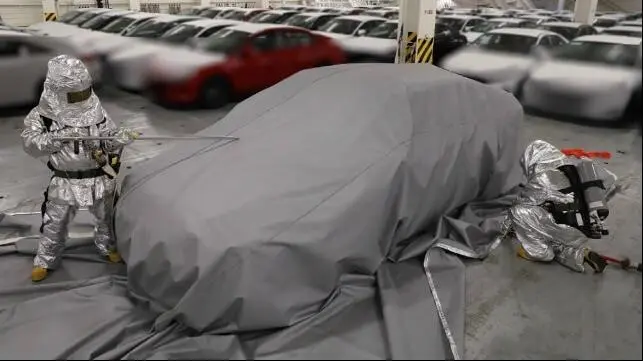
The prompt use of special fire blankets, coupled with early detection of abnormal conditions, be it fire or smoke, can help achieve containment and avert major incidents by preventing the spread of fire. However, the nature of PCTC ro-ro decks, with lashing points and lashing belts, pose challenges in fully isolating vehicles and preventing oxygen ingress, while access constraints also create extra difficulties for crew.
The HAZID analysis has underscored the need for clear, fire response strategies and for collaboration among stakeholders to mitigate risks associated with EV fires on PCTCs.
Preparation for incidents is crucial. Regular inspections and maintenance should ensure that fire detection and extinguishing systems on the ship are fully operational. Furthermore, enhanced and dedicated crew training in EV and battery fire response, and in the systems and technologies adopted, is an urgent and vital topic for the industry.
Related Articles
 BATTERIES, SUPERCAPACITORS, FUEL CELLS AND OTHER ENERGY STORAGE TECHNOLOGY
 BATTERIES, SUPERCAPACITORS, FUEL CELLS AND OTHER ENERGY STORAGE TECHNOLOGY
 BATTERIES, SUPERCAPACITORS, FUEL CELLS AND OTHER ENERGY STORAGE TECHNOLOGY