Real world RCCI: reactively controlled ignition goes live
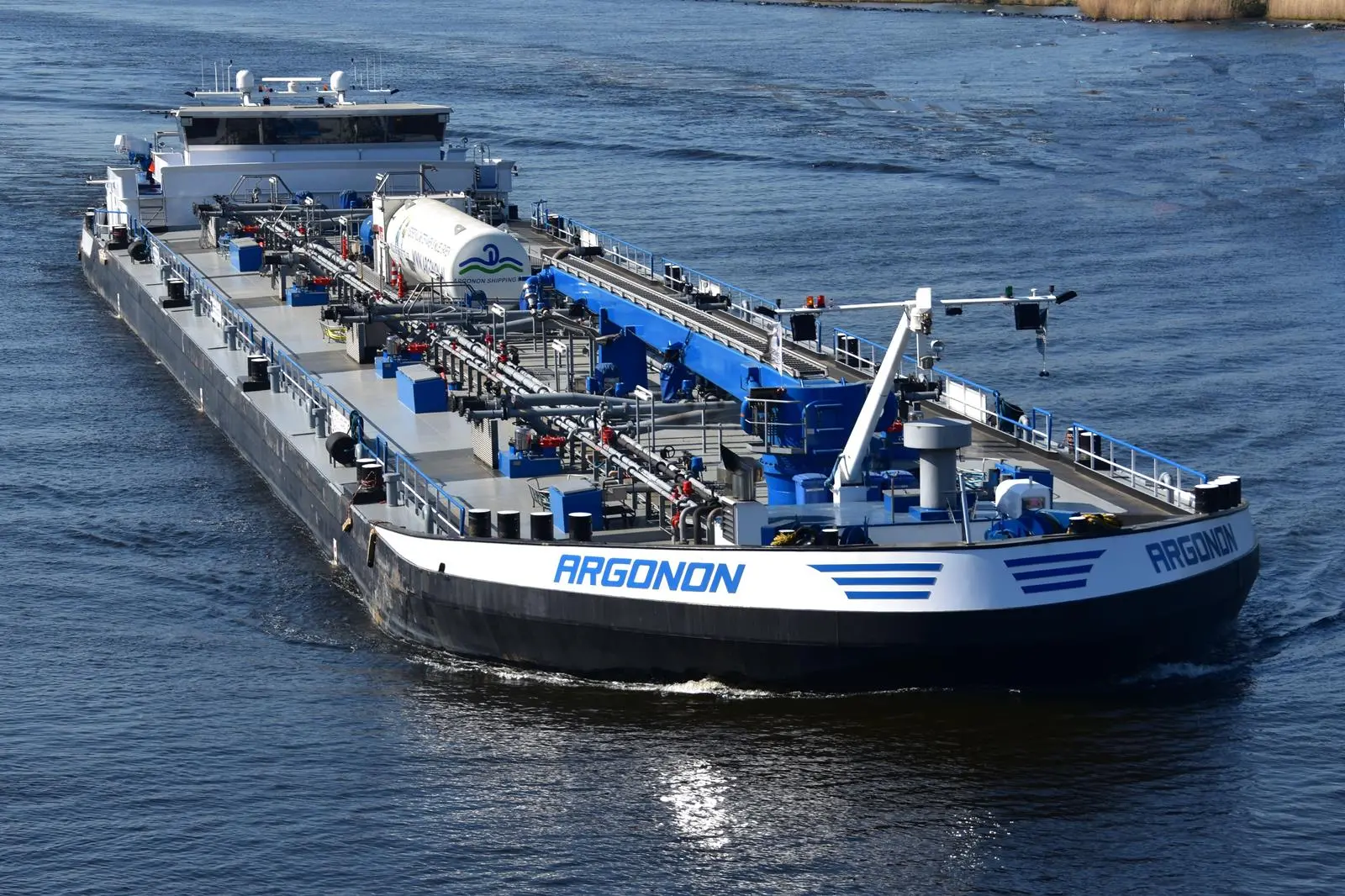
Deen Shipping’s MTS Argonon is a fairly ordinary-looking 6,100dwt bunker tanker. But beneath its placid exterior, beats a long-awaited world first: a commercial, reactively controlled compression ignition (RCCI) engine.
So, what could have prompted a pragmatic carrier to risk a perfectly serviceable, Caterpillar 3512 engine in order to explore something so exotic?
In fact, there are a couple of very good reasons: one is fuel flexibility, another is emission regulation. And then there’s also efficiency.
In a standard engine quite a lot of energy goes missing during the power stroke, whether that’s spark or diesel ignition. It’s a fairly simple mechanical issue centring on crank angle: at what point in the cycle the combustion delivers its main thrust.
Ideally “what you want is all the fuel burnt at once, at around top-dead-centre (TDC), then you have the highest efficiency; no ignition before that point, and no delay”, says Paul Nooijen of ArenaRed, the innovation company behind the RCCI solution.
However, SI engines can spark as much as 40 degrees before TDC, and most of the fuel is actually burned some way after, 10% lagging till plus-90 degrees. “You lose twice: not just all the pressure build-up before TDC, but also the fuel that comes late into the combustion,” says Nooijen. “Diesel is more efficient, ignition tends to start at its earliest 20 degrees before TDC, and by 70 degrees after TDC it’s usually burned 90% of the fuel in the chamber.”
But both could do better, with a little help.
Therefore, ArenaRed’s RCCI retrofit completes the whole process, from ignition to combustion, in a short, 23 degree crank arc.
So, what does this fairly small bit of kit actually do that enables an engine to radically alter its behaviour?
“The RCCI works by taking a low reactivity fuel, whether that’s hydrogen, gasoline, methanol, ethanol or propane, and bringing it into the combustion chamber via a very simple port fuel injector,” he explains: this happens across the entire intake stroke, giving it plenty of time to mix with the incoming air. In the case of the Argonon, “the main fuel is LNG” he says.
Then 1% diesel is added via a special injection head, but not as a trigger for the classic, dual-fuel pilot ignition. “Instead, you bring in this small amount of diesel at around 100 degrees before TDC, this gives it enough time to move completely into its gas phase,” says Nooijen. “This is important, because if you work on a diesel principle, you inject the fuel at a very high pressure to optimise atomisation… but you are still talking about droplets, which form NOx on the outside and soot on the inside during combustion.”
It is only when the piston rises to just before TDC that this now homogenous charge ignites, and it does so fairly promptly. According to Nooijen, “You have ignition three degrees before TDC, and its combusted 90% of the fuel by 20 degrees after TDC.”
Interestingly, the lack of an advancing flame front reduces thermal stresses, lowers heat loss from the exhaust, and the very complete burn also mitigates methane slip. Together, hitting the right point on the crank angle, avoiding NOx generating hotspots and cold areas of unburned hydrocarbons means an RCCI retrofit can deliver up to around a third more power, at the same time as gaining another 10% in sheer efficiency. And it doesn’t need expensive after-treatment either, ditching the SCR.
In fact, it gets very close to the holy grail of the engine manufacturing industry: complete, clean homogenous combustion.
However, if ignition isn’t triggered by spark or valve timing, how is control actually achieved?
At the centre of the magic is ArenaRed’s diesel injection head. This combines three elements; injector, tip cooler (stopping the nozzle itself from becoming a hot spot) and most importantly, a combustion pressure sensor plus a very clever bit of software. Nooijen explains this marries pressure data with volume information to tell the system how much diesel to inject, adapting the charge on the fly and keeping parameters such as pressure rise rate per cylinder and per stroke “within tolerance specifications”.
Moreover, it can iron out otherwise problematic fuel variations: after all, it only takes a couple of percent more moisture than expected, a slightly raised compression ratio or a two-degree advance in ignition timing, and an engine would usually wander into either soot or NOx formation badlands.
So, how does it work out in practice? “We’ve seen that if the ignition starts to come in too early, say from three to five degrees BTDC, the diesel portion drops down from 1% to 0.98% lowering the overall reactivity of the fuel… and as a result the combustion walks back two-degrees to the right point over the next few cycles,” says Nooijen.
Obviously, the RCCI’s responsiveness to changing conditions means a fairly sophisticated software operation; he adds that “around 1GB of information is processed every hour” by the CPBC.
However, there’s another advantage that should wow ship owners: the system, by its nature, has incredible fuel flexibility as any variations in combustion characteristics are handled in a direct fashion by what’s actually happening in the chamber. “You don’t even need to empty your tank, the combustion will adapt to the mix inside something like two seconds,” he explains, adding “that works even if you’re running methanol”, typically one of the hardest fuels to utilise in a standard engine.
While MTS Argonon is running LNG as that suits its current route, Nooijen favours cost-effective propane for first movers. However, he believes that biofuels, especially alcohols like ethanol, “are the future”, and of course, the RCCI doesn’t need any hardware changes in order to adapt.
While the RCCI retrofit will mean many engines can squeeze out a bit more than the rated power, there are some considerations for load points given the different characteristics of these alternative fuels. For example, “propane will ignite earlier than LNG, so rather than getting an output of, say, 100kW maximum per cylinder, it will be limited to 60kW” he explains. There is a contingency operation: above this, the engine will revert to more standard dual fuel operation.
Intriguingly, “whether it’s a two stroke, or a new automotive with variable turbos, common rail actuators and so on, the RCCI retrofit stays basically the same” says Nooijen: a port intake, the CPBC controller and injection head. Given such a minimal intervention, it seems likely that other owners will be very interested in applying the technology.
The last word should go to Gerard Deen of Deen Shipping, who is rather reassuringly offhand about his world first: “No problems,” he says, “everything is working fine.”