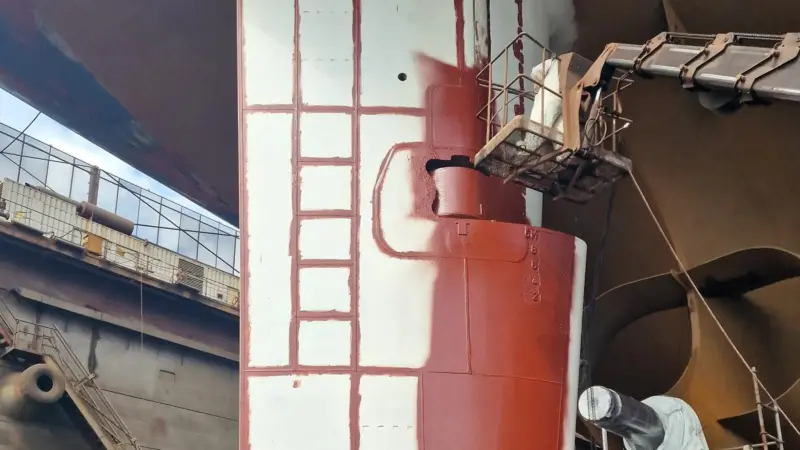
Researchers question the effectiveness of anodes in ballast tanks
The corrosion team from the Antwerp Maritime Academy, in close cooperation with several universities in Belgium, surveyed over 100 ships and were unable to find any significant difference in the extent of ballast tank corrosion between ships with anodes and those without, no matter how old the ships were.
The results, like earlier studies, show a lot of variation between ships, which can result from the age of the vessel, substrate preparation, application conditions, mechanical damage and maintenance regimes. Additionally, sacrificial anodes are only effective when submerged in an electrolyte for a longer period of time, a situation which may not always be the case in ballast tanks. Of the tanks studied that were fitted with anodes, 21% were nearly always wet and 84% alternated between wet and dry in varying ratios.
This did not emerge as an important factor in the analysis, and the researchers could not identify any advantage to the presence of anodes for either ballast regimes. Instead, they explain that their results indicate the importance of the coating application and the fact that the complex geometry of ballast tanks severely impedes the optimal and straight-forward installation of anodes.
Anodes represent a significant cost for shipowners. For example, they could cost around $500,000 for a Panamax bulk carrier, not a one-time cost as they are usually designed to last about five years. Weight is another issue. An ultra large crude oil tanker could have 67 tons of zinc on board as a cathodic protection system. This means that on each loaded voyage, 67 tons less cargo can be embarked. Additionally, the dissolution of metals and their subsequent discharge into the marine environment during ballasting can potentially impact marine ecosystems.
It is a challenge to correctly determine the number of anodes to be installed, and defining their location can be critical. An anode will normally only protect surfaces in direct line of sight, so surfaces behind stiffeners, around corners and inside pipes may not be adequately protected. Initially, the total weight of anodes required is fairly easy to calculate, but changes over time can diminish the effectiveness of the initial installation. The percentage of damaged coating surface must be considered on an on-going basis.
Inadequate distribution can result in bulkheads that are over- and/or under-polarised. Either can be extremely detrimental. Excessive negative potentials will cause excess hydrogen gas evolution and may lead to disbondment of coatings or embrittlement of high-strength materials, possibly leading to fracture. This over-protection can result in calcareous deposits which can build up under the coating at any damaged area and can lift off the intact coating from the steel, thereby accelerating the rate of coating loss. Under-polarisation will result in ongoing corrosion.
The corrosion team of the Antwerp Maritime Academy demonstrated through an extensive in situ research program that corrosion in ballast tanks is a fairly linear process that starts after four or five years and then continues steadily increasing across the surface at a rate of approximately 1.7% per year. This means that the quality of a coating system only becomes apparent after several years. The research was published in a paper entitled Corrosion in ballast tanks of merchant ships – in situ study of the significant parameters.
While the researchers accept the soundness of the principles behind sacrificial anodes, their research demonstrates that anodes are only effective if installed, maintained and followed-up correctly, which it seems is not done adequately onboard many merchant ships. “In reality, we noted during our in-situ inspections that the anodes were often distributed indiscriminately in the tanks,” they state in the report.
The results have led to a further study by engineering firm Elsyca carried out with the Antwerp Maritime Academy. This time a single LNG carrier was examined in detail, and Elsyca’s CPMaster modelling software was used to create a picture over time leading to the current state of one of the vessel’s ballast tanks. The aim was to demonstrate that such modelling is an effective tool in the initial design and subsequent maintenance of effective cathodic protection in ballast tanks. The study involved making a 3D model of the ballast tank in a CAD program, running CPMaster, visualising the outcome and then comparing it with the reality onboard the ship.
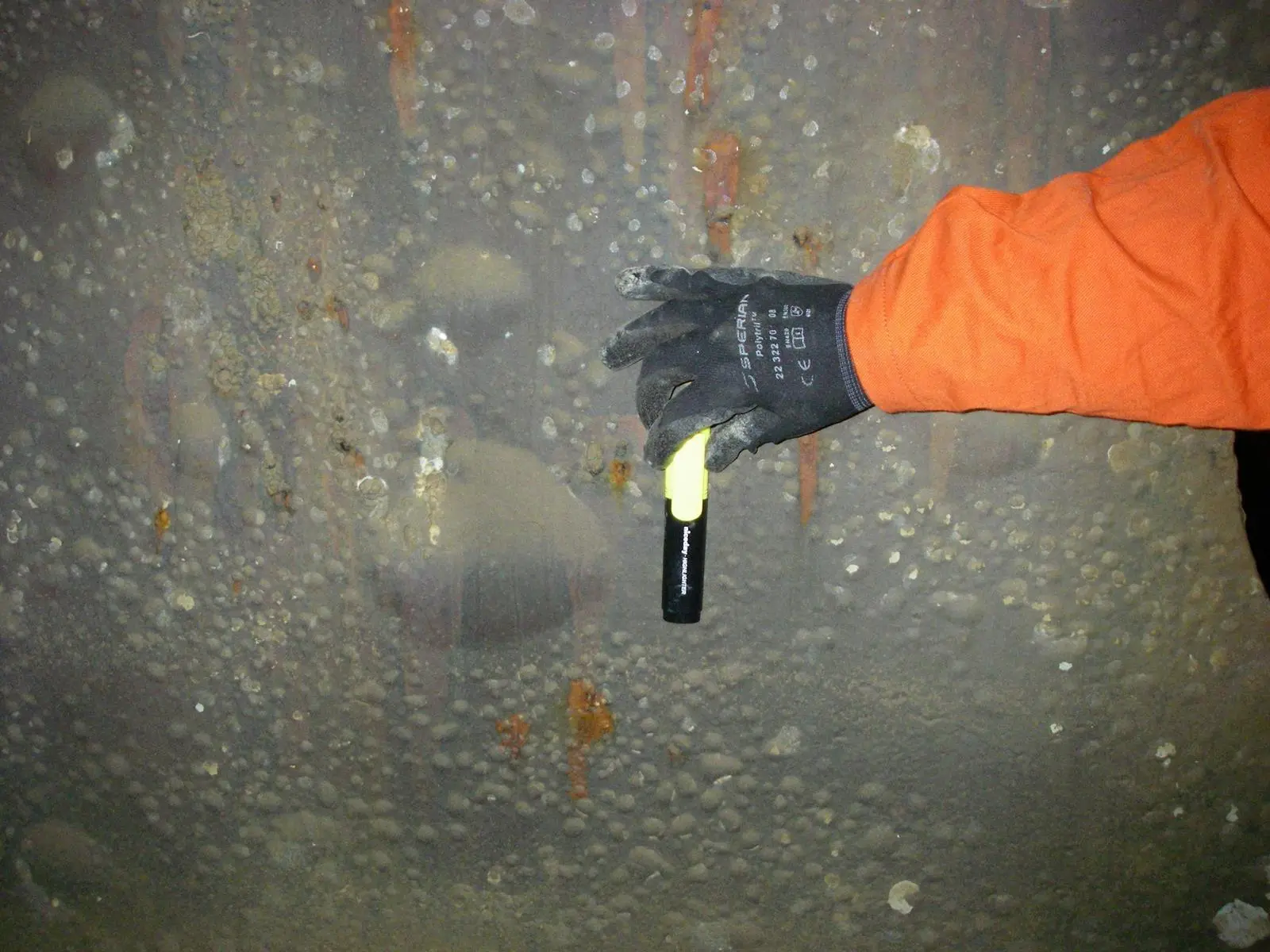
The Elsyca model showed a good fit with in-situ observations of the tank. “We are convinced that the outstanding state of the tank is mainly the result of an excellent coating system that most probably has been applied under good conditions without any compromises regarding substrate preparation and application,” said lead researcher from the Antwerp Maritime Academy, Captain Dr Kris De Baere. “The cathodic protection system with sacrificial anodes was added later, is oversized, and the anodes are not distributed in a uniform way.” He says the sacrificial anodes might be responsible for the massive number of blisters in the tank coating.
“We think the software package CPMaster, developed by Elsyca, is a useful tool to optimise the anode distribution throughout the tank. Obtaining an equal level of protection with less anodic material entails an economical advantage and implies that less heavy metals will be introduced into the environment”, said Capt De Baere.
“Many marine architects still rely on experience and rules of thumb and are not able to guarantee a corrosion-free service life, resulting in high operational and maintenance costs and reduced lifetime expectancy”, said Christophe Baeté, manager for corrosion engineering at Elsyca. “Elsyca engineering simulation technology quantifies the corrosion issues and enables the engineer to make informed design decisions. The number and location of the galvanic anodes is determined upfront leaving no margin for error,” he added.
The research continues, and more than 50 vessels have been examined since publication of the first research report.