Ringing in the changes
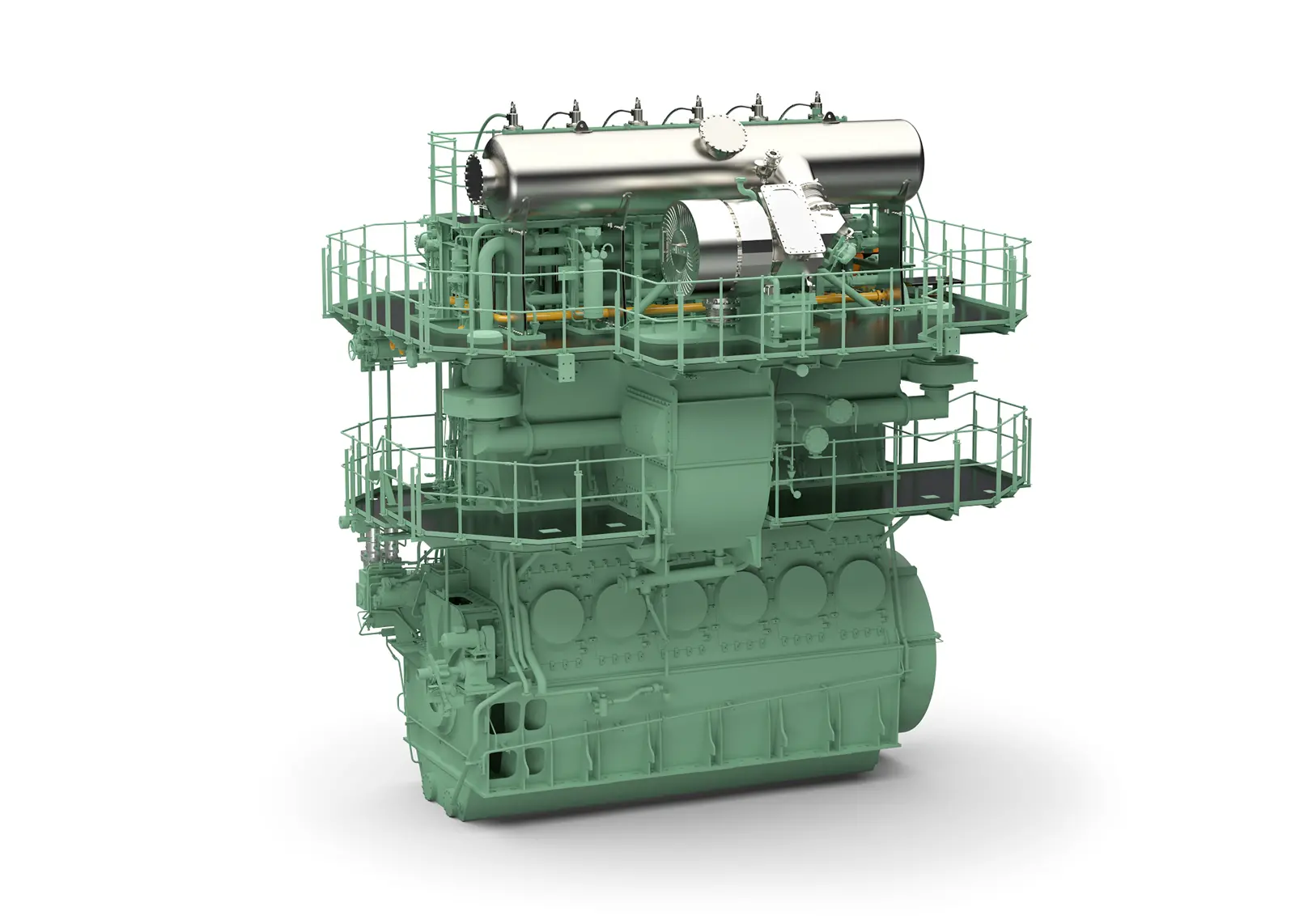
The Marine industry is facing tough challenges like the reduction of fuel consumption, the use of complex fuel combinations, less emission and increase of engine efficiency.
To facilitate this, the combustion system will have to survive at higher temperatures and combustion pressures that result in increased stress on the cylinder liner, piston, and piston rings. To meet these demands, new technologies and material combinations are required.
Piston rings
The overall piston assembly including the piston, the piston rings and the cylinder liner, historically accounted for up to half the mechanical losses within the engine.
Engine availability and efficiency are heavily influenced by the wear rate of these components, with high wear rates shortening component life times. Engine efficiency is also impacted by the effect of wear on seals, with “blow-by” (or the release of pressure between rings in the engine caused by imperfect cylinder lubrication sealing) increasing as wear continues.
While improvements in engine efficiency and service life spans have extended rapidly over the course of recent decades, increasing bore sizes, with knock on effects on ring diameters and consequently rigidity, and increasing combustion pressures and temperature levels in modern engines are driving demands for even more resistant piston rings.
The development of alternative fuels and LNG, which also result in higher combustion chamber temperatures, are also contributing to the additional focus in this area. We can expect the development of combustion chamber parts will not end with this but is being driven by ever-increasing demands for efficiency and last but not least the environment.
MAN Energy Solutions
Within the two-stroke segment, MAN 2-stroke, crosshead marine diesel engines have traditionally used cast irons and Alucoat as the standard material and coating used for piston rings.
The target is to achieve a ring with a hard coating material, fulfilling tribology properties but in a better way and moreover better equipped for the challenges mentioned above than the cast irons with Alucoat which are currently used.
MAN has announced plans to use cermet coating with improved surface roughness covered by Alucoat on all rings in the three-ring pack type.
MAN has also informed the Motorship that as part of its design work for its next generation Mark 10.5 engines it has developed its piston ring design. It is planning to ground the cermet on the top ring, in order to get a defined and a uniform oil wedge and running profile. This evolution will be used in combination with a cylinder liner design that features full-honing conversion at the TDC area. This evolution will be used in a majority of future MAN 2-stroke engine designs, the engine designer confirmed.
Task one of the ring improvement project was to understand the service behaviours of the ring and coating morphology running in sulphur free engine running systems. Secondly, the experience from this generated the most suitable ring, liner, surface and coating composition and then applied this material for the Mk 10.5 as well as for multi fuel engines in service.
WinGD
Engine designer WinGD has also been developing its piston ring design. Konrad Räss, WinGD director, research and development, has shared that the engine designer introduced a two-ring pack type on its X52, X92DF and X72B two-stroke engine types. “Next generation engine designs will include a two-ring pack as standard,” Räss said. The engine designer is considering the possibility of modifying existing engine designs to include the two-ring model.
Aside from lower production costs “which wasn’t the main driver”, the two-ring model offers improved sealing, as fewer rings lead to lower friction, and lower mechanical losses. It offers a good compromise between reducing the build-up of pressures between different compression rings (pressure differentials increase in line with the number of rings used), which contributes to blow-by, and ensuring redundancy.
The WinGD two-ring model employs a gas-tight lock on the top compression ring to reduce the risk of ‘blow by’. Räss noted that WinGD is using galvanic wear-resistant coatings on its piston rings in order to prolong service life. WinGD has been undertaking research into coatings for low friction coefficients, high scuff resistance and low piston ring and cylinder wear rates for decades.
Räss noted that WinGD had adopted a fully ground and lapped wedge-shaped running profile for its piston rings over 20 years ago to ensure a robust oil film in any situation. Close observations and cooperation of other OEMs for other sectors, such the automotive sector, had led to the adoption of best practice, he said. For the next generation fuels, WinGD does not see any need to update the piston ring concept from its current design.