



Shipping bosses call for increased shore power funding
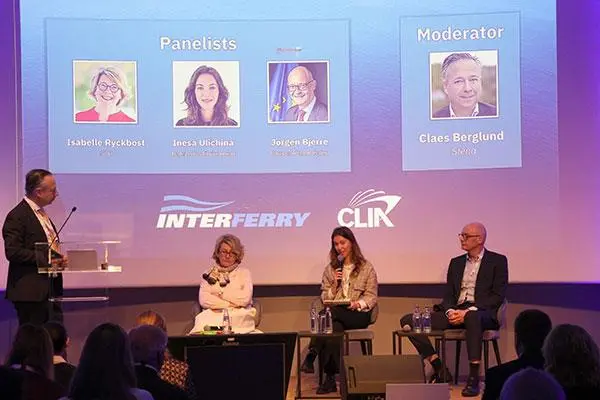
Moderated by Claes Berglund of Stena, the panel discussion featured Isabelle Ryckbost, secretary general of ESPO, Inesa Ulichina, sustainable shipping officer at Transport & Environment, and Jørgen Bjerre of the European Commission. The event attracted a broad range of policymakers and regulatory stakeholders from the European Parliament and Commission, as well as ferry and shipping executives.
Industry representatives highlighted that current funding models predominantly focus on Onshore Power Supply (OPS) connections at berth, without fully considering the requirement for ferries to charge their onboard batteries for propulsion during crossings. Executives argued for a more comprehensive approach, advocating for investment across the entire energy supply chain from power generation to port infrastructure, including upgrades to port electrical grids and energy networks.
Johan Roos, Interferry’s director of regulatory affairs, emphasised the importance of a wider perspective. “Investment in OPS infrastructure is key to the energy transition of European and worldwide ferry operations, supporting the adoption of battery technology and reducing reliance on limited resources of alternative fuels. Focusing only on the vessel in port misses the bigger picture. We need robust power supply to charge the propulsion batteries on the ships, so that we can tap into the full technological potential of OPS.”
He further underlined the need for a coherent energy infrastructure strategy. “The energy infrastructure in many industrialised countries requires a more integrated approach, including the role of electric transportation and shipping. Funding must be directed towards upgrading entire port infrastructures, and European Union member states have an opportunity to set a global benchmark in this regard.”
Interferry CEO Mike Corrigan reiterated the organisation’s commitment to sustainable shipping. “The ferry industry is at the forefront of developing sustainable propulsion solutions, as demonstrated by the numerous projects and investments led by our members. Shore power is a cornerstone of our industry’s decarbonisation efforts, and we must ensure that funding addresses the full scope of infrastructure needs. A holistic approach is essential to achieving meaningful carbon reductions.”
Related Articles
 ELECTRIFICATION AND BATTERY HYBRIDS
 ELECTRIFICATION AND BATTERY HYBRIDS
 ELECTRIFICATION AND BATTERY HYBRIDS