



Sleipnir connects to shore power at Rotterdam
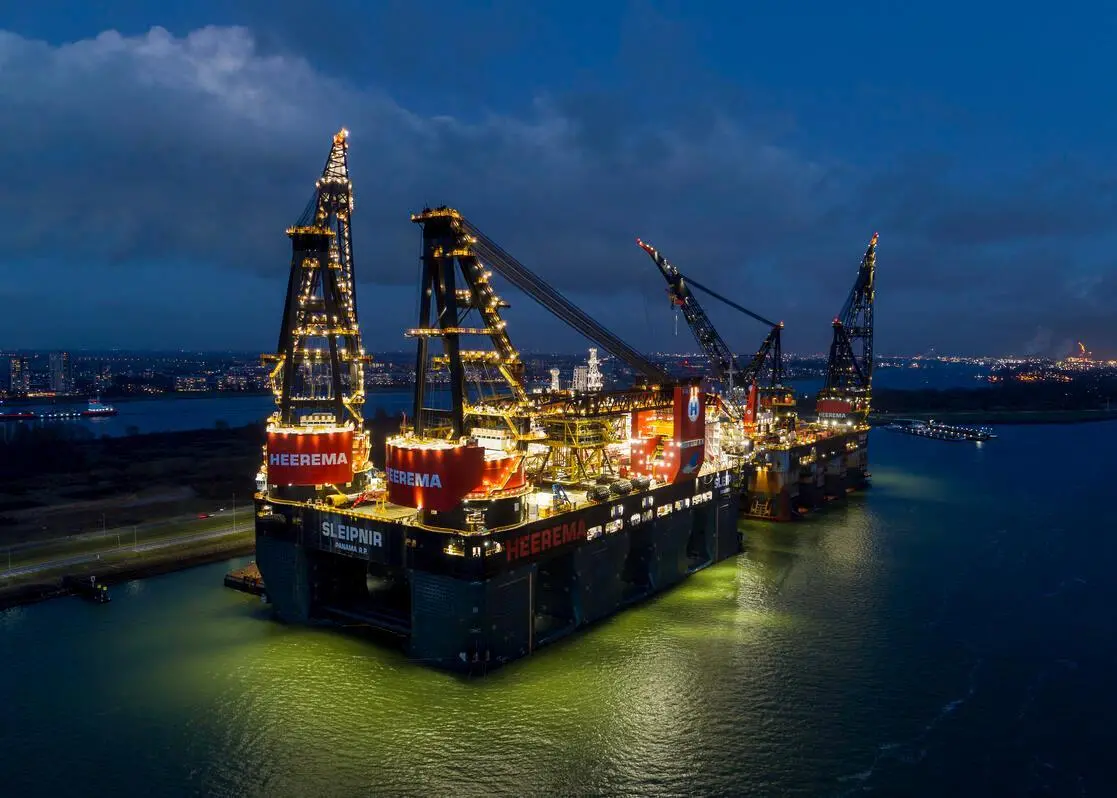
The connection built by Heerema, Eneco and the Port of Rotterdam Authority will supply Sleipnir and Thialf with sustainable energy that will originate from wind turbines located on the headland nearby or from another renewable source should it be required. The connection has a 20 MW capacity, which is the energy equivalent of around 15,000 homes, making it the largest shore power installation in Europe.
When Heerema’s vessels turn off their engines when moored in the port of Rotterdam for a standard repair and maintenance period there is a saving of 15,000 metric tons of CO2, 20 metric tons of particulate matter, five metric tons of sulphur and a significant amount of nitrogen– comparable to the annual emissions of 5,000 diesel cars.
Koos-Jan van Brouwershaven, Heerema’s CEO, said: “Each year from now to 2026 we have outlined our targeted emission reductions, and by plugging-in shore power we reduce our overall impact by 5%, equivalent to 5,000 diesel cars, which fulfills our first year’s target.”
Every year, about 30,000 ships visit the port of Rotterdam. By using shore power, vessels can switch off their diesel generators, saving up to 25,000 litres of diesel per day per ship, improving air quality and significantly reducing noise.
At least 90 percent of the offshore, ferries, cruise and Ro-Ro ships and container ships in Rotterdam must use shore power by 2030. This will save the emission of approximately 200,000 tons of CO2 and 2500 tons of nitrogen.
Rotterdam is currently offering free shore-based power at Maaskade for large inland vessels (CEMT class V and higher) that are willing to participate in a trial with shore-based power from a battery system installed by Skoon Energy. Since 2010, shore-based power boxes for inland shipping have been installed at about 60 locations in the centre of Rotterdam. These boxes can supply shore-based power to four to six inland vessels up to a maximum of 40 Ampere.
These days, some larger inland vessels (in CEMT class V and above) require more power. By placing the battery between the existing shore-based power box and the inland vessel, the battery will supply the extra required power up to a maximum of 63A when an inland vessel requires more than 40A. In such a case, without the battery in between, the fuse would blow and the inland vessel would be without power.
Related Articles
 ELECTRIFICATION AND BATTERY HYBRIDS
 ELECTRIFICATION AND BATTERY HYBRIDS
 ELECTRIFICATION AND BATTERY HYBRIDS