Spanish Charter For Former Honfleur
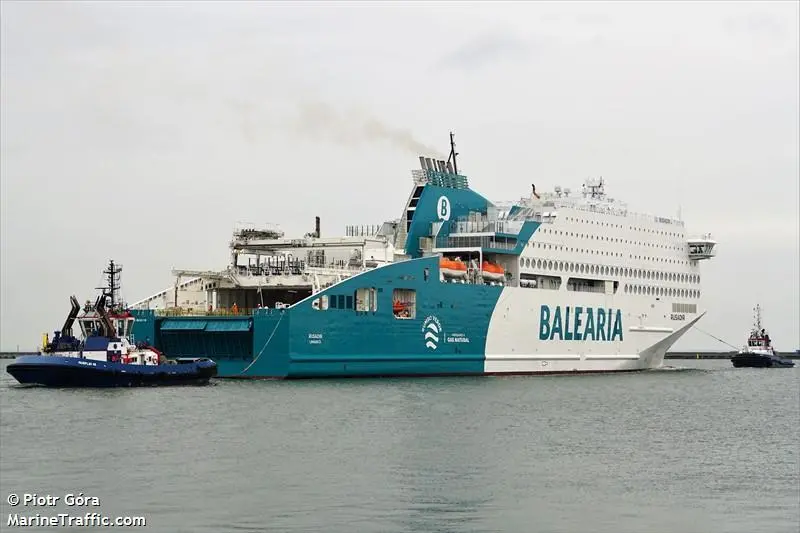
Having been specified with an LNG dual-fuel-electric power and propulsion system, the ferry had been set to break new technical ground on the cross-Channel market from 2019 onwards. However, after a succession of delays, Brittany Ferries had finally cancelled the contract with Flensburger Schiffbau-Gesellschaft (FSG) when the ship was half-built, following the German yard’s filing for insolvency in 2020.
Former FSG owner Siem Industries then had the hull towed to Norway for outfitting and finalisation by Fosen Yard at Rissa, with Siem intending to sell or charter the newbuild once completed. After a series of sea trials, the ship was handed over during May 2022 and transferred to a shipyard quay in Gdynia, where she remained. With Rusadir now due to arrive in Malaga on April 1 from Poland, the Balearia charter is about to take effect, and it is understood that there is a possibility of an eventual outright sale to the Spanish group.
The vessel provides capacity for 1,680 passengers and includes 261 cabins. The Lithuanian firm Aros Marine was engaged for 19 months’ work on the ship’s interiors between the vessel’s arrival at Fosen’s premises in November 2020 and formal delivery to Siem last May.
The ro-ro through-drive configuration, originally conceived to ensure expeditious turnarounds on Brittany Ferries’ busiest route linking Ouistreham (Caen) and Portsmouth, embraces some 2,600 linear metres. This provides for up to 550 cars plus 64 trailers or trucks, or for a full freight payload equating to some 130 trucks, or corresponding permutations.
The primary power for the dual-fuel electric propulsion solution is delivered by a multi-genset installation based on Wartsila 46DF-series machinery. The plant comprises three six-cylinder models and one eight-cylinder version of the wide-bore design, affording a combined, maximum output of nearly 30,000kW. Electrical energy is fed to a pair of electric propulsion motors acting on shaftlines turning two fixed-pitch propellers.
The arrangements allow for a range of operating modes according to scheduling requirements, enabling crossings at speeds up to 22 knots, or for slower or overnight transits with perhaps just two gensets fired-up. While running on cleaner-burning LNG ensures compliance with tougher emission rules and more exacting environmental goals, the nature of the multi-prime-mover, electrical power solution promises greater operating flexibility, redundancy and service dependability on all-year ferry passages.
LNG bunkering is achieved by way of a multi-step system. Trucks hauling ISO-standard tank units are driven from the quay directly on to the ship’s open aft deck, and onboard cranes then hoist the LNG tank containers into position in cells adjacent to a fixed storage tank at the rear of the superstructure. Four of the ISO ‘swap’ units feed the master tank supplying the gas to the engines. Empty tanktainers are hoisted back on the skeletal trailers, coupled to trucks and driven off the ferry for refilling ashore. The system means that the vessel can derive LNG bunkers from stations some distance away, rather than being reliant on ports with dedicated facilities.
Brittany Ferries’ initiative encapsulated by the Honfleur had not been without a measure of direct and indirect public funding support. The newbuild project had ranked as the first for which financing had been agreed under the Green Shipping Guarantee (GSG) programme, implemented by the European Investment Bank to promote low-carbon capital investments. Moreover, certain of the more innovative technical design and engineering aspects had been backed by the French Agency for Environment and Energy (ADEME).
MAIN PARTICULARS – Rusadir
| Length overall | 187.4m |
|---|---|
|
Length bp |
176.9m |
|
Breadth, moulded |
31.0m |
|
Depth |
9.6m |
|
Draught, maximum |
6.6m |
|
Gross tonnage |
43,130t |
|
Deadweight |
5,880t |
|
Decks |
11 |
|
Passenger capacity |
1,680 |
|
Passenger cabins |
261 |
|
Ro-ro capacity |
2,600 lane-m |
|
Vehicles |
130 trailers/trucks or 550 cars + 64 trailers/trucks |
|
Propulsion system |
LNG dual-fuel electric |
|
Main genset engines |
3 x Wartsila 6L46DF + 1 x Wartsila 8L46DF |
|
Main genset engine power |
29,770kW |
|
Speed, maximum |
22kts |
|
Class |
DNV |
|
Class notations |
1A Ferry(A), BWM(T), COMF(V-3), E0, Gas-fuelled LNG, LCS, MCDK, TMON |
|
Registry |
Limassol, Cyprus |