Stern foil improves efficiency
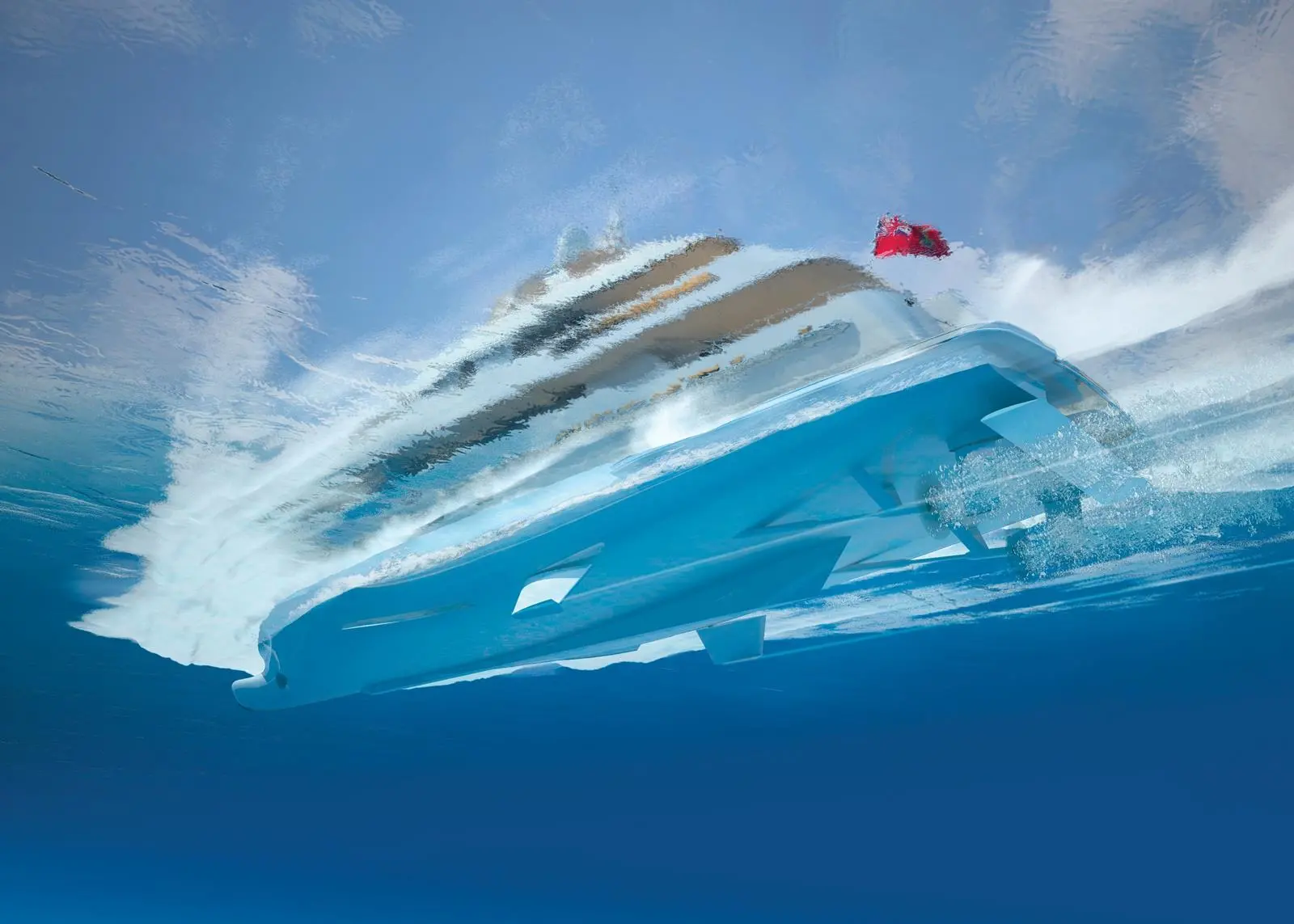
The patented stern foil system has been developed by Dutch naval architects Van Oossanen and is to be trialled at full scale, using a prototype system fitted to a 42m motor yacht to be built at the Heesen Shipyard.
Van Oossanen has invested over €1 million in developing the Hull Vane, including carrying out tank testing. The Hull Vane comprises a foil that is fitted across the stern of the hull, below the transom, and extending aft from the transom. It is designed for fitting to displacement hulls. The prototype 42m installation will be capable of speeds up to 16 knots when powered by a pair of 1,080kW MTU diesels.
The way in which the Hull Vane is reported to work is complex but as Piet van Oossanen commented: “It is a mix between the thrust developed by the vane itself and the reduction in the wave height of the transverse wave system behind the hull caused by the low pressure system on the top surface of the Hull Vane”. Despite the added wetted surface created by the Hull Vane the result is an increase in efficiency.
The test results and computer simulations have shown resistance reductions of up to 25%. The reduction increases with speed, the prototype installation being at the top end of speeds for displacement hulls of its size. Studies have been carried out on cargo ship hulls, which at the lower speeds involved suggested resistance reductions from 5% to 15%. Similar results have been found from studies based on large container ship hulls.
Although the main thrust of the development has been to reduce resistance, tank tests carried out in a simulated seaway showed that the Hull Vane helps reduce hull pitching movements. This is caused by the Vane creating an opposing thrust when the bow of the ship lifts to a wave, and also when the bow drops, thus leading to a reduction in pitching motion of up to 15%. This reduction in pitching, also helps improves hull efficiency and reduce stress.
Predictions for the 42m prototype show that the vessel will require just 643bhp to reach a cruising speed of 12 knots. The Hull Vane is located a precise distance below the hull at the stern where it is still located above the propellers, so that it does not affect the draught or any other feature of the hull design.