Tackling the engine speed optimisation challenge
The Dynamic AC (DAC) system is a direct descendant of the company’s Onboard DC Grid, launched last year as a way of enabling engine speed to be varied without compromising fuel efficiency on smaller (less than 20MW) hybrid electric vessels. That solution garnered a lot of attention after its first installation on a 93m platform supply vessel. But it was hard to apply to larger vessels.
“The DC grid was a solution to the problem that generators operating at variable speed, for efficient running, cannot be connected directly to the AC system at a fixed frequency of 50Hz or 60Hz,” explains Kanerva. “A DC-based system solves the problem for low voltage systems, but for medium voltage building a DC system has been difficult. And for high voltage systems the required circuit breakers are just not available.”
The DAC system is the company’s answer to that challenge. It enables operators of vessels with an electrical requirement of more than 20MW to optimise fuel consumption by adjusting the rotational speed of the main engines and allowing the system frequency to vary within a specified range. The main power system in the ship is specially engineered for variable frequency, while distribution for the auxiliary and hotel loads is provided by frequency converters or directly from the variable frequency system.
Kanerva believes the approach can offer benefits across several vessel types in the future, “wherever there is a wide and varied operational profile and changing power demands”. For the launch, ABB focused on cruise vessels. The company believes that a large vessel can reduce fuel costs by around 6% a year – or 2,000 tonnes of fuel annually – using the new configuration.
The particular operations of cruise vessels make them an interesting case study. Design of a new cruise ship is based on the routing between her home berth and intended ports of call. Itineraries may include longer transits to warmer waters and island hopping once there. As a result of these different types of voyage, the speed and power demands vary substantially.
Diesel-electric power plant conventionally runs at constant speed, with generators switched on or off to match power production with demand. A modern cruise ship typically accommodates four to six main engines, resulting in large changes in available power as the engines are engaged or disengaged. These big steps in power dictate preferable speed windows based on fuel economy. In turn, certain speed ranges should be avoided as they require the power plant to run at poor efficiency.
Routing and power plant design can be matched so that the speed profile leads to optimized fuel consumption. But a cruise ship very seldom does the same itinerary over her entire lifetime. Moving to another route might require completely different speed and power profile and further lead to unattractive fuel economy. This might even reduce the owner’s possibilities or willingness to relocate vessels.
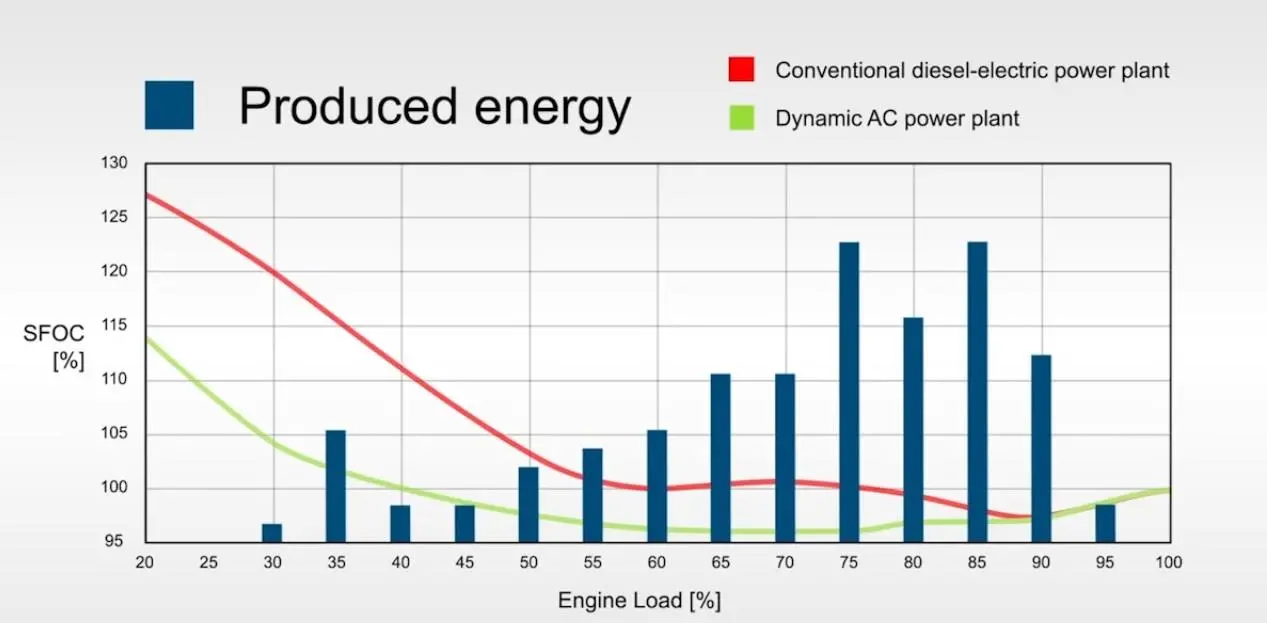
Between those generator steps, it is possible to improve the power generation efficiency by adjusting the rotational speed of the engines. Consumption is typically minimised at around 85% load, when the engine is operated at constant speed. However, adjusting the speed allows for finding the optimal consumption at all operating conditions.
The difference in SFOC at partial loads is due to more efficient combustion process, which reduces the fuel consumption as well as emissions. With liquefied natural gas (LNG) the difference may be even higher. Engine speed adjustment also reduces the methane slip in LNG powered engines.
Variable frequency power plant
The frequency of generators will naturally vary as the engine speed is adjusted. Converting the generated voltage into constant frequency by full-sized power converters would result in unreasonably high investment and space requirements. Utilizing DC network is also not feasible at the power range of large cruise vessels. Savings would still not justify the investment cost. Neither is the technology for medium voltage DC solutions yet mature to be utilized in commercial passenger vessels.
In the Dynamic AC (DAC) concept, the electrical system is similar to a conventional AC system but designed to operate at variable frequency. The generators in this concept are designed to operate within the specified frequency range. The magnetic circuit and windings need to be dimensioned with care, along with other electromagnetic equipment directly connected to the variable frequency network, including transformers and electrical motors.
Other equipment in the electrical network typically withstands variable frequency without notable changes in the design. Nevertheless, it is important to pay attention to the selectivity and protection functions so that they operate correctly through the entire frequency range. System integration, including short-circuit and harmonic analyses, also becomes more complex with variable system frequency. For example, variation of the reactances with the frequency must be considered.
There are numerous rather small consumers in a vessel that are supplied by the engine room switchboards or by the fire zone substations. This low voltage distribution is normally 400-690V with constant frequency of 50Hz or 60Hz. The DAC concept is flexible with respect to the low voltage distribution and provides a few different configurations that can be customized according to the needs and preferences of the ship’s owner.
The basic solution is to use centralized frequency converters (island converters) to feed constant frequency at desired value to the engine room and to the fire zone substations. This is quite straightforward approach and allows the downstream distribution network to remain unchanged.
A more optimised solution is to feed variable frequency directly to the substations and split the downstream network into groups of variable and constant frequency supplies. The island converters at the substation switchboards are much smaller than the centralized converters in the basic solution, as they supply only a portion of the loads with constant frequency. This configuration requires a little more engineering but enables reductions in both installed power and the size of frequency converters.
Optimising the system
In order to avoid unnecessary power conversions, the amount of consumers in the constant frequency network should be kept as low as possible. Several auxiliary and hotel loads are based on technology that tolerates variable supply frequency. This applies to motor drives, electronics, heating and lighting systems. Naturally the compatibility with variable frequency must always be confirmed, although nowadays many devices are already specified to operate on a wide range of supply voltage, for example 110–240V. With proper optimisation, substantial part of the load can be supplied directly by the variable frequency without having to install large amount of island converters onboard.
To achieve higher level of integration, it is possible to combine the island converters with motor drives in multi-drive configuration. This solution would reduce the size of island converters even more and in some cases make separate converters for single motors unnecessary.
The low voltage distribution is an architectural design task. The DAC concept with its basic configuration allows an easy approach of using traditional method. However, close co-operation between the main power plant manufacturer and distribution designer can result in significant reduction of cost and space, as the complete system is optimized instead of single components.
In addition to optimising fuel consumption at the planned operational profile, the DAC system means that the fuel savings are in place during the whole lifetime, even if the vessel is later relocated to other routes. This provides additional degrees of freedom and flexibility in ship design and route planning.
ABB notes that the best energy efficiency over the lifetime is achieved when the power management system is fully integrated with all the automation and advisory systems in the vessel. Having the information and operational history from different systems available, the optimisation functions can adapt to different route plans and operating conditions as well as account for the changes in the performance of machinery and the vessel in general.
As for additional cost, Kanerva explains that it is negligible compared to the savings to be made from fuel efficiencies. Some components – particularly the frequency converters needed to serve power consumers that require a fixed frequency – are more expensive for medium voltage systems.
As yet, the DAC has no active references, Kanerva notes, although the configuration has been tested in simulations. But following enquiries from ship owners when the Onboard DC Grid was created, ABB is convinced that there is demand for the solution.
Kanerva does not suggest what the next application beyond cruise vessels might be, although he admits that ice-breaking vessels do hold interest. “Those vessels naturally have a very varied power demand,” he notes. “We see a lot of potential for DAC in that area, where a wide operating profile is needed, including a significant peak while breaking ice.”
For now, the DAC system awaits its first installation and proof at sea. But with significant fuel savings promised, it is unlikely to be long before the first cruise customer takes advantage of ABB’s latest step towards more efficient electric propulsion.