Technology can only do so much
An often recounted cautionary tale regarding cargo hatch cover integrity is the potential for pounding waves to flood one or more cargo bays. A bulk carrier is then likely to sink like a stone. Kaivan Chinoy, principal marine surveyor for AVA Marine Group, recounts a more common scenario:
“We had loaded a cargo of bagged sugar from Port of Santos (Brazil) for discharging in the Algerian ports of Algiers and Annaba. En-route the vessel encountered extremely heavy weather off the Canary Islands and though the hatches of the vessel appeared to be in good condition but upon arrival at the anchorage in Algiers some cargo damage was noted in some of the forward holds. The master of course had issued a Note of Protest (Sea Protest) long before arrival but the receivers had the vessel arrested and the port authorities took away the captain’s passport and his discharge book.
“Once we came alongside the cargo receivers, during the survey, started to exaggerate the claim which was obviously unjustified and alleged that due to health and safety reasons they would not be able to sell the cargo in the market. The agents, customs and agriculture department all were involved in this and even though the P&I was able to issue a letter of undertaking to release the ship from arrest; the cargo was still in the holds. We could not go anywhere. We tried to persuade the receivers through intense negotiations to take delivery of the cargo and the club even agreed to negotiate a reasonable depreciation allowance, but in vain.”
It was two months before the vessel was finally released.
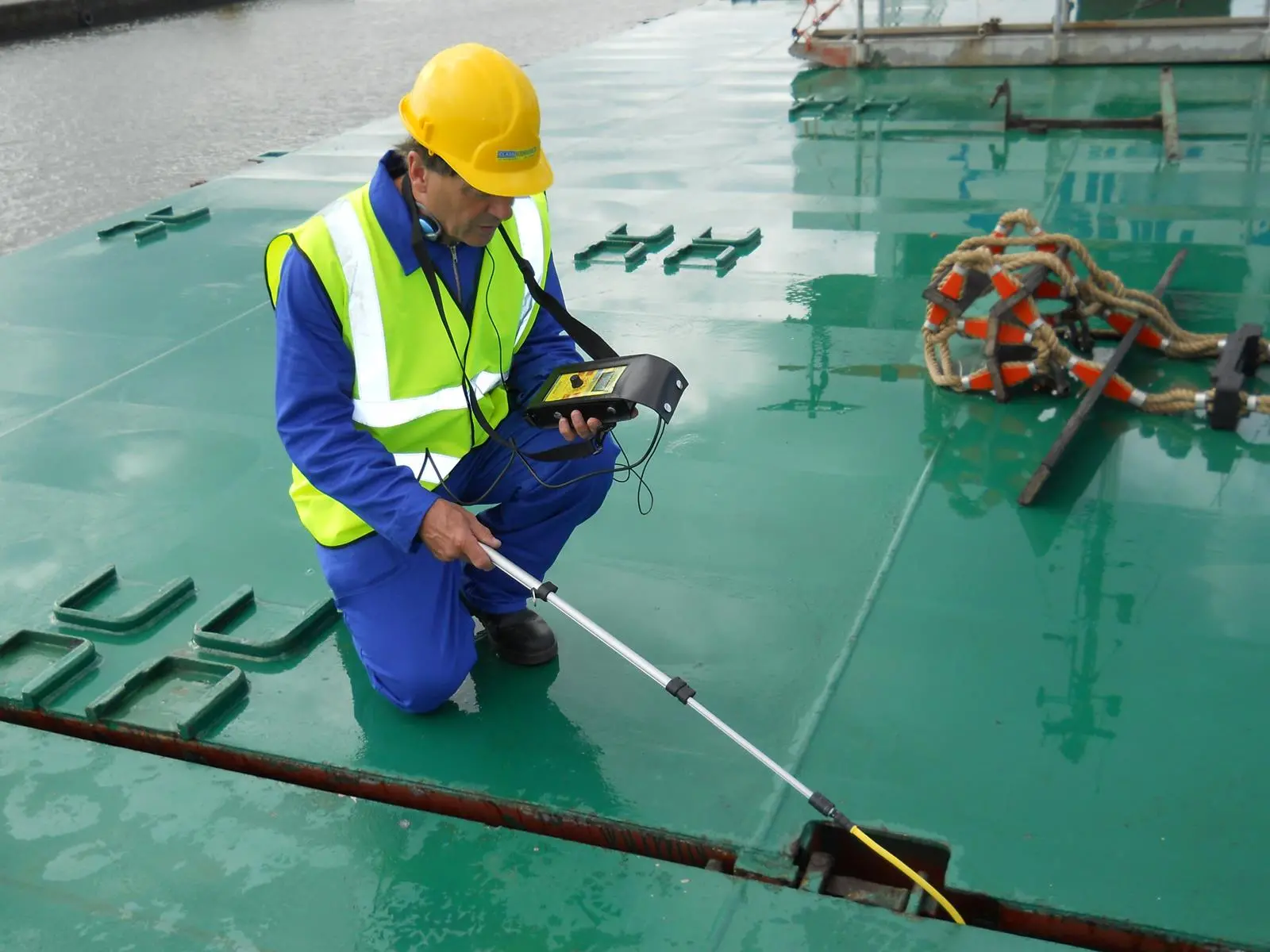
The most common problems that cause cargo damage relate to poor maintenance or defective hatch covers, says Chinoy. Ultrasonic testing (UT) is a much more reliable indicator of hatch cover performance in a dynamic seaway than chalk or hose tests and an excellent loss control tool. “This is why all our surveyors at AVA Marine Group prefer this method of leak detection. We advise shipowners to invest in a UT hatch detection kit (depending on the manufacturer it costs about $4,000 – 8,000 per kit) and one is usually enough per vessel.”
Under current legislation, hatch covers must be tested but there is currently no requirement that this testing is done using a UT device rather than hose or chalk tests, says Paul Luen, CEO of Martek Marine, manufacturer of the Hatchtite UT device. However, most P&I clubs will only accept ultrasonic testing. Although there are currently no regulatory changes planned in this area, Luen believes that legislation will eventually rule out the older methods of testing.
“Another area in which regulation may be strengthened or better-enforced could be the regularity and thoroughness of the checks themselves,” he says. “SOLAS regulation XII/7 does state that ‘Routines should be established to perform checks during the voyage’ and ‘Voyage checks should consist of an external examination of the closed hatch cover…in anticipation of, and after, heavy weather but in any event at least once a week, weather permitting.’ Unfortunately, hatch cover testing is one of the safety checks which can be neglected under time and workload pressure and shipowners and regulators must continue to work together to ensure this isn’t the case.”
When selecting a testing device, Luen advises shipowners to ensure that it is simple to use – even after a seafarer has been working a long shift. Every upgrade should make use of the latest technology. “Technology moves so quickly in this era that a five year old device might be many times less effective. Obviously, investing right initially will extend the life of your device and reduce your risk of any issues ever occurring.” The accuracy of the device is important as is type approval and the ability of the provider to offer spares and servicing.
As with all electronic equipment, the UT device should be stored somewhere with a relatively stable temperature and low moisture levels. Hatchtite comes with a strengthened leather case to protect it when not in use but, though robust, testing devices will always last considerably longer if they are cleaned and dried after each use and stored correctly. The device’s contacts should be lightly greased using WD40 or something similar to protect against corrosion.
Luen sees training as essential to ensure the crew can use the equipment effectively. “The device itself is very easy to use, it is simple enough to understand and use quickly. It is portable and light enough to be used by one person, but the confidence given to crew by just a little training will make them much more likely to use it regularly and correctly.” He also advises that some records are kept even if it is just a time sheet requiring one tick to show the test was carried out at recommended intervals or, even better, more frequently. This gives owners and operators some legal backing in the event of cargo-damaging water ingress, though this is of course very unlikely if testing is carried out as recommended. Ship vetting is also important. If shipowners can show the presence of an ultrasonic hatch cover testing device on board, this can contribute to a better vetting rating which could pay great dividends in the future.
Class Instrumentation produces the Cargo-Safe UT hatch cover tester. The tester is sold with a device that can be used to check the emitters, inspection microphones, extension arm and microphone emergency lead. It is calibrated at the factory and predicted to stay in calibration for five years. The constant output circuitry guarantees the ultrasonic output of the transmitter to be constant over the entire discharge cycle of the batteries, validated by the green flashing LEDs.
Class Instrumentation developed “A Master’s Guide to Ultrasonic Hatch Cover Testing’ published by the London P&I Club. The guide makes note of some considerations that are sometimes overlooked. If there are any obstructions, e.g. tween decks or centre girders, the strength of signal is likely to be reduced and the signal attenuated if it has had to bounce off many surfaces. Therefore if there are tween decks the transmitter should be placed on the tween deck hatch, and if there are centre girders, each side of the hold should be tested separately.
Peter Peltenburg, group director of Cargo Care Solutions, a company that provides roro equipment and maintenance solutions for hatch covers, says that a common issue for leakage on bulk carriers is the rubber packing, particularly end pieces and corners, and also the incorrect adjustment of cleats. Other damage often occurs on the hydraulic drive system or mechanical parts like hinges and wheels. He advises strict adherence to maintenance routines as a preventive action. “Failures often happen in places where the facilities are not as widely available as those offered in ports such as Shanghai, Singapore or Rotterdam. If you have to fly parts or people in, it costs a lot more money that if you would invest time and money on regular maintenance.” A timely pre-inspection prior to drydocking is also important to prevent last-minute arrangements that inflate part prices and transport costs.
Cargo Care Solutions has introduced the UltraPad solution, a polymer hatch cover bearing pad, predominantly for use in container ship hatches. It is claimed to have the lowest wear rate on the market and an improved locking pin arrangement. The head of the locking pin is designed to ensure better grip and better force distribution making mounting of the UltraPad faster than other pads. The thread is also larger to improve locking ability. Easy wear detection is provided by prefabricated grooves of 1mm, 2mm and 3mm deep located in positions where pads wear down most. UltraPad can be used as replacement for traditional Bronze Teflon support pads without any modifications needed.
MacGregor has developed a system for the optimised design of container ship cargo areas including such features as hatch covers and lashing system so that the cargo system that can carry a maximum amount of containerised cargo, taking into account the various container sizes and container weights and their positions on board in a flexible way. A well-designed system is more productive and efficient both from monetary and environmental point of view, says the company.
“Instead of calculating homogeneous maximum stack weights we now calculate a ship’s earnings based on actual cargo profiles,” says Kari Tirkkonen, MacGregor Senior Naval Architect. “With the right design parameters for a vessel and its cargo handling system, MacGregor can maximise the amount of cargo carried in relation to deadweight tonnage. The distribution of heavy and light containers, and subsequently total cargo weight, should therefore be one of the main factors when considering a new ship.”
“This approach is not just for newbuilding projects,” adds Mr Tirkkonen. “If a customer contacts us about a year before drydocking, we can produce a plan on how to enhance a vessel’s cargo system to better meet actual needs. We already have a number of enquiries from customers who are interested in employing the benefits of this new approach.”