The life of cranes, and how they learn
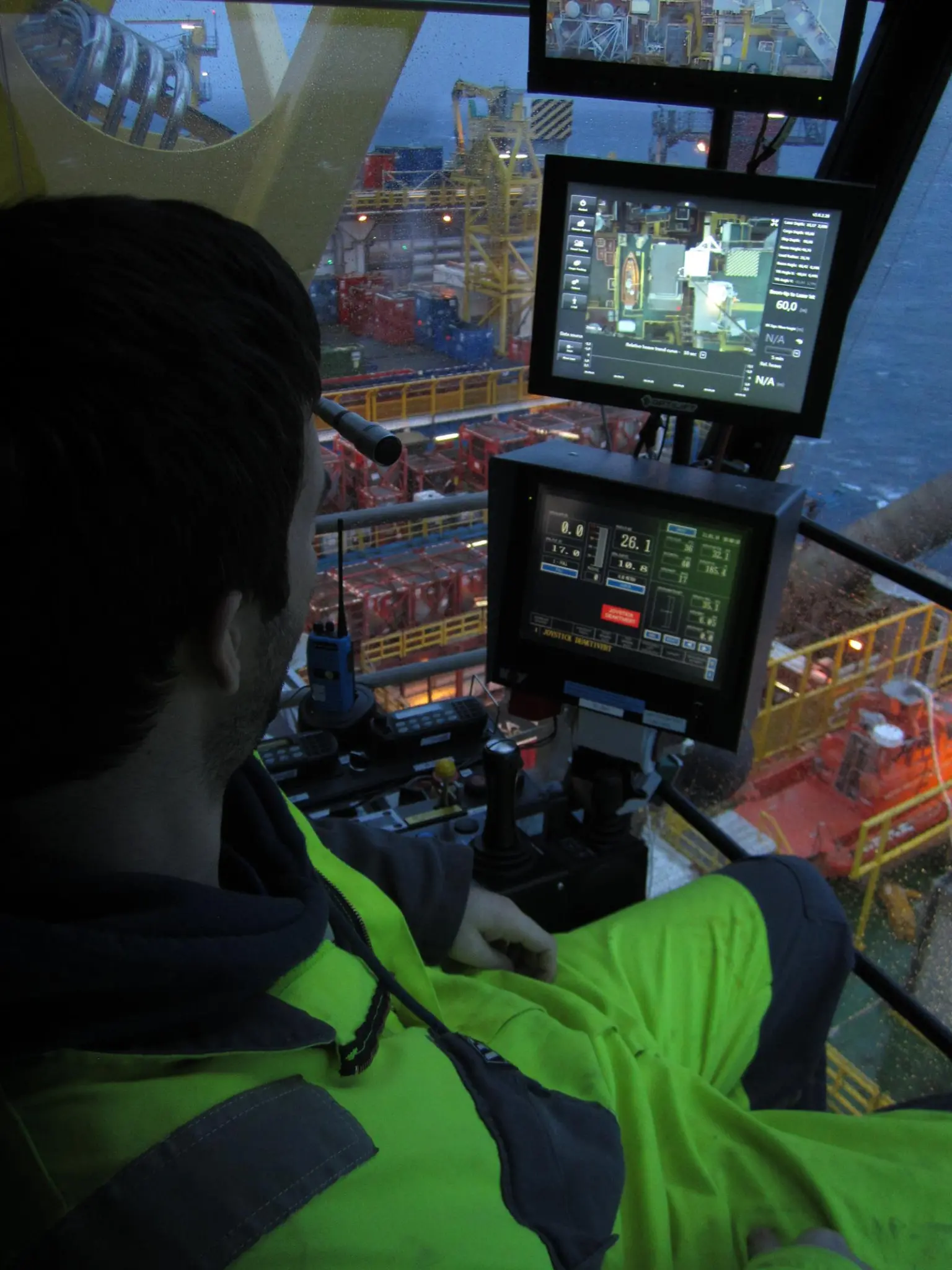
Both welded structures and machinery have a design lifetime that’s exhausted not by the calendar, but by work cycles, weighted against load. There are established calculations (and an ISO standard), but while analyses based on previous cycles are all well and good, utilisation patterns can change and since it’s onboard a ship, the foundation beneath the crane is inherently unstable, adding dynamic lifting moment.
Further, there’s an exponential increase in failure rate at the end of the design life, complicated by the fact that at this point, not all parts of the crane will age at the same rate. Notably, rotating machinery can develop issues faster than structural elements – and their failure curve will typically be that much steeper.
So what can AI and in particular, machine learning (ML) add to the mix?
Firstly, there’s been a change in thinking. While a 24/7 support service provide a go-to when things are amiss, “this is a reactive solution” says Joerg Peschke, MacGregor’s Director of Drives and Controls.
However, since MacGregor has delivered cargo and load handling equipment onboard thousands of ships, preventative maintenance and real-time indication of potential trouble is far more efficient for both the operator and the company.
There’s a problem. “You can’t rely on high density data transfer when a ship is out at sea,” Peschke points out. So, MacGregor started to evolve an edge computing solution which keeps the bulk of the data crunching onboard.
Here’s where things get interesting: there’s a lot of information to process spanning a wide number of sources, from load, pressure and heat sensors to those measuring position, speed and direction. And it doesn’t stop with multiple feeds from each element or component, these also need to be tied in with vessel motion and weather.
To try to wrap machinery health predictions up with written code would probably take decades especially given the wildcards of sea and air; further, it’s likely it would require massive updates to take advantage of new, more accurate information.
The other approach is to feed neural networks with labelled data sets. Then, those labels are applied to anything with similar characteristics – a numerically weighted response is applied to ‘train’ the brain. As a result, ML can be used to find hidden features and relationships, utilising them to flag up suspicious sensor patterns. Moreover, it can continue refining and updating these associations.
For MacGregor, ML’s ability to identify equipment malfunction is an “enabler”, says Peschke: it yields an ongoing condition-based check of the equipment, with real-time projections of the health and lifetime of both structural and power machinery, including hydraulic and electrical loads.
First and foremost, “continuous observation of the sensor data minimizes the risk of equipment breakdown during planned operations” he says, making sure that the weather windows can be fully utilised. Importantly, this works alongside other, more traditionally defined automation systems which have their own version of ‘smart’, being able to adjust the crane operation envelope to wind and waves and warn of inappropriate manoeuvres.
With the ML distilling data down to manageable packets for transmission (ship to shore transfer being developed in collaboration with Kongsberg Maritime), landside offices can benefit from a near real-time web-page view, updated with a lag of only a few seconds. As all parties access the same information at pretty much the same moment, crew, operation centres and third parties such as MacGregor can collaborate on the immediate situation.
“Monitoring and analysing crane performance data that is streamed directly from the vessels will enable us to make better-informed decisions and reduce problem solving time,” says Yannis Voulgaris of Load Line Marine, one of MacGregor’s OnWatch Scout service customers.
However, crew are still on the front line of lifting operations; with that in mind, there’s been a demand for a straightforward appearance to the interface. “We probably underestimated the work it would take to make it look simple,” admits Peschke “But we’ve managed it.” He explains the ‘old school graphs’ are still available, but an overview schematic shows ‘OK’ checkboxes at various points covering the main jib, knuckle jib, slew, tugger winch and so on. “If there’s a critical message or warning, you can push the resolve button, this will display the error description and step-by-step, explicit, actionable instructions with links”, he says: “You don’t have to search for anything – not even spares which you can push straight into the shopping basket.”
He adds, “Our customers are not left alone with the sensor data, but are given the conclusions.”
Onboard cranes have other uses for machine learning.
Although there’s rising interest from commercial shipping, Optilift has so far been focused on the offshore sector. Unmanned operations are already being realised in the field, underlines CTO Torbjørn Engedal, the goals being lower OPEX, better asset optimisation – though arguably, most significant is reduced risk. Despite safety initiatives, stubborn peaks keep appearing in onboard lifting incident figures: for example, a 2019 report from the Norwegian offshore industry revealed they’d doubled in just a couple of years.
But development faces a similar challenge to crane health monitoring: the bandwidth isn’t up to sustaining a high density, long distance connection. So again, there has to be some onboard intelligence to fill in the gaps.
This slots in nicely with the stepwise evolution toward full autonomy through ‘assistance’ modules: anti-pendulum, anti-sway and anti-collision are fairly familiar features by now, though ML adds further ‘recognition’ capabilities. However, Optilift has also developed a complete auto-lift and soft landing module. Watching the demo it seems unremarkable: the crane can pick up the load, position it over a deck and bring it down gently while compensating for heave. However, it’s a little more difficult than it appears, requiring the crane “to have eyes as well as a brain”, says Engedal. Both lift and landing are timed based on relative velocities and measured tension of the wire to make sure there’s no re-entry. The anti-collision automatically adapts to structural changes on the landing or pickup site, the cruise control follows the vessels horizontal movement during sea lifts and pauses for the right moment to act. Interestingly, it can also release a specially designed hook by itself, with no intervention.
But this iterative model toward autonomy requires it to work alongside humans. That’s caused hesitancy around adoption of many ‘intelligent’ systems although here, the potential benefits of ML are more obvious: instead of attempting to define an image by code, train the brain on hundreds of thousands of pictures till it can recognise crew and prevent the load crossing above, or worse, hitting them with cargo or hook.
But despite ML’s buzzword status, it needs to be enclosed within more traditional calculations “that will use physical laws or models to carry out sanity checks” on the outcomes explains Engedal. That’s because neural networks are “defined by what they’re fed” – not by the kind of logic a human would, or could, follow. Further, he adds you can’t go in and “tweak or fix the underlying cause of an ‘illogical’ decision”, so the biggest challenge remains “to select and tune the training data to cover all possible use-cases”.
This is very hard work. For example, MacGregor already had ten years of historical sensor data – terabytes of it – which was made available to project partners. Despite that, examination found “there were gaps”, admits Peschke. A crystal ball would have come in useful as “most of the information was process oriented – we had the error messages and conclusions, but years ago, we didn’t think it necessary to store background data, indications from the accelerometer or pressure sensors”, he explains. Therefore, an amount of back-working of the information was necessary.
But as Peschke explains, bringing ML onboard will likely trigger changes that go well beyond the machinery. There was a need for collaboration “as we realised we couldn’t do it all ourselves”, he says. Further, everyone has had to adapt to a new way of working: “Before, the sales team could lay out a well-known list of options,” he says: “Now, there’s more questions to be asked… and our clients are far more involved in development.”
Finally, ML has another layer of possible uses: it can also learn how sensor signals themselves degrade, warn, and potentially recalibrate to take up the slack. A technical paper by Yokogawa Electric reports ‘slight differences in patterns ….which indicate the deterioration in the performance of the sensor caused by changes in the electrode’ were spotted by ML. So, in future there should be less wondering if an anomaly is sensor failure – or if it’s really signalling the beginning of trouble.