Theres no turning a cargo ship into a battle ship
Companies that say they have unique insight or advanced analytics are mostly indulging in advanced marketing, says one maritime security expert. “After a lot of investigation, we’ve found the most effective non-lethal deterrent is a well aimed warning shot,” says another. However, there are those in the industry that continue to challenge this established wisdom, and as a result onboard anti-piracy technology is getting more sophisticated. The challenge is to see how far it can be taken on a cargo ship.
The US Government has spent millions of dollars developing sophisticated technologies for use on US warships to prevent successful attacks by terrorists and other adversaries. The systems are installed on most ships in the US fleet and are in operation on a daily basis. The Applied Research Laboratory (ARL) of The Pennsylvania State University is one of the primary research and development facilities for these technologies, and US-based company WatchStander obtained a license from them in 2001 to create a counter-piracy adaptation.
The WatchStander system uses a mast-mounted SIMRAD 4G radar scanner to detect all targets within effective range of a ship. At a distance of several kilometres it can pinpoint objects the size of a dolphin’s dorsal fin with clarity. The system’s software evaluates the behaviour of any objects and automatically determines which ones are probably pirates. If any observed vessel conforms to the known pattern of pirate pursuit behaviour, such as launching skiffs, circling or changing direction to set a course toward the defended ship, the master and crew will be alerted and an automated defensive response will follow immediately.
WatchStander therefore strips would be attackers of the element of surprise and employs an escalating range of non-lethal weapon combinations of increasing force to cause attacks to be broken off, says Ron Lichtman, executive vice president for Watchstander. Non-lethal countermeasures include: light cannons, sound cannons, laser cannons, pepper dispensing projectiles and evidence cameras. These devices are bridge-wing mounted on automatically-targeting, revolving 360° pan/tilt platforms.
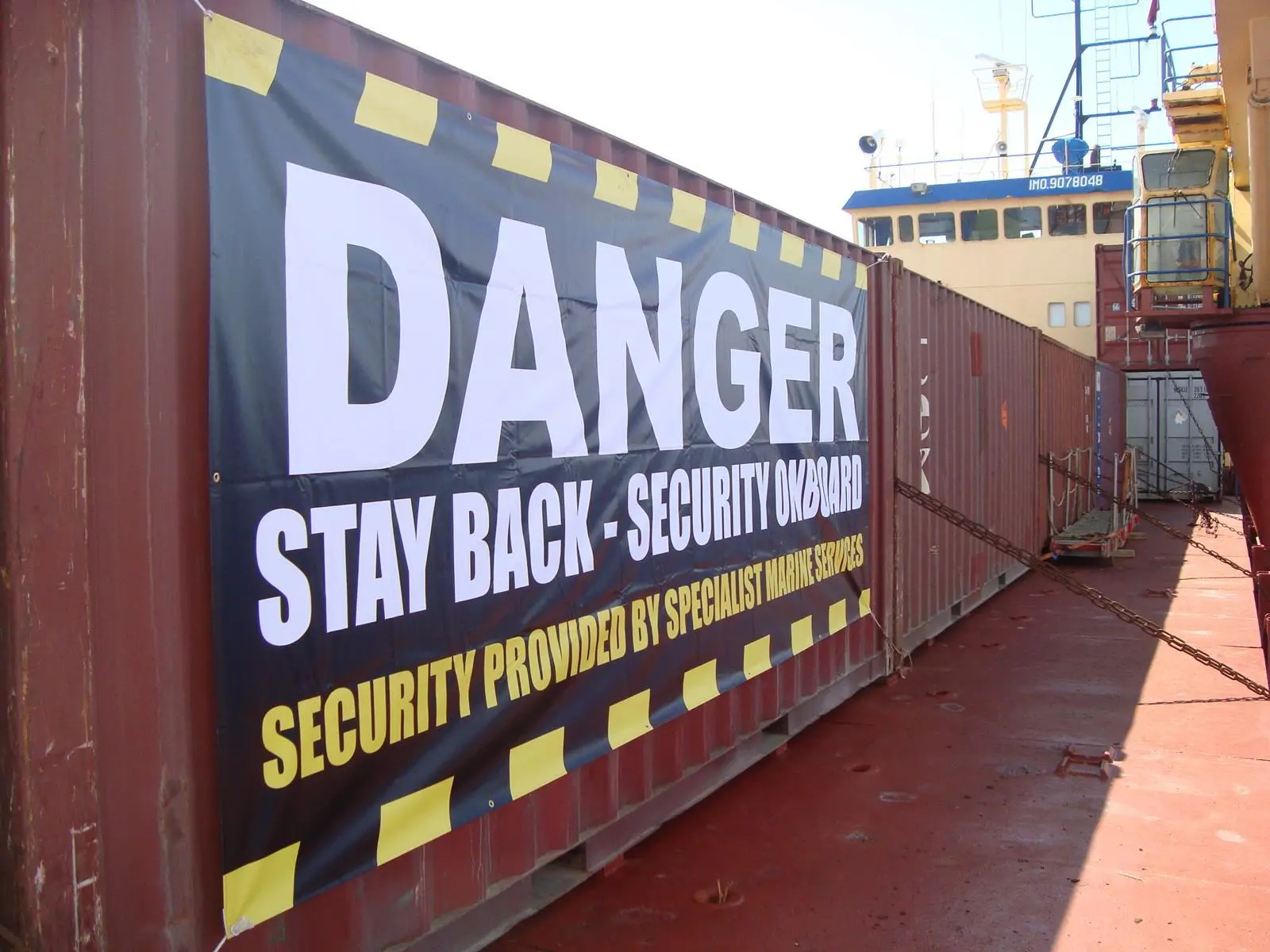
In another approach, US-based Specialist Marine Services has developed multiple Decoy and Diversion Drills which are designed to delay the immediate boarding of a target vessel by slowing down the attack and boarding process, providing the crew with sufficient time to calmly react and make their way to the designated secure area.
The Decoy and Diversion Drills are carried out from on-board the client vessel and can be deployed instantly. During an incident, on confirming that the vessel is under immediate attack, the on-board security team will launch a fake life raft. “This will distract the pirate crew who will immediately assume that the crew members trying to avoid being captured and taken hostage,” says Steven Platt, director of SMS. This tactic diverts the attention and focus onto the fake life raft buying the crew members valuable time to react. During this time the on-board security team will adopt strategic vantage points throughout the vessel.
“Due to our time spent involved with maritime security and anti-piracy we have learnt that many shipping companies, vessels and security companies set patterns. Such patterns are well known and are very familiar among active pirate crews,” says Mr Platt. “On boarding a target vessel, pirate crews instantly know where the crew members are hiding and immediately make their way to the citadel, shooting their way through any obstacles or barricades that may have been put in place. Once on board it is simply a matter of time before the pirate crew takes command and full control of the vessel with the crew members becoming hostages and left at the mercy of their angry captors.”
SMS has therefore also created an alternative to standard citadels by modifying a shipping container to become a secure room. When used in conjunction with the Decoy Life Raft Drill and other procedures, the secure room will ensure maximum security and safety. Mr Platt says this causes confusion among the pirate crew and disrupts their usual attack and boarding process. “By breaking these patterns, we are taking the initiative away from the pirates and by enforcing these countermeasures the advantage is lost as the hijackers become confused and disorientated on finding no life on board. Other effects of the countermeasures will leave the pirate crew disheartened along with having a mental effect.”
All countermeasures used are of a non-lethal nature and are intended to cause minimal harm or injury whilst having a positive effect of breaking down the attack and boarding phase. In most cases they find a security teams waiting for them and on noticing they have walked into a trap, they surrender. Otherwise, from past experiences a damaged or disabled ship is of no value to a pirate crew. This was demonstrated when the Danish vessel the M/V Leopard was attacked and the crew members were removed from the vessel. The same applies to an empty ship with no crew members seemingly present. It is considered to be worthless and after taking what they want, the pirate crew will move on to their next target, says Mr Platt.
Some solutions finding a place on board along with security teams aim at building on existing ship systems rather than introducing something entirely new. This is true for the anti-piracy add-on developed by Jeppesen. Bergen Risk Solutions has teamed up with Jeppesen to add a new feature to Jeppesen’s C-MAP OceanView route planning system: Jeppesen Piracy Update. The system integrates essential information on sea piracy worldwide with detailed chart, weather and tropical cyclone information.
The challenge in a crisis is usually not a lack of information but too much, says Arild Nodland, CEO of Bergens Risk Solutions. “So you need a system that can process and disseminate what is timely and relevant.” Nodland successfully used Jeppesen’s PiracyUpdate system during a pirate attack off Nigeria. PiracyUpdate reporting and maps were used to provide a common operating picture to lawyers, insurers, the owner, charterers and other parties during the hijacking of a Greek tanker. “PiracyUpdate quickly established an overview of the geographical situation,” said Nodland. “As PiracyUpdate is integrated with other Jeppesen products – electronic navigation charts, ports database, weather and wave forecasts – we were also able to quickly plan a safe and secure seaborne medical evacuation.”
Also building on existing onboard technology is the Nemesis 5000, a water canon based anti-piracy boarding deterrent system from Dasic Marine. This system is an unmanned development that uses existing vessel utilities to deter boarding by producing a constantly moving defensive curtain of high pressure water jets around a vessel. One user of the system, KOTC engineer and purchasing group team leader Nawaf Al-Shatti, says crew morale has been enhanced as well as their safety with the installation of the system across the company’s fleet. “The crew feels security and tranquillity sought by KOTC because this device reduces the piracy operations and its risks.”
Introducing anti-piracy design changes to newbuildings come at a cost, says Steven Jones, maritime director for Security Association for the Maritime Industry (SAMI). “Over the course of a vessel’s long trading life it could be exposed to many threats or perhaps very few. As such, and despite the requirements of the International Ship and Port Facility Security (ISPS) Code there is no one size fits all solution, or one which can remain relevant and effective.
“Given the complexity it seems that many naval architects or indeed shipyards have not seemingly seen the commercial imperative to fully tackle the issue. It also appears that many owners placing newbuild orders do not give security much consideration.” Despite their increasing involvement in naval vessels, the classification societies are not thought likely to set new design standards for vessels based on ISPS requirements, he says. It is also unlikely that IMO will force any design changes with regards to security.
The traditional approach of low freeboard, open railings, outside accommodation staircases and open decks is a boon to those posing a threat and makes it very difficult to lock vessels down. “It seems a rethink is needed,” says Mr Jones who believes that the most simple and cost-effective changes that can be introduced to allow cargo vessels to comply more easily with the ISPS Code are changes in the ergonomics and layout of vessels.
“The layout of access points and means of allowing crew to move around vessels have changed very little over the past half century. For all the changes internally, the ladders, alleyways and railings that form part of the accommodation of today’s vessels would be very familiar to mariners of past generations.
“It would seem that there is a time for a change and the latest generations of naval vessels may provide inspiration. The most modern naval vessels have accommodation and command bulkheads that extend outwards level with the bulwarks and the hull. This makes it far easier to control access, and to stop unlawful boarders. By doing the same for commercial vessels it could make it easier and safer to monitor, manage and respond to security breaches across a larger area.”
Other maritime security experts are looking beyond US naval developments to land-based possibilities being developed by the US military. One technology is the non-lethal directed-energy weapon called Active Denial System designed for area denial, perimeter security and crowd control. It is nicknamed the heat ray as it works by firing a high-powered beam of 95 GHz extremely high frequency waves at a target. It works like a microwave oven, exciting the water and fat molecules in the skin, and instantly heating them via dielectric heating “It caused every fibre of your body to want to be somewhere else,” said one test subject for the technology.
Whether or not this becomes a technology applied to the problem of piracy is uncertain but with the range of other measures being implemented, the need for something as relatively simple as closed-circuit TV has been emphasised again and again, both for during counter-piracy missions and for possible use in legal proceedings afterwards.