THERMAL INSULATION OF TURBOCHARGER TURBINE OFFERS POTENTIAL EMISSIONS REDUCTION
The research is focused on hybrid automotive drive trains, but increasingly stringent maritime emissions reduction goals mean the results could provide future research potential for marine engine systems. In both cases, the increasing efficiency of internal combustion engines could significantly lower exhaust gas temperatures.
“Heat flowing down the exhaust is wasted from an engine perspective,” said Dr Richard Burke, head of the research team at the Institute for Advanced Automotive Propulsion Systems at the University of Bath in the UK. “An insulated turbocharger reduces the heat losses so that the engine can run at a more efficient point whilst maintaining the same aftertreatment temperatures compared to a standard turbocharger.
“In automotive applications, the benefits of the increased inlet temperature are most notable during engine warm-up where the engine will be calibrated to take measures that ensure that the aftertreatment warms up relatively quickly. These measures include throttling the engine, injecting additional fuel or recirculating exhaust gases and all come at a cost of lower efficiency (higher fuel consumption) in order to generate the heat in the exhaust.”
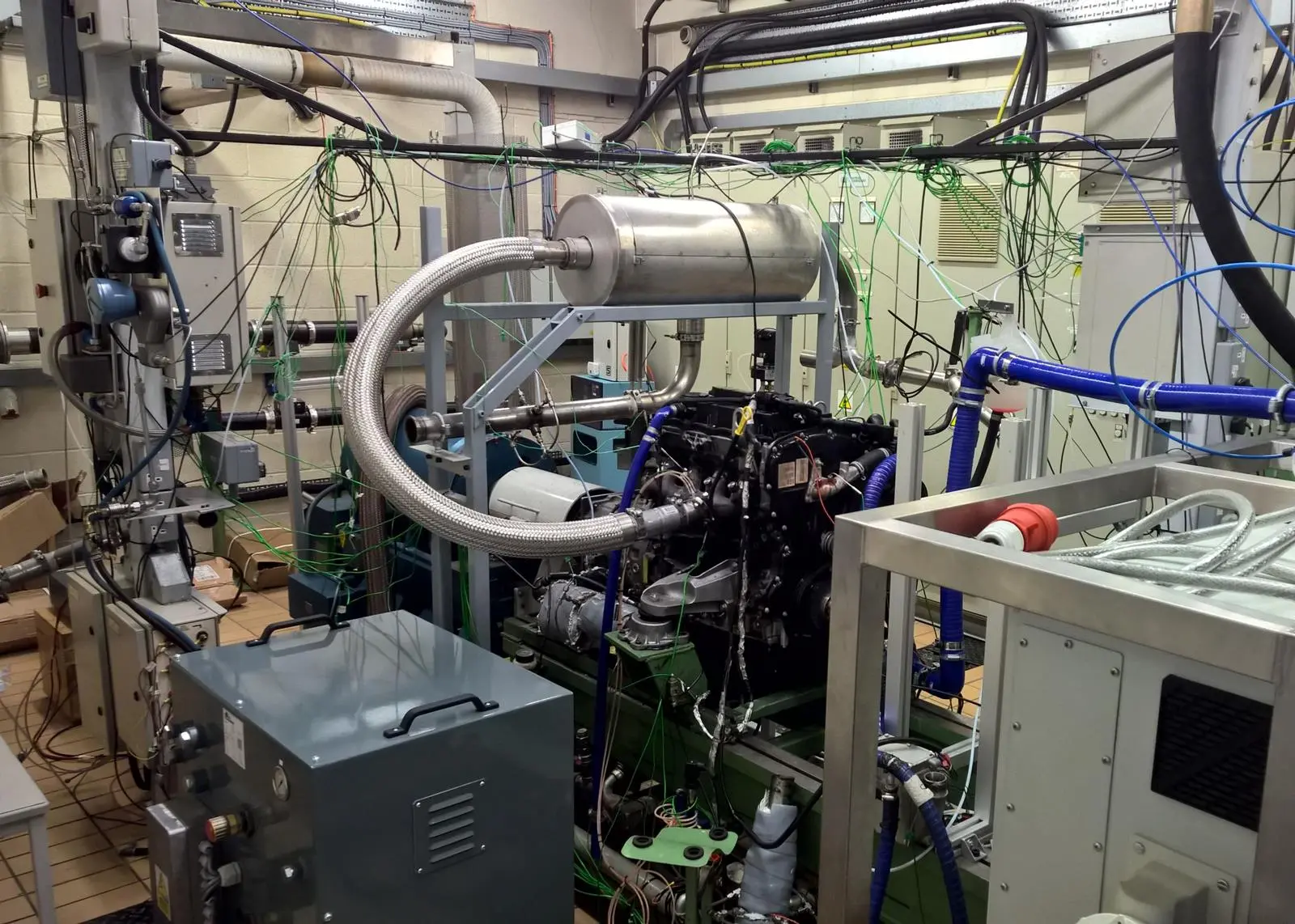
Burke and his research partners conducted an experimental study comparing a standard turbocharger to one with an inner insulated turbine housing. They tested a range of transient conditions applied to a 48V hybrid two-stage boosted diesel engine system on a test rig developed by the Institute for Advanced Automotive Propulsion Systems.
The insulation consisted of an inner and outer metal shell with silicate fibre in between. The addition of the insulation was checked to ensure that it did not affect the aerodynamic performance of the turbine. Using 3-D CFE/FEM simulation, it was predicted that external heat losses between the engine and the aftertreatment would be reduced by 70% compared to a standard, non-insulated turbocharger.
The results of the transient experiments demonstrated a 1-3% reduction in fuel consumption and NOx emissions, and a 2kRPM turbo speed benefit was achieved due to the increased turbine inner gas temperature.
The results were used to parameterise a 1-D, lumped capacitance model that could be used to predict the behaviour achieved in the lab. The model matched well for high temperature and low-frequency transient processes.
For NOx emissions, the benefit of the insulated turbocharger turbine is the increase in temperature, especially during warm-up, for the selective catalytic reduction (SCR) catalyst. In the hybrid vehicle system analysed, the electrically heated catalyst uses energy from the battery that could otherwise have been used to propel the vehicle. Using it to heat the catalyst to control emissions could be seen as a parasitic loss, but the insulated turbocharger turbine reduced the amount of heat required for this.
A reduction in fuel consumption could also be achieved during particulate filter regeneration which would therefore require less fuel to raise the temperature of the exhaust. “There will be a further benefit because the NOx aftertreatment can be more effective due to the increase in temperature, so some of the NOx mitigation measures such as late fuel injection and high exhaust gas recirculation rates that usually penalise fuel consumption and increase particulate emissions can be relaxed,” says Burke.
The turbocharger is a primary source of heat loss in the exhaust system, as it is cooled to protect the bearings. This means there is a significant heat loss inherent to the turbocharger that needs to be considered at a system level, says Burke. “Is there a chance that we are creating too much cooling to protect the bearings which is compromising the exhaust emissions? There could be some interesting thermal designs to consider here that try to block heat conduction into the bearing housing.”
He says the research results on the 48V hybrid system open up the potential for new electrical technologies that could reduce emissions including electrically-assisted boosting systems, electrically heated catalysts and electric thermal management systems. It also offers the potential for collecting energy via regenerative braking.
Burke’s research team is focussed on improving the modelling further such that the thermal insulation effects can be characterised accurately from minimal or no test work using higher order models. “This is essential as hardware decisions will be increasingly made based on simulations in the future. It is essential that we can generate suitable models that truly reflect the behaviour of the technology.”