Too many type approvals
Wärtsilä, one of around 60 companies offering ballast water treatment systems, voiced the industry’s relief when the US Coast Guard rules published in March reflected those of the IMO convention. “Clarification from the US represents a milestone,” said a company representative.
However, the regulatory situation in the industry is still far from being settled.
More than 25 systems have gained IMO type approval but manufacturers are now applying for acceptance by the US Coast Guard (USCG), because even though the US has confirmed it will initially accept a treatment standard aligned with the IMO convention, it does not accept the IMO type approval process and has defined more rigorous testing requirements.
California’s stricter discharge rules also still need to be considered. From California’s perspective, the industry is maturing. As of this year, there are now three systems deemed to be able to meet California standards in 100% of shipboard tests – those from manufacturers Mahle, Qingdao and Techcross. A fourth, Ecochlor, could be counted except that its testing did not include bacteria tests suited to California’s evaluation. The other 20-odd systems evaluated either did not have the test data or the results to meet California’s criteria.
There is still hope that California will fall into line with US federal rules, at least temporarily. The state needs to have some means of enforcement amidst current budget limitations, says Debra DiCianna, principal environmental engineer at Columbia Group’s Rosenblatt Ship Design Division in the US. The USCG will enforce federal rules but not state rules. Until the situation is resolved, Ms DiCianna advises shipowners to ask manufacturers to provide all their test data to confirm that they are at least getting close to meeting US requirements.
Severn Trent De Nora is one manufacturer that has made a formal submittal to the USCG for the designation of its Balpure system as an Alternate Management System (AMS). This means it will be accepted for use onboard vessels in US waters that need to comply with USCG rules for five years. This time period is designed to provide manufacturers with sufficient time to obtain full USCG approval. Any vessel using an AMS must still comply with the terms and conditions of the US Environmental Protection Agency Vessel General Permit (VGP) when operating in US waters which already contains discharge limits similar to the IMO standard.
“With the USCG final rule which entered into force in June 2012, the stalled IMO convention will only make the introduction of invasive species much worse and delay the inevitable,” says Jim McGillivray, Balpure general manager. “Continued delay to ratification of the ballast water convention will only result in the appearance of flagrant disregard of good environmental stewardship – thus making the entire market suffer negative public opinion. Even the early adopters will be lumped together with the truly guilty and reputation recovery will be all the more difficult.”
The marine industry must respond by adopting best practices, says Mr McGillivray. “Just waiting until there are no more choices and hoping the convention goes away will eventually backfire on the industry. As the USCG and EPA rules eclipse the IMO convention enforcement, the rest of the world will not be able to explain why such reasonable and effective actions were not taken when equipment to meet the standards was available.”
Wärtsilä agrees action is required. While a level of regulatory confusion appears to have been removed and with it an obstacle to shipowners going ahead and installing systems, reports the company, a second concern from shipowners – the capability of the technology – should also be abated. According to the company: “Such is the high standard of technology created as a result of intense land-based testing that each system undergoes in Europe and the US, followed by shipboard trials designed to ensure that the technologies work in practice as well as in theory, that ballast water treatment systems have effectively undergone more scrutiny than any other system fitted on international vessels. The tightest standards for approval and adherence to those standards are integral to the development of ballast water treatment solutions and this has been demonstrated over the last three years as two type approved systems were withdrawn from the market by their developers.”
Despite this, many shipowners are yet to commit. For example, fewer than 6% of Swedish ships have installed systems, and fewer than 2% of Hong Kong ships. Although the uptake by shipowners is slow, Severn Trent De Nora has sold 16 systems since receiving IMO type approval in July 2011. The sales include VLCCs, offshore barges, pipe-laying vessels and LNG carriers, and more orders are said to be imminent.
Other manufacturers are also announcing orders. RWO has an installation and order tally exceeding 70 for its CleanBallast system. Hyde Marine claims a first treatment system installation in 2000 on the cruise vessel Regal Princess and its 200th unit was purchased this year by Hyundai Mipo Dockyard for a Sovcomflot Novorossiysk Shipping Company tanker.
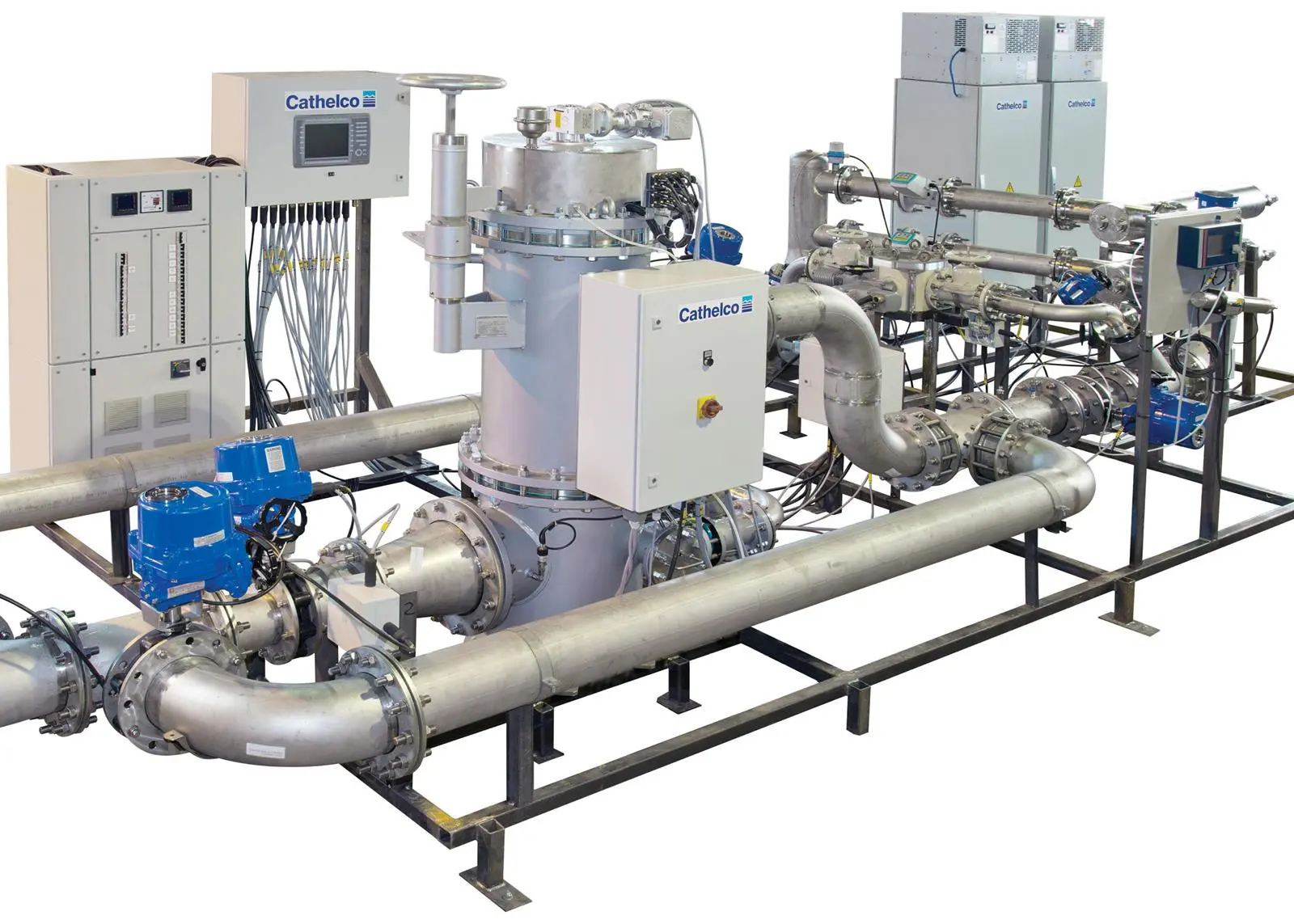
Despite the uncertainty surrounding equipment approvals, new systems continue to come through the IMO approval process. An example is the filter and UV systems from Shanghai Cyeco Environmental Technology and from Cathelco. New technology is also appearing. The Cathelco system has a helical flow that maximises the surface area of the water exposed to the UV lamps and a unique foam ball cleaning system ensures the surfaces of the quartz sleeves are kept clean. Another manufacturer, Samkun Century, has developed a plasma generator that increases UV dose delivery.
The International Chamber of Shipping (ICS) acknowledges that the IMO testing guidelines were drafted before it was known what sort of technologies would be developed. ICS believes that something like the ETV is required and that testing should specifically include fresh, brackish and marine waters. It should also consider the effect of water temperature, and standard test organisms should be specified for testing as it is believed that some testing facilities are selecting organism with a high natural mortality rate for convenience. Tests involving suspended solids should be more challenging than currently specified, and a range of flow rates should be tested to cover operations such as topping up ballast tanks and the fine adjustment of ballast en-route. The ability to gain type approval for flow rates of 6,000m³/hr for a system tested at 60m³/hr remains a concern.
Scalability was a key concern during the type approval of Severn Trent De Nora’s Balpure system which was granted by the German Administration BSH. Since the Balpure unit tested was a BP-500 tested at 200 – 250 m3/h, extensive computational fluid dynamics were used to prove the scale-up concepts and this also aided Severn Trent De Nora in the development of a low-differential pressure slip-stream injection mixer (US patent pending). “Ballast water treatment system vendors with equipment tested at land-based and shipboard installations with fractions of the type approval certificate capacities should be able to provide to owners the detailed results and methods to ensure their equipment offered actually will function in the same way as the smaller actually tested articles. This should be a key investigative effort by each owner buying a ballast water treatment system,” says Mr McGillivray of Severn Trent De Nora.
Optimarin estimates that so far only 5% of vessels that will be covered by the convention have had treatment systems ordered for them. This is despite repeated calls, mostly by those geared up to provide and install systems, that a bottleneck will impact on what shipowners will have to pay and potentially how they will be able to trade. The assumption, however, from a shipowner perspective is that when the convention is ratified, the 365 days after ratification and before entry into force will give the signatory parties time to establish a steering committee and agree at its first meeting to delay/adjust the phase-in schedule.