



Torghattan Nord’s H2 Ferries Mark Shipping’s New Dawn
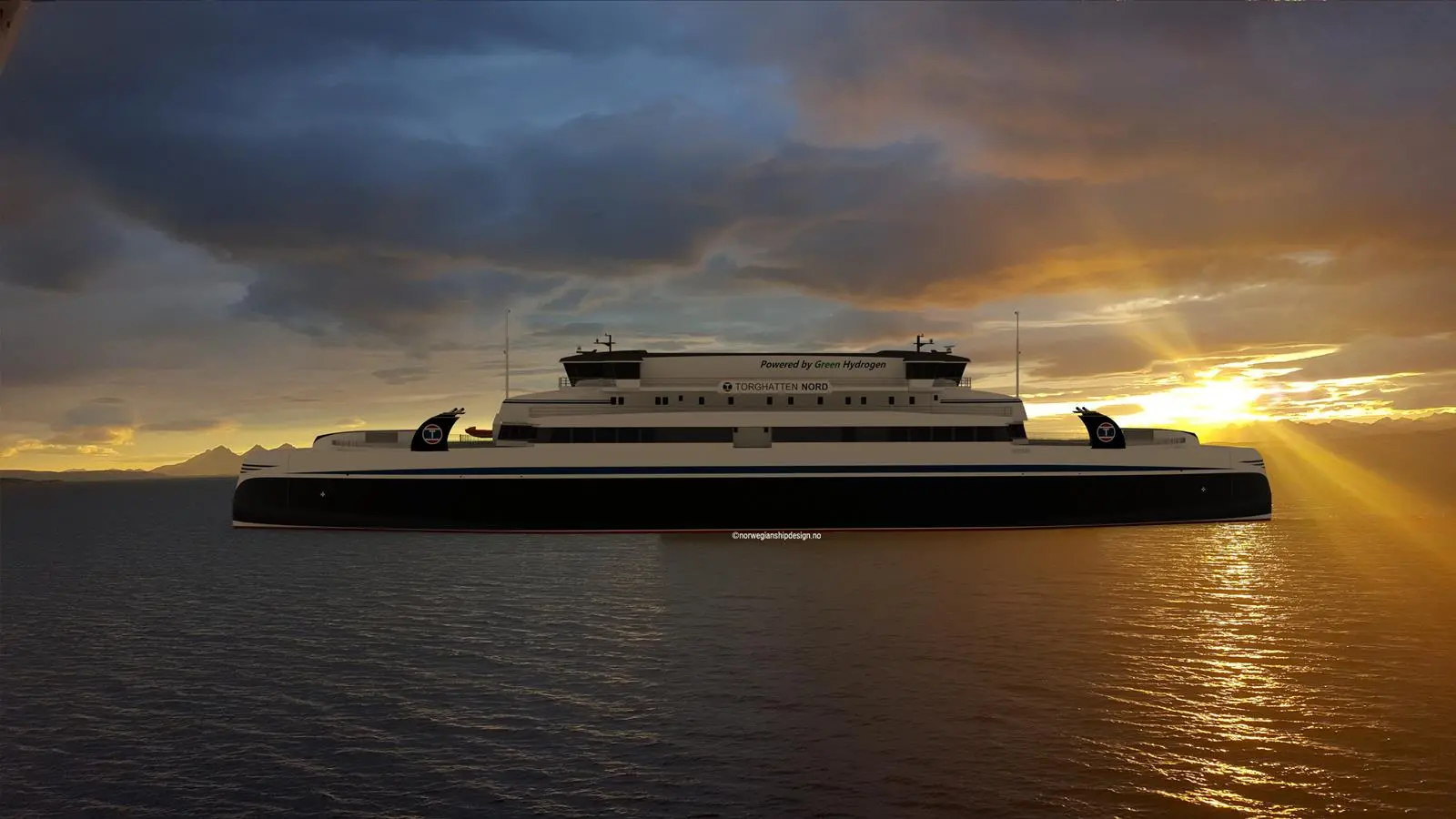
Scheduled for operation from late 2025 along the arctic waters of Norway’s Vestfjord, Torghatten Nord’s new 599 passenger, 120 car-carrying double enders will be powered by pair of ultra efficient Marine System 200 hydrogen fuel cell stacks designed to provide 6.4MW of gross power. They will be the largest hydrogen fuel cells put to sea to date.
And while there has been conjecture that a proton-exchange membrane (PEM)-type fuel cell may not be equipped to deal with the fluctuating electrical loads demanded of a modern ferry’s power consumers, manufacturer PoweCell says they are the most “dynamic fuel cells on the market”.
Traditionally, a PEM fuel cell is built around a stack of carbon compensates, which can shut down if system pressures drop. “But our stacks behave differently,” Johan Burgren, PowerCell,’s marine business manager, told The Motorship. “We have stainless steel stacks that can achieve high voltage across the pressure spectrum, at very low pressure, but also at high pressure.”
The H2 fuel cells will stabilise at about 1000 volts to provide constant, intermittent, or dynamic power to switchboards, responding to the power demand within seconds, just as a rotary engine would.
“We can go from 20% load to 100% load in seconds, without starving the stack or any degradation effects,” said Burgren. “When we were developing the core technology it was very important that the fuel cells could be installed without the need for a large battery bank or other type of load variation mitigation system.”
For redundancy four stacks will be sited in compartments designed high up in the ship, adjacent to compartments housing auxiliary equipment, such as filtration systems, colling pumps and so on.
“Gaseous hydrogen is very buoyant and quickly disperses upwards,” explained Gjermund Johannessen, the CEO and Managing Director of The Norwegian Ship Design Company. “All hydrogen installations are therefore arranged in a concentrated area on the uppermost deck, and no hydrogen is fed below deck. This is so any leaked gas will quickly disperse upwards and away from the vessel.”
The hydrogen is stored in ten shipping containers, each with capacity for eleven bottles of gas pressurised at 350 bar. Each container has its own tank connection space with several advanced safety features, including pressure reduction to 10bar, an advanced monitoring and fault detection system, and an emergency shut down system.
As each vessel is expected to operate two daily roundtrips on the 100km crossing, mostly in open ocean north of the polar circle, hydrogen storage capacity is about 5t, with daily bunkering from a dedicated but as yet unknown shoreside facility.
Designed for a service life of about 30,000 running hours, the fuel cell system itself consists of very few moving parts, mainly valves, transmitters, cooling water pumps and an electrically driven cathode compressor that provides pressurised air to the fuel cell stacks.
However, it is the stainless-steel stack – where the actual hydrogen to power conversion takes place – that could prove the costliest component to replace. Burgren estimates it to be around 40% to 50% of the cost of the complete fuel cell system. As such, PowerCell plans to keep a team of engineers onboard to “babysit the system for the first year or two after commissioning”, and to train ships’ crews on how best to operate and maintain the technology.
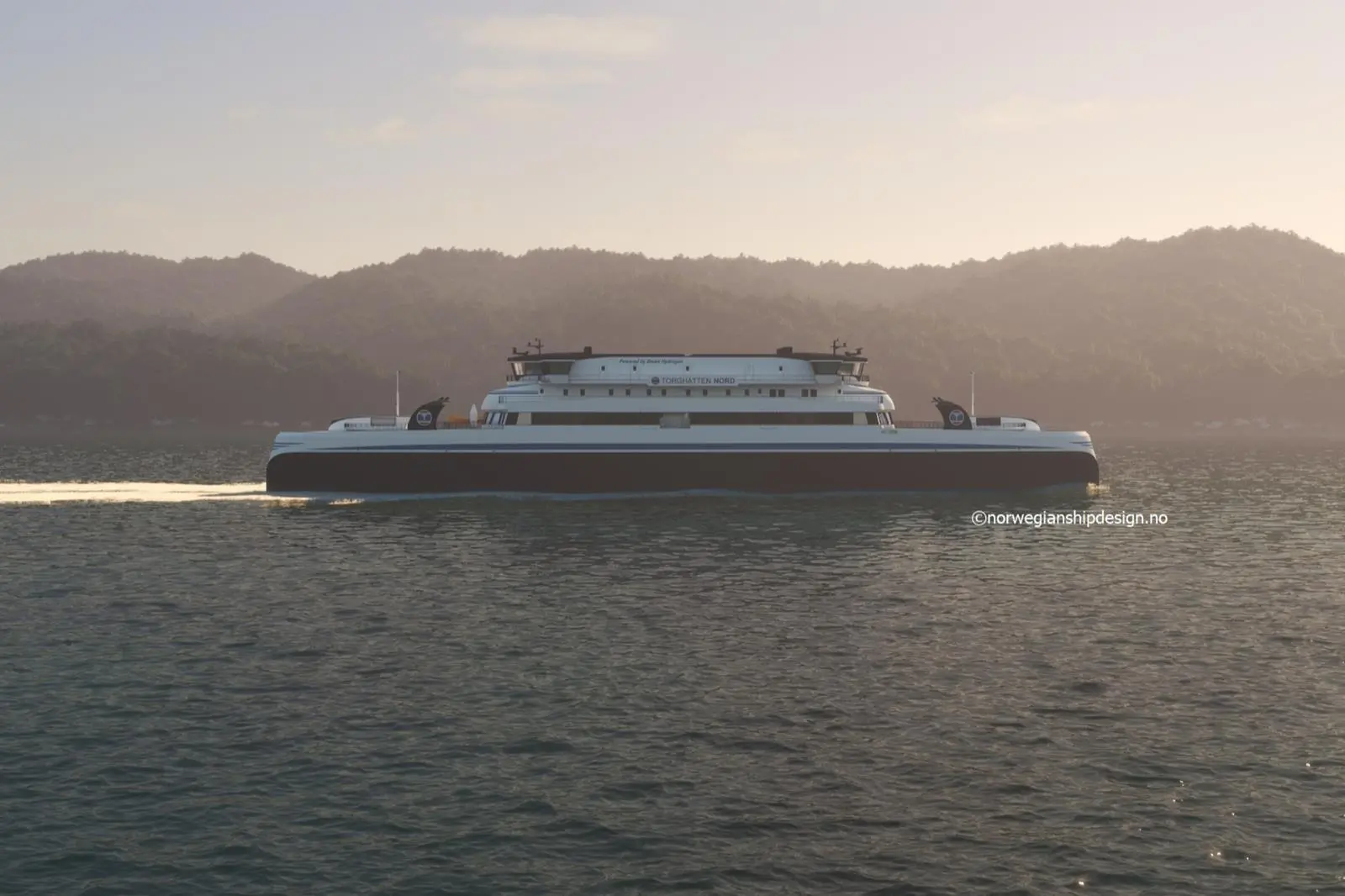
Aside from the zero-emission capability of a hydrogen-fuelled ship, The Norway Ship Design Company has designed the vessel’s hull form for optimal fuel efficiency, with each vessel propelled by two electrically driven azimuth thrusters, one at each end. Norway’s SEAM, as system integrator, will deliver propulsion control and safety systems.
While electric power to propulsion motors and other consumers is intended to be generated by the hydrogen fuelled fuel cells alone, there is a battery system designed into the powertrain for peak shaving or to deliver power in the event of fuel cell system failure. And should there be any hydrogen availability or battery charging issues, diesel gensets allow for normal vessel operation on 100% biodiesel. This level of redundancy was a pre-requisite specified by the charterer, the Norwegian Public Roads Administration (NPRA).
“These vessels are specially designed for the efficient and comfortable carriage of vehicles and passengers in exposed waters,” said Johannessen. “The ambitious tender for two hydrogen vessels for year-round trade in Vestfjord to the Lofoten Islands led us to design a completely new solution compared to what we know today as ‘ordinary’ ships.
“We evaluated a number of different solutions for the onboard hydrogen system and believe we have come up with a unique and safe concept that takes hydrogen’s properties into account. What we are developing now will set the standard for an entire class of passenger ships powered by hydrogen. Our philosophy is that new technology shall never compromise vessel safety, function and efficiency.”
Safety has been the core focus area of the design, with the general arrangements, system solutions, and equipment selection having been analysed, simulated and verified by fuel safety consultant HyeX Safety.
Unusually for what is ostensibly a Norwegian project, it was UK-based Classification Society Lloyd’s Register that granted the ferry operator approval in principle last August. This was based on a set of comprehensive and constructive HAZID risk assessments.
Michael North, Lloyd’s Register’s Commercial Manager, Norway and Iceland, said it was LR’s experience with vessels already in service that run partly on hydrogen, as well as Egil Ulvan Rederi’s zero-emission bulker With Orca, also designed by The Norwegian Ship Design Company and which won a Motorship award last year, that led to the organisation’s involvement in the project.
“These projects gave us an understanding of the risks and what to do with bringing hydrogen on as a fuel. In order to do that, in the absence of our hydrogen rules, which are in place and will be formally released in July, we used our risk-based certification process. Even when rules are in place, there will still be risk assessments made in relation to hydrogen installation due to the nature of these fuels and as the market is still evolving. We can’t be completely prescriptive.
“Hydrogen is an explosive substance, with a potential risk for fire and explosion. So, we reviewed the safety aspects of how hydrogen as a gas performs and behaves, as well as the ways to handle it. One of its benefits is that it is a very light molecule and as long as you have an unobstructed path, any hydrogen that leaks from the hydrogen spaces, will be able to go straight up into the atmosphere.”
LR’s HAZID evaluated the H2 system’s impact on ship safety to define what action need to be put in place. Through the appraisal and AiP certification process, the vessel is essentially approved for the building stage.
When delivered in October 2025, the new vessels will operate under a 15-year agreement with the NPRA, in a contract worth NOK 4.9 billion.
In a statement published on the NPRA website announcing the agreement, Torghatten Nord’s CEO Torkild Torkildsen, said: “We will be the first major buyer of hydrogen in Norway, thanks to the decisions of the NPRA and the Government’s climate policy. This also provides significant opportunities for the shipbuilding and ship equipment industry to take part in the development of competence in the field of using of hydrogen as an energy source.”
The new ferries will reduce CO2 emissions on the Vestfjord connection by 26,500 tonnes annually compared to the existing LNG-fuelled vessels on the route. This corresponds to the annual emissions from 13,000 diesel cars.
Shipbuilding contracts are thought imminent and likely to be with a Turkish yard, with CEMRE among the leading yards contending for the contract, The Motorship understands.
THE FUTURE OF H2 AS A MARINE FUEL.
While hydrogen is not going to work as an alternative fuel option for all vessels it has an important role in the short sea segment. For ferries on a longer crossing where batteries and shore power is not an option, compressed hydrogen is the optimal choice for and much less cost extensive than any other alternatives for zero emission.
“We applaud every zero-emission project and all the good work done by everybody involved. But unlike the liquid hydrogen (LH2)-operating Norled ferry Hydra, delivered in 2021, which can be regarded as a demonstration project, the compressed gaseous hydrogen approach Torghatten Nord has taken is the more energy efficient and commercially competitive option,” says Gjermund Johannessen, CEO and Managing Director, The Norwegian Ship Design Company.
“We have been involved in a large number of important zero emissions projects, but the choice of fuel for zero emission short sea shipping can be summarised thus: ‘Commercially you will, where technically possible, always choose full electric with power originating from shore. If full electric is not possible the next option is compressed hydrogen. Then if you have a very long travelling distance LH2 may be the next option. In some cases, the higher energy cost of LH2 can be reduced if the production of hydrogen is far away, adding a higher delivery cost of the less volume efficient compressed hydrogen’.”
Related Articles
 BATTERIES, SUPERCAPACITORS, FUEL CELLS AND OTHER ENERGY STORAGE TECHNOLOGY
 BATTERIES, SUPERCAPACITORS, FUEL CELLS AND OTHER ENERGY STORAGE TECHNOLOGY
 BATTERIES, SUPERCAPACITORS, FUEL CELLS AND OTHER ENERGY STORAGE TECHNOLOGY