Towards a gas-fuelled future
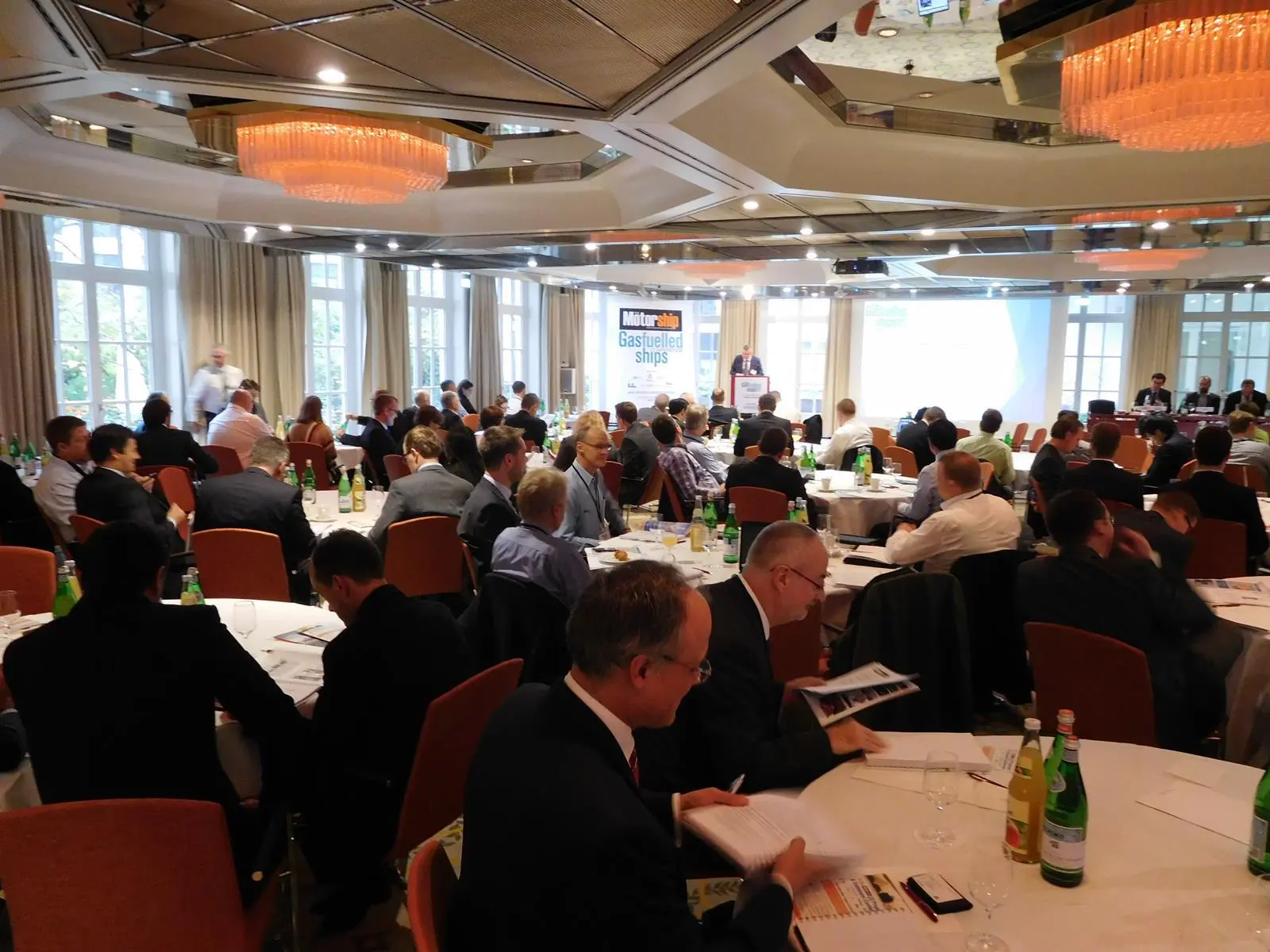
Held at the Grand Elysee Hotel in Hamburg on 9-11 November last year, the event welcomed a strong turnout of senior technical executives from across the spectrum of industry stakeholders. Given the pace of development over the past year – with milestones including the first North American LNG-fuelled containerships, the conclusion of the first phase of the IGF Code and the longest ever LNG-fuelled voyage – there was much to discuss.
Jörg Jahn, area manager Germany Central & South and principal surveyor, DNV GL, set the scene. The underlying economics of LNG as marine fuel are increasingly inescapable, he noted. “Oil reserves globally are lower than LNG reserves. We will see oil price go up in the next two to three years while LNG production will increase by 50%.”
While the certainty of that oil price prediction must be in question given subsequent developments in oil price, faith in the increasing availability of LNG – along with increasing emissions regulations – have created a strong order book for LNG-fueled vessels. While around 70 are in operation today (excluding gas carriers), 80 are on order, with the range of vessels ordered – from containerships to car carriers as well as ferries and bulkers – also a positive indicator.
Jahn, representing the event’s gold sponsor, also claimed the gold medal for first mention of the famous ‘chicken and egg’ situation of LNG as marine fuel. He noted that bunkering was already taking place in Hamburg and Rotterdam, with six bunker vessels on order. “Infrastructure is slowly developing and there will be a market for LNG as fuel,” he asserted. “The paradigm shift will take time.”
Persuasion role
A moment of inspiration followed from Georg Ehrmann, managing director of the German Maritime LNG Platform, as he explained how the group convinced Germany’s politicians to dedicate money to promoting the use of LNG – with the result that the country was the first to offer LNG bunkering in Europe. Permission management and standards in ports are critical, he says. For example in Hamburg, the firefighting service demands a safety distance of 250m when bunkering with LNG – a fact that caused much amusement in the hall. “You are the experts, you know this is wrong,” said Ehrmann. “You must convince the authorities in your countries.”
An examination of the regulatory framework for LNG bunkering in Europe was provided by the conference’s first keynote speaker, Agnieszka Zaplatka, seconded national expert/policy officer, European Commission – DG Mobility and Transport. The Commission is active in promoting LNG as a maritime fuel as part of moves towards the European goal of ‘energy union’, she said. She highlighted the Commission’s plan to develop an LNG storage strategy with reference to maritime transport. By November 2016, EU states must submit national policy frameworks towards the directive of zero emissions, zero waste in transport. And an imminent study on LNG will examine steps towards the completion of a EU framework for LNG fuelled shipping.
The role of the US as an emerging force in the global LNG market was discussed more than once over the two days. The first discussion came from Jason Smith, US Coast Guard (USCG) commander and detachment chief at the USCG Liquefied Gas Carrier National Center of Expertise. He presented the ambition and promise of the local LNG market in no uncertain terms: The US has the fifth largest natural gas reserves in the world, at 5% of global reserves; it is the world’s largest producer of natural gas (though little of it liquefied at the moment); yet it is the smallest of 17 exporters of LNG – although once all political hurdles are cleared, it expects to become one of the biggest.
Four US vessels operate on LNG at the moment, noted Smith – two from Tote, one from Crowley and one from Harvey Gulf. Six LNG bunkering facilities are available, some loaded by tank trucks. Talking about some of the regulatory hurdles in LNG bunkering licenses and vessel design requirements, Smith noted that regulation in the US tends to be either incident-driven, in which case high-level politicians drive the agenda, or project driven, in which case the reforms must be driven by innovative companies. Updating the USCG equivalency determinations for LNG fuelled systems to reflect the new IGF Code will enable further development, he said.
Living by the code
The IGF Code was the subject of further examination from Dr Gerd Wursig, business director LNG-fuelled ships, DNV GL. Few know the code like Wursig, who has been intimately involved in its development. The headline may be that the code is finished, he noted, referring to its adoption by the IMO General Assembly in June. It may be something of a camel – “a horse designed by committee” – but now we must live with it.
The code is already spurring further development, said Wursig. Fuel cell demonstrators are already being developed, with bunkering guidelines and recommended practices in place. Now Sweden takes chairmanship of the code’s further development, which will aim to establish standards for methanol and ethylene fuel. The completed code is a big boost to an important fuel segment, Wurdig concluded: “There are more orders for new LNG-fuelled vessels than there are scrubber orders for newbuilds.”
Lars Robert Pedersen, deputy secretary general, BIMCO – and alongside Martin Shaw, chairman, MOAMS, one of two excellent conference chairman – used his presentation to challenge some of the presumptions prevalent in environmental regulation. Chief among these was the negative impact that a non-holistic approach could cause. But whuile arguing for a more holistic approach, Pedersen was keen to acknowledge that there is little doubt that sulphur emissions for shipping could be harmful and must be curtailed. LNG is a proven and safe method for achieving this reduction.
But LNG is not the only available solution for curbing sulphur emissions, and an exploration of one of the alternatives was provided by Rob Drysdale, global field engineering & logistics manager, aviation & marine, ExxonMobil. The company has produced two new ‘hybrid fuels’ that allow shipowners to comply with Emission Control Areas. Drysdale also offered a refiner’s perspective on the feasibility of fuel availability needed to support a global 0.5% sulphur cap by 2020 – the subject of an IMO study that now looks set to be completed next year. “Refinery investment will have to be huge,” he observed.
Continuing the fuel market session, Ed Glossop, vice president of LNG markets EMEA and Asia, World Fuel Services Europe, updated delegates on current and predicted pricing structures for marine fuels. The anticipated spread of LNG prices (using Rotterdam prices) suggests that LNG will become competitive against HFO, but crucially also against MFO, by December 2021. LNG is also likely to be competitive against scrubber costs, and prices are likely to fall through demand aggregation, Glossop reported – encouraging news for early adopters.
Beyond Norway
Introducing a fascinating session, Jan Tellkamp, in charge of small scale LNG at DNV GL, spoke on LNG vessels in service and on the drawing board in Europe. By 2018 we will see 200 LNG-fuelled or LNG ready vessels in operation globally, he projected. Critically, LNG is “moving beyond Norway”: North America represents 27% of the global orderbook, and just 7% of those already in operation. Europe has 55% of the orderbook and 14% of those in operation. Norway, currently 77% of vessels, has 14% of the orderbook.
Sean Bond, director of global gas solutions, ABS presented the North American market perspective. He explored in detail how cheaper gas had incentivised the region to adopt LNG as fuel, with more than 20 gas-fuelled projects underway in the US and Canada.
A crucial session on finance for ship investments featured an interesting presentation from Roman Poersch, managing director, Wilhelm Borchet. Poersch examined two case studies of companies that the company had helped to find innovative European finance options. There is a lot of support available from the European Commission CEF initiative, said Poersch, or Horizon 2020 for innovative technology projects. The European Investment Bank is another interesting source. “Once successful in your CEF-T project, you will get up to 30% of costs back.” But such funds were nearly three times oversubscribed last year.
Exploring the finance models on the other side of the Atlantic, Pace Ralli, co-founder, Clean Marine Energy, explained how the company has approached finance when participating in WestPac’s LNG fuel projects. “There’s still a spread [between LNG and oil prices]. But regardless where you are, simple fact it’s better to be dual-fuel than single fuel,” said Ralli, highlighting the value proposition. But there are also conversion risks, he noted.
The afternoon session of the first day took a more detailed look at the technical challenges – rather than market factors – of operating on LNG. Nina Savijoki, sales manager and naval architect at Deltamarin discussed design implications that need to be taken into consideration when building (or converting) a ship to run on LNG, based on the company’s study six different vessels with several lay-outs.
Turbine potential
Jeremy Barnes, commercial marketing director, GE Marine, presented on the value of turbines as a propulsion choice compatible with LNG. He explained how gas turbines can meet IMO Tier III and EPA Tier 4 limits without after-exhaust treatment, giving valuable real estate back for cargo or passenger capacity. “We calculate you could carry around 7% more cargo on an 18,000teu containership [by switching from engines to turbines],” said Barnes. Turbines are also 80% lighter and 30% smaller than a comparable engine.
René Sejer Laursen, mechanical engineer, MAN Diesel & Turbo, shared the company’s first service experience of the dual-fuel ME-GI engine, operating on a converted vessel owned by Nakilat in Qatar. He also discussed commissioning of the first dual-fuel ME-GI engine installed in a new build vessel, for Tote.
Alex Vredeveldt, senior scientist and naval architect, structural dynamics, TNO, provided further insight into the positioning of LNG tanks on ships – challenging the standard B/5 rule for how far tanks must be from the ship’s sides. A crash experiment conducted by the company revealed that LNG fuel tanks maintain structural integrity in quite severe collisions. More work is needed, but early results suggest that prescriptive rules could be superseded and equally safe (or safer) designs demonstrated, said Vredeveldt.
The session was concluded by Ann Rigmor Nerheim, senior project engineer – LNG Fuel Systems, commercial marine, who discussed the tricky issue of sloshing – in particular how LNG fuel systems could be designed to be safe in all weather conditions.
The first day ended with Gas Fuelled Ships’ traditional ‘traffic lights’ session, with working groups discussing to what extent technical, regulatory and economic hurdles to the uptake of LNG as a marine fuel had been – or remained to be – overcome. As well as providing a useful forum for identifying challenges, the session has proved a fertile ground for setting the agenda of future editions of the Gas Fuelled Ships conference.
After the intense concentration of a full day of presentations and discussions, delegates were treated to a traditional Bavarian-style beer hall dinner, courtesy of long-standing dinner sponsor GE Marine. The Gröninger private brewery and restaurant provided the perfect ambience in which to unwind and reflect on the day with colleagues and partners.
Alternative fuels study
The second day commenced with a presentation from Christian Mørch, development engineer at MAN Diesel & Turbo, who presented findings from a joint research project with DNV GL titled ‘Cost and benefits of using alternative fuels’. Studying a variety of fuels used on a 75.000dwt tanker powered by a MAN B&W 6G60 engine (capable of installations burning all the fuels included in the study), the research showed that the cost of installing expensive LNG tanks meant that LNG had a very high initial cost. But the study – which compared dual-fuel operation with alternatives including liquid petroleum gas (LPG), methanol, methanol/HFO and ultra-low sulphur fuel oil – found that the lifecycle costs of LNG/HFO operation are competitive.
Hendrik Brinks, Principal Researcher, DNV GL, took up the presentation of the results. Methanol needs a discount of around 18% on MGO prices to have the same payback time as LNG. “It is not possible at the moment, but not entirely impossible in the future,” noted Brinks. LPG is comparable to LNG in payback time, but boasts less initial investment and a slightly shorter payback time. Despite high start-up investment, with LNG-fuelled vessels (as with LPG) cash flow is positive from the start. Ultra-low sulphur fuel oil breaks even after the global sulphur cap is introduced.
Joe Powers from Clean Marine Energy, a close partner of WestPac Midstream, talked about WestPac’s plans to build low-emission fuelling infrastructure in North America. WestPac’s project mix in North America and the Caribbean includes primarily small-scale liquefaction and marine terminals. The two projects most developed are in Jacksonville and the Pacific North West, driven by Tote’s Marlin class vessels serving the Jacksonville to Puerto Rico route.
Henning Pewe from DNV GL followed, discussing the challenges of simultaneous operations – loading cargo while bunkering LNG. A semi-enclosed bunker manifold area might offer advantages for simultaneous operations, said Pewe. Transfer arrangements – hoses and rigid arms – will also make a big difference. A case study of simultaneous operations on the ferry Viking Grace exemplified best practice. The ferry is bunkered in a busy area in central Stockholm. The operation requires a security zone and safety zone around bunkering, with a hazard zone around sources of release.
Methanol moves
In the second half of the session, Per Stefenson, technical division, Stena Rederi and Toni Stojcevski, project manager, methanol adaptation, Wärtsilä Sweden, discussed how the companies had cooperated to convert the ro-pax ferry Stena Germanica to burn methanol. Methanol can be made from almost anything with a carbon atom in it, said Stefenson, making it a perfect bridging technology whilst looking for renewable energy sources.
Carlo Contessi, general manager of applications developments at Wärtsilä Italia, explained how the company had adapted engines to provide for ethane fuel on a multi-gas carrier. Evergas plans to build eight of the 27,500m3 vessels. Ethane is heavier than methane, and even heavier than air, meaning there is a risk of it staying at the bottom of the tank. Combustion, efficiency and energy content are the three main challenges the project had to target. The short process, from class discussions in November 2014 to final approval in 2015, was another big challenge. 3.5-5MW a day less power is needed using ethane than methanol for the vessel in question, with a saving of around €100,000 a year.
After lunch Martial Claudepierre, LNG business development manager, Bureau Veritas and Laurent Rambaud, vice president business development retail LNG, Engie, took the stage to discuss te first LNG bunker vessel dual-fuel build for operation in SECAs. In 2014 Engie, NYK Lines and Mitsubishi signed a framework agreement to develop LNG bunker supply. Hanjin Heavy Industries became the first company to order a bunkering vessel, while UECC has signed a supply contract to their two new vessels from the end of 2016, said Rambaud.
The joint venture’s Zeebrugge LNG bunker facility will open, serving UECC, in the fourth quarter next year. Meanwhile four ports including Amsterdam, Rotterdam, Zeebrugge and Hamburg are participating in a project to harmonise port regulations on LNG bunkering.
Max Kommorowski, director LNG hybrid, Becker Marine Systems, talked about the first season’s experience of operating Becker’ innovative LNG-powered cold-ironing barge. Becker is now in discussion with ports across Europe to bring its cold ironing barge to their facilities. “Of course this will be a bridging solution,” said Kommorowski. “Ships already built will operate for the next 25 years though, and this barge has the opportunity to serve vessels for that length of time.”
Carnival orders
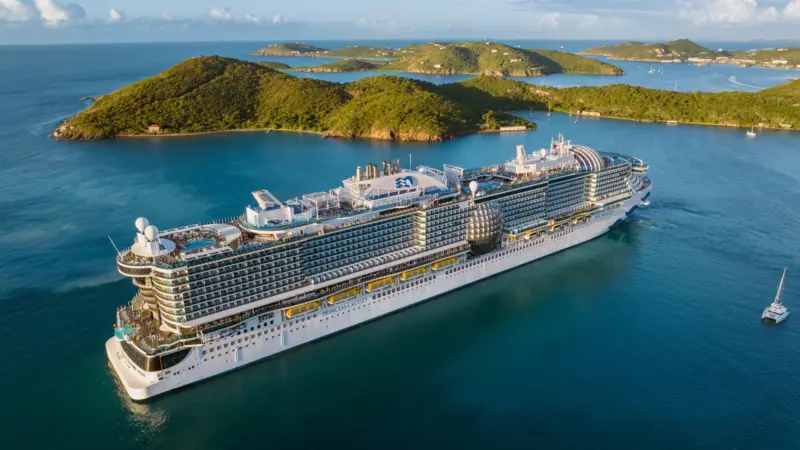
Starting the next session Tom Strang, senior vice president maritime affairs, Carnival Corporation discussed why the company is looking closely at LNG as marine fuel. Carnival Corporation, which incorporates the AIDA and Costa Cruises brands, has ordered four new LNG fuelled vessels from Meyer Werft in 2015.
“We keep cruiseships within our fleet for up to 30 years,” said Strang. “We need to find a way of future-proofing them. And if we make a decision today we could be talking about up to 20 vessels in the class… Do we expect the current limits on SOx, NOx to be the end of the journey? What’s going to happen in 2020? And if we want to go with one global gas supplier, how is that going to work with ports that are trying to develop a concessionaire model [for their bunkering operations]?”
Strang was emphatic on Carnival’s role, via its four LNG-fuelled newbuilds, in encouraging the growth of the fuel. “A tipping point was reached,” he explained. “We saw enough evidence to move into LNG. There are challenges, but that is where we also see opportunity. We could have gone HFO plus scrubbers but we believe in LNG. For these types of ships we are certain that this is an option that is right, and we are certain that there will be LNG available.”
Peter Keller, executive vice president of Tote, joined the event via a satellite link from the US to talk about the company’s initiatives in LNG as a marine fuel. An in-depth report on that insightful presentation – which gave an overview of Tote’s efforts to develop LNG bunkering, supply and vessels – can be found in the December 2015 issue of The Motorship and on our website.
The conference concluded with a ship operator panel featuring Captain Wolfram Guntermann, director environmental fleet management, Hapag-Lloyd; Niels Bjorn Mortensen of Maersk Maritime Technology; Per Stefenson, of Stena Rederi; and Tom Strang. The consensus of the panel was that with the forthcoming 2020 regulations, uncertainty about the availability of fuels and little transparency on non-compliance with emissions regulation, there are huge challenges ahead for all. The panel agreed that sanctions need to be effective, proportionate and persuasive but above all, there needs to be clarity and affordable solutions to create a level playing field. Mortensen suggested that the ultimate solution would be a ‘continuous emission monitoring system’ to ensure complete compliance within and outside of ECAs.
On the final day of the event, delegates were treated to two technical visits highlighting the diversity of low-flashpoint fuels already in use in the marine sector. A tour of the Stena Germanica offered an opportunity to learn about the vessel’s ground breaking use of methanol fuel in one main engine – with plans to convert the remaining three engines to run on methanol early this year. And a visit to Becker’s LNG-powered barge Hummel revealed how the vessels has been serving cruiseships at Hamburg with a clean source of electrical power since May 2015.