



Ulstein applies hybrid approach to trawler newbuilding
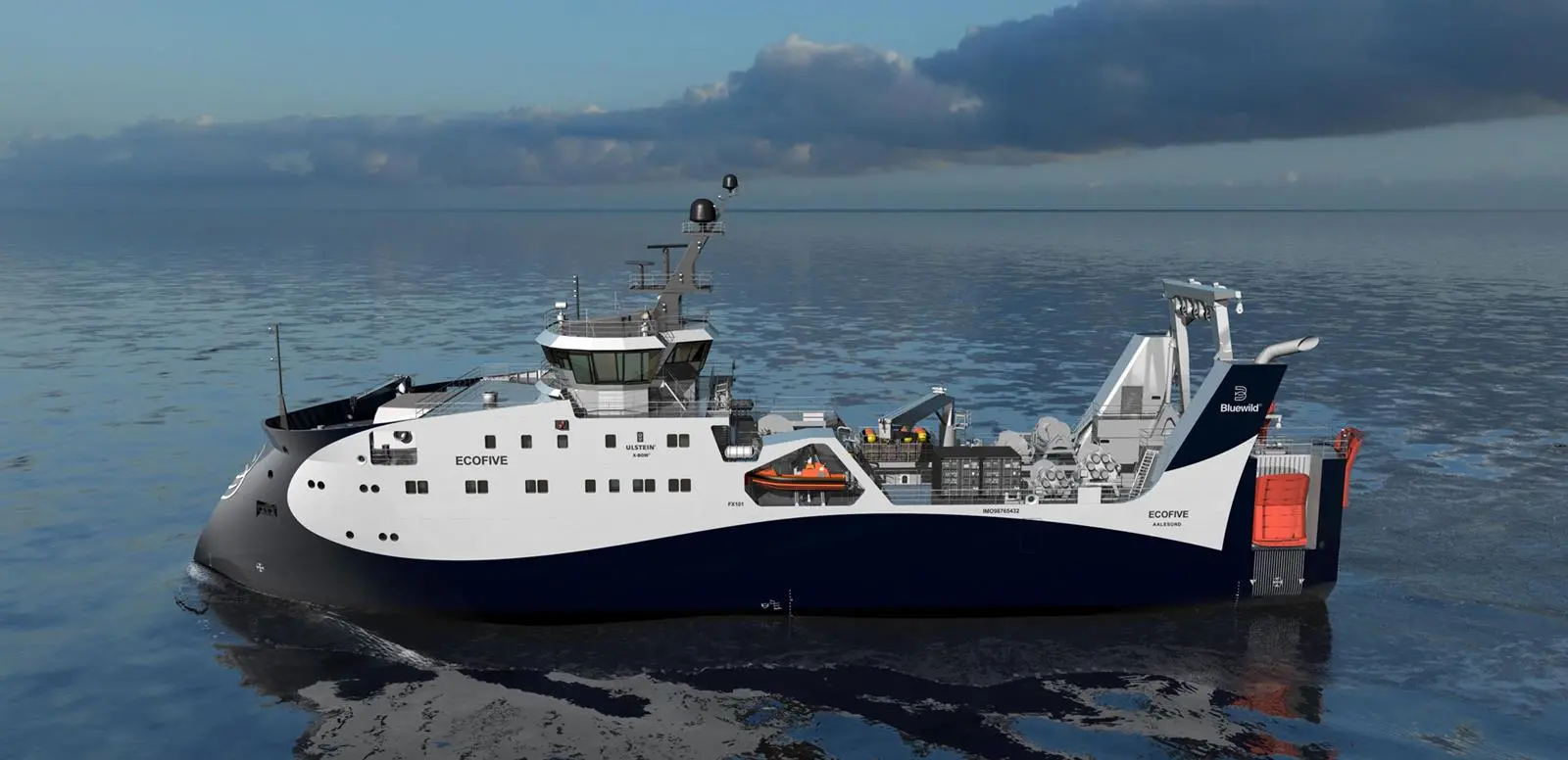
The order for a 73-metre factory trawler at Westcon Shipyard for Blue Wild, an Ålesund-based Norwegian ship owner was confirmed in early February 2022. The new trawler will primarily be used for prawn and whitefish trawling.
The stern trawler has been designed by Ulstein Design & Solutions AS, which based the design on its existing FX101 demersal trawler concept. The new order is expected to usher in a new design segment for Ulstein: the new factory trawler combines a twin skeg propulsion concept with Ulstein’s existing proven hybrid diesel-electric and diesel-mechanical propulsion solution.
By combining the diesel-mechanical and diesel-electric systems into one larger hybrid propulsion system, the new system will occupy less space and cost less than a larger diesel-electric system. Compared to similar conventionally propelled vessels, fuel savings of up to 25% are expected, depending on the mode of operation.
The hybrid power and propulsion system, which combines the best features of diesel-electric and diesel-mechanical propulsion, is supported by a 1.1MWh battery pack. The battery pack will recover surplus energy, such as the return energy from the winches, which can be stored in the battery pack, while excess heat from the engines will be recovered and used where desired elsewhere in the ship.
Ulstein noted that it mapped how the vessels use their power system, and identified trawling as the most important mode of operation. It was therefore chosen to install two propellers instead of the traditional solution with one propeller because the increased propeller area increases the vessel’s towing efficiency. The propellers are placed in separate skegs in a twin-skeg hull, which provides great advantages in terms of placement of the propulsion equipment and increases the propeller efficiency.
“Once you go for two propellers, you get new opportunities to operate the vessel in ways you do not have on vessels with only one. By calculation, two propellers use less energy together than one propeller to achieve the same towing power. Also, one of the propellers can be loaded more than the other to steer the vessel. Generally, fishing vessels get a large added resistance when compensating for wind, waves and currents with large rudder angles,” says Erwin Jager, sales manager fisheries at Ulstein Design & Solutions.
“Both for an anchor handler and a trawler, great demands are placed on towing power. We have looked at how reference vessels in the fishing fleet are used, and for most of the time, they are used for trawling, while only a relatively small part of the time is related to sailing, and then usually at relatively low speed. In consultation with the shipowner, a conscious choice was made to prioritise the properties during trawling and optimise the hull for minimum resistance at moderate speed”, says Frode Sollid, system architect in Ulstein Design & Solutions AS.
The shift to a twin-skeg design also allowed for the propulsion of the vessel to be optimised between the power-intensive step of trawling for shrimp, and the less power-intensive step of trawling for whitefish.
“Shrimp fishing requires a large towing force, while the power demand is not as great for whitefish trawling and when transiting to and from the fishing grounds the power requirement is even lower. The hybrid propulsion system is adapted to both fisheries. If designing and planning only for maximum engine power to ensure that the vessel will be able to perform all the assignments in the operation profile, the vessel will be expensive to operate and lead to unnecessary emissions during the less energy-intensive operations. In such development work, it is therefore important to ask the question: Can this be done in another way?”
“During the most energy-intensive operations, such as shrimp fishing with quadruple trawl, both main engines will be used, mechanically connected to each propeller to be most efficient at high power. But the vessel should also be able to operate efficiently with lighter trawling that requires less engine load, and it has been enabled to do so in diesel-electric mode with only one of the main engines in operation. Operating time between the engines will be reduced, while the operative engine will be allowed to run more optimally. The propellers can then run at a very low speed, which gives very high efficiency during trawling, the vessel will be quieter and little power is needed to operate the ship. In this way, the advantages of both diesel-mechanical and diesel-electric power systems are utilised, while many of the disadvantages will be avoided.
Related Articles
 ELECTRIFICATION AND BATTERY HYBRIDS
 ELECTRIFICATION AND BATTERY HYBRIDS
 ELECTRIFICATION AND BATTERY HYBRIDS