WHERE WILL THE JOURNEY TO REDUCE METHANE SLIP END?

There is no physical law that states Otto-cycle engines will always produce methane slip, and some single-fuel Otto-cycle engines have come close to a design which almost eliminates this issue. But, says Rene Sejer Laursen, Director, Fuels and Technology at ABS, there will always be a boundary in the combustion zone were the fuel-to-air ratio is outside the range, where the gas-to-air mixture cannot burn. “One of the challenges is to minimize this zone by improving the mixture of air and fuel to get a fully homogeneous mixture in the entire combustion chamber. This is however an extremely difficult design challenge that will probably never be completely solved.”
Otto-cycle engines are a compromise in design between diesel combustion and methane combustion and in order to be competitive in efficiency, the design is stretched to its Mean Effective Pressure limit, says Laursen. If the engine was optimized solely for gas, diesel combustion will be very poor, and it would probably not be attractive for the marine market. As a result, the combustion chamber design is not ideal for combustion of gas: at high load the engine operates close to both the misfiring and the knocking zone and this can cause instabilities in the combustion which also explains some of the methane slip.
Other challenges include valve overlapping which sends methane from injection directly through the exhaust valve without any combustion and the design of a combustion chamber which minimizes pockets where the gas can hide during combustion. “This development has been going on for quite some years, and engine makers have made significant improvements solving these problems,” says Laursen.
An exhaust gas recirculation (EGR) system has been added to mix exhaust gas into the scavenge air system. This makes it possible to control the air mixture better than just using the turbocharger to help control combustion. “Another solution under development is a gas oxidiser that can be mounted in the exhaust gas system to burn the slipped methane. However, this requires high temperatures which means it would have to be mounted before the turbocharger in the high pressure location, a development that is so far only suitable for 4-stroke engines, since in 2-stroke engines the temperatures are lower.”
Monitoring methane slip
To reduce methane slip further, online measurement of the gas quality/gas composition is required, says Laursen. Introducing a gas chromatograph would be a way to monitor gas composition, but this equipment is expensive and requires a lot of maintenance in order to work as intended. Engine manufacturers are therefore instead looking to develop sensors that can be used to measure gas composition online as it can improve efficiency and minimize methane slip.
“The monitoring of methane slip in operation is not being done currently, and presently there are no plans to introduce regulatory requirements to do so,” says Laursen. “Because methane slip increases with poor combustion and a poor mixture of the air and gas, the operator’s focus should be on keeping the engine continuously optimized, meaning that injection equipment is well maintained, wear of combustion components is monitored and injection timing is adjusted according to combustion conditions.”
MAN’s EGR reduces methane slip by 50%
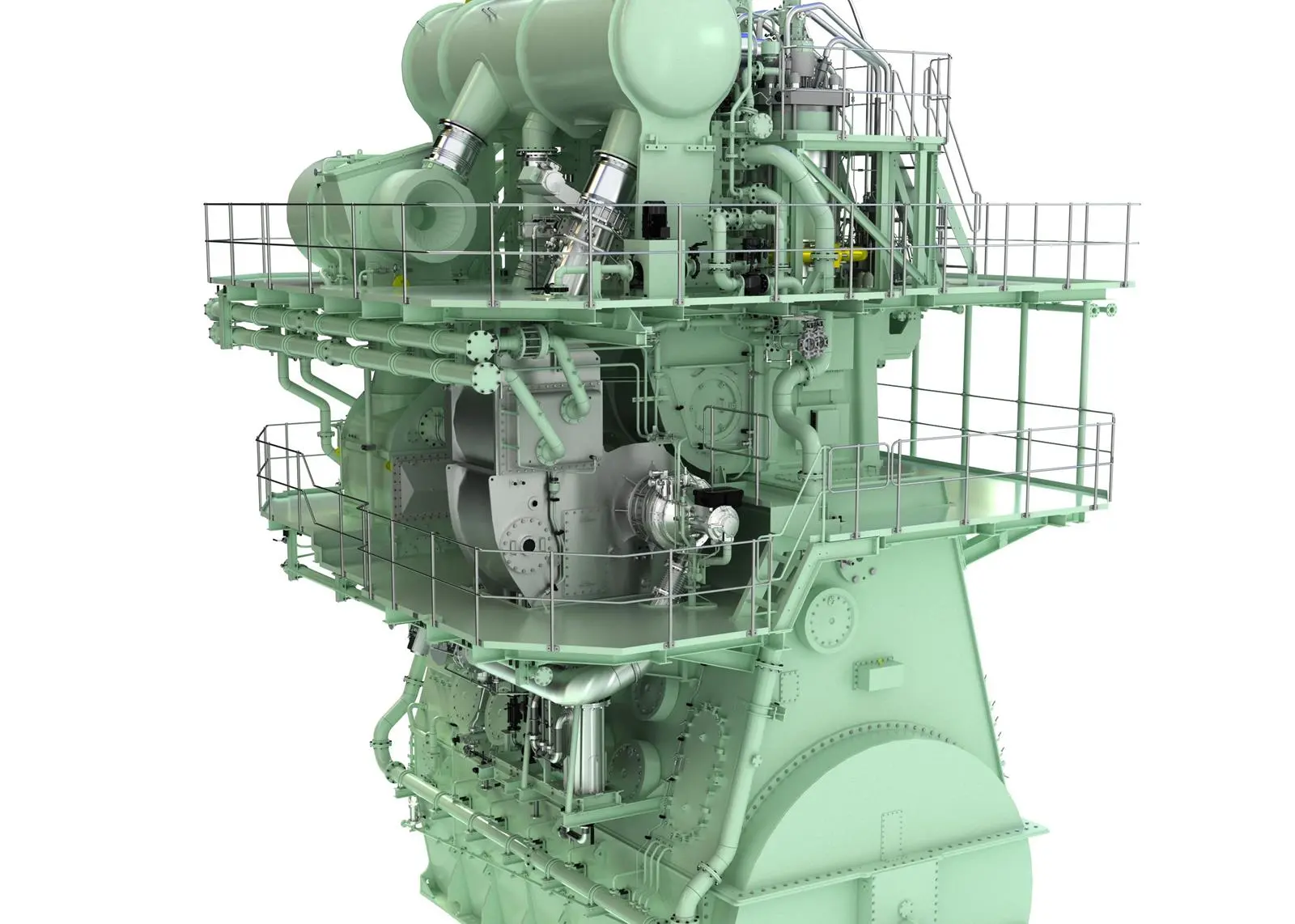
MAN Energy Solutions recently announced that it has received 40 orders for its Otto-cycle MAN B&W ME-GA engine – the latest addition to its dual-fuel portfolio introduced in March 2021. The company attributes the order surge to the market’s demand for the latest generation of Otto-cycle, two-stroke engines and the low levels of methane slip it achieves. Orders have come from all three major shipyards in Korea.
Thomas S. Hansen, Head of Promotion and Customer Support, MAN Energy Solutions, said: “The ME-GA comes with our high-pressure EGR as standard, a technology we have refined over the past decade. The increased focus on methane-slip reduction, as well as other operational/technical benefits, has established EGR technologies as the new standard for contemporary LNG-carrier design featuring Otto-cycle engines.”
MAN has achieved methane slip rates of 0.1 – 0.3 g/kWh in its Diesel-cycle ME-GI engine, but as a relative newcomer to Otto-cycle technology, has conducted over a thousand tests on the ME-GA engine varying different combustion parameters to minimise methane slip. “We improved the efficiency of gas consumption by 3%, and with the addition of EGR we are able to reduce methane slip by up to 50%,” says Hansen. This was achieved by giving the slipped methane a second chance at combustion and also by improving control of the oxygen injected into the cylinder. “We were able to control a phenomenon which is an Achilles Heel for Otto-cycle engines, and that is to prevent the gas mixture from self-igniting. The EGR makes it possible for us to compress the gas more to achieve a high combustion pressure without self-igniting by controlling the oxygen content in the chamber.”
MAN is also exploring the potential of oxidation catalysts that could eliminate methane from the exhaust gas, but Hansen says the technology could come at a significant space and cost penalty. While Otto-cycle engines can boost the overall fuel efficiency for some LNG carriers, the addition of such technology could push the economics to the point where it would be preferable to have a Diesel-cycle engine instead.
An extended transition
MAN has already developed a methanol engine and is expecting to have an ammonia engine read by 2024, perhaps giving the impression that LNG, often considered a transition fuel, will be left behind relatively quickly. Hansen anticipates the potential for a sudden disruption, but he says there will still be a big fleet of gas carriers, and over the next 10 years, a lot of LNG-fuelled vessels will be built. There could be thousands of ships operating. “We have to make those ships as efficient as possible.”
Beyond that, he believes market forces could also keep LNG viable. “I would expect companies, seeing a declining interest in their product, to lower their prices, and that could shift everything again if the price is sufficiently low. If carbon capture is available, then I don’t say LNG will be left behind, just LNG’s pollution will be left behind.”
Evaluating the full LNG life-cycle
UK researchers published a study this year analysing the environmental life cycle and costs of LNG as a fuel, including examining methane slip from high and low pressure dual-fuel 2-stroke engines. The study was based on published research data, and they found that the engines reduce climate impacts across all metrics compared to the other engines and fuels evaluated, but only when supply chain emissions (upstream, transport and bunkering) are constrained. Switching from other fuels to LNG offered a reduction in GHG emissions of up to 28%, whereas supply chain emissions contributed 21-24% for the LNG-fuelled engines and 14-16% for conventional liquid fuelled engines.
The researchers note that the 2-stroke data was obtained from test-bed results rather than operational data. So, following the study, one of the researchers, Dr Paul Balcombe from Queen Mary University in the UK, led a mission to measure methane emissions on the Cheniere-chartered newbuild GasLog Galveston during a round-trip voyage from Cheniere’s Corpus Christi liquefaction facility in the US to a discharge port in Europe. The work has been supported by the Collaboratory to Advance Methane Science, and the results are expected to be published later this year. “This project comes at a critical time, with policymakers seeking to understand both how to regulate industry and ensure that climate targets are met. Accomplishing this will depend on ensuring transparent, emissions-related data is available and lessons learned from studies such as this are implemented.”
Factoring in renewable energy
Researchers from the University of Victoria in Canada conducted a well-to-propeller environmental assessment for two vessels operating in British Columbia. They found that Diesel-cycle natural gas engines produce 2% fewer CO2 emissions than low sulphur fuel oil, while lean-burn Otto-cycle engines and dual-fuel gas engines result in 4% higher CO2 emissions.
In all cases, the largest contributor to emissions was the marine engine. This conclusion was attributed to the strict environmental regulations enforced in British Columbia, relatively new natural gas infrastructure and that most of the electricity used in the natural gas pathway comes from renewable energy sources such as hydro.
It’s a bigger problem than LNG
Looking to the future, DNV Business Development Manager Christos Chryssakis believes that exhaust after-treatment could further reduce methane slip – even up to 70%, but there is currently little incentive to add expensive systems without a regulatory push.
He notes the importance of upstream emissions: without reducing those, the best engine technology doesn’t necessarily help the environment. The IMO has started discussion on the lifecycle of fuels, driven by the use of biofuels and synthetic fuels, which face similar potential problems to LNG. But, he says, methane slip is not just a problem relevant to gas production. In oil production, gas either escapes or is flared because there is no interest or infrastructure to capture it. “It’s a bigger problem than just LNG,” he says. “And it’s important to take care of it, because methane has a very big environmental impact in the short term.”