Winch stress is ultimately the owner’s problem
Weighing anchor in inclement weather can result in excessive loading of the windlass transmission and motor and a high risk of failure, but this is just one of the circumstances where winch performance is being called into question. Around 1% of the world’s fleet lose anchors each year and the problem may be increasing as the number of vessels increases.
Traditional sheltered anchorages have become overcrowded and new ones have been established further offshore in deeper water where they are exposed to more harsh conditions. “The anchoring equipment of most ships sailing now is not designed for these new conditions resulting in more equipment failure,” says Knut Ødegård, technology manager for Pusnes deck machinery at Aker Solutions.
A second consequence of the growth in the world’s merchant fleet is lack of experienced seamen. “Many of the failures on board can be traced back to lack of understanding and information about maintenance and operation of the equipment,” says Mr Ødegård. As a consequence, Aker Solutions has issued and translated into various languages a pocket Quick Guide to Pusnes Deck Machinery with vital information about operation and maintenance of the anchoring equipment.
Manufacturers are always quick to put the blame on the yard and the crew, says Shahoul Hamid, responsible for marine standards at Maersk Tankers Technical Operations. “The truth is, while the equipment is manufactured by them, it is fitted by the yard. It is not supervised. During commissioning, the yard is required to operate the winch to the maker’s representative for about 20 to 30 seconds, that’s it. We’ve had many issues with the winches with the makers blaming the yard and vice versa. In the end, it is the owner who has to tackle the problem.”
Mr Hamid says the company has lost six anchors in the last two years, about half because of missing pins. “In order to prevent any further anchor loss due to missing pins we weld the pins now, not spot weld but full-on complete weld. One can ask why we have not done this earlier or even why same was not done in the newbuilding yard? Guess we superintendents are also inexperienced. Some things you have to learn the hard way.”
Mr Hamid believes responsibility should be shared: crew who are inexperienced, makers who cannot solve the issues because they did not install the equipment and the yard which does not care once the vessel is delivered and guarantee period is over. “As for the anchor issues, class rules are outdated. They are required to test the anchors at 82.5m when in reality VLCCs regularly anchor at depths more than that. This means the yard, makers and everyone else hides behind the class rules. If an equipment is designed for 82.5m, is it far-fetched to assume that they will at least work, albeit with reduced performance, in depth about 110m? That never happens. We’ve had equipment that simply overheats and required 12 hours to heave up an anchor. A job that takes 45 minutes!”
According to Germanischer Lloyd, most incidents of anchor dragging, or damage to equipment that the class society is aware of, are connected to anchoring in unsheltered waters and the anchor not being weighed early enough in case of deteriorating weather.
In general, anchoring systems as required by IACS UR A1 are intended for temporary mooring of a vessel within a harbour or sheltered area when the vessel is awaiting berth, tide, etc. The equipment is therefore not designed to hold a ship off fully exposed coasts in rough weather or to stop a ship which is moving or drifting. The required anchoring equipment is based on an assumed current speed of 2.5m/sec and wind speed of 25 m/sec but no wave loads.
IACS UR A1 is a basic requirement for all ships and, for most ships, the required anchoring equipment is considered sufficient for typical operational procedures. Ships that are supposed to be regularly anchored under conditions not envisaged by the current rules may need to be equipped with reinforced anchoring equipment. Currently, it is the responsibility of owners and makers to specify deviating operational conditions and to design those ships for such conditions. However, current requirements for anchoring in sheltered waters are being reviewed and additional requirements or recommendations for anchoring in unsheltered and deeper waters are being discussed by IACS and industry partners such as Aker Solutions.
James Henton, survey procedures manager at Lloyd’s Register says that a specified design anchorage depth is proposed and agreed at the vessel design stage. The windlass power has to be commensurate with this, and the specific pull of the windlass is worked out. A different calculation is used where the design anchorage depth is over 82.5m. All anchoring arrangements are subject to sea trials at ship delivery at which the anchor is raised from its specified design anchorage depth and performance measured and timed.
During trials on board ship, the windlass is to be shown to be capable of:
(a) for all specified design anchorage depths: raising the anchor from a depth of 82.5m to a depth of 27.5m at a mean speed of 9 m/min; and
(b) for specified design anchorage depths greater than 82.5 m: in addition to (a), raising the anchor from the specified design anchorage depth to a depth of 82.5 m at a mean speed of 3 m/min. Where the depth of water in the trial area is inadequate, suitable equivalent simulating conditions will be considered as an alternative.
If the operator is working beyond the specified design anchorage depth there may be some difficulties encountered in some instances, says Mr Henton. All equipment should generally be operated within its design envelope. “Where owners require equipment for anchoring at depths greater than 82.5m, it is their responsibility to specify the appropriate total length of the chain cable required for this purpose. In such cases, consideration can be given to dividing the chain cable into two unequal lengths.”
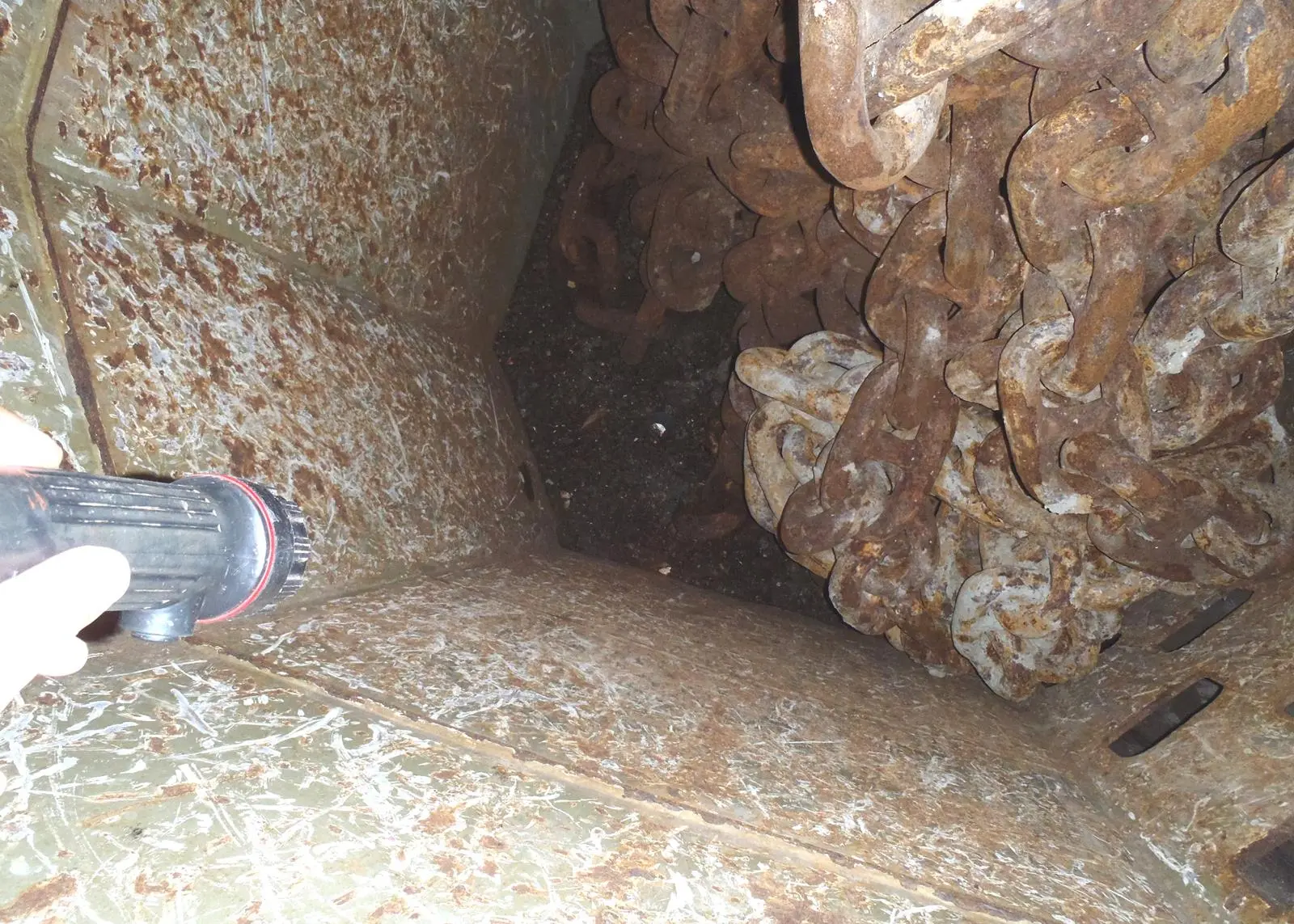
Biofouling prevention poses another challenge for deck machinery. Already required in places such as Australia and New Zealand, and present in IMO’s recommendations, is the need to have clean anchor chains and lockers when entering a new region. “Sticky mud contains a range of biofouling biota and is usually washed off by a chain sprayer system but there are pitfalls”, says Dr Robert Hilliard, principal at biofouling specialist Intermarine Consulting. “Sometimes the sprays are inadequate – four strong jets working at 90° degrees are desirable- and sometimes sprayer activation is a manual function so can be forgotten.” The pilot may also be in a hurry and ask for the anchor to be hauled up as quickly as possible, which generates even more mud because the chain is moving too fast for the sprays to wash it off.
When a project vessel departs for countries such as Australia with an uncleaned anchor and chain, these must be lowered into blue offshore waters as far as the retrieving winch can handle then washed during the return. Although some chain may remain in the locker there is usually enough space to hose down any remaining mud through exposed parts of the rose plate to the forward bilge eductor. “First the ship has to be stopped in calm conditions, and if too much chain is lowered the winch will struggle to lift it and can burn up. Deep sea washing is an imperfect, risky solution compared to ranging the chains in dry-dock and making sure the sprayers are working effectively,” says Dr Hilliard, who also commends proactive crews for placing a rating with a deck hose on the forecastle to help wash the chain when anchor hauling, particularly if the installed sprayers are known to be inadequate.