



BIO-UV targets lower flow segments for growth
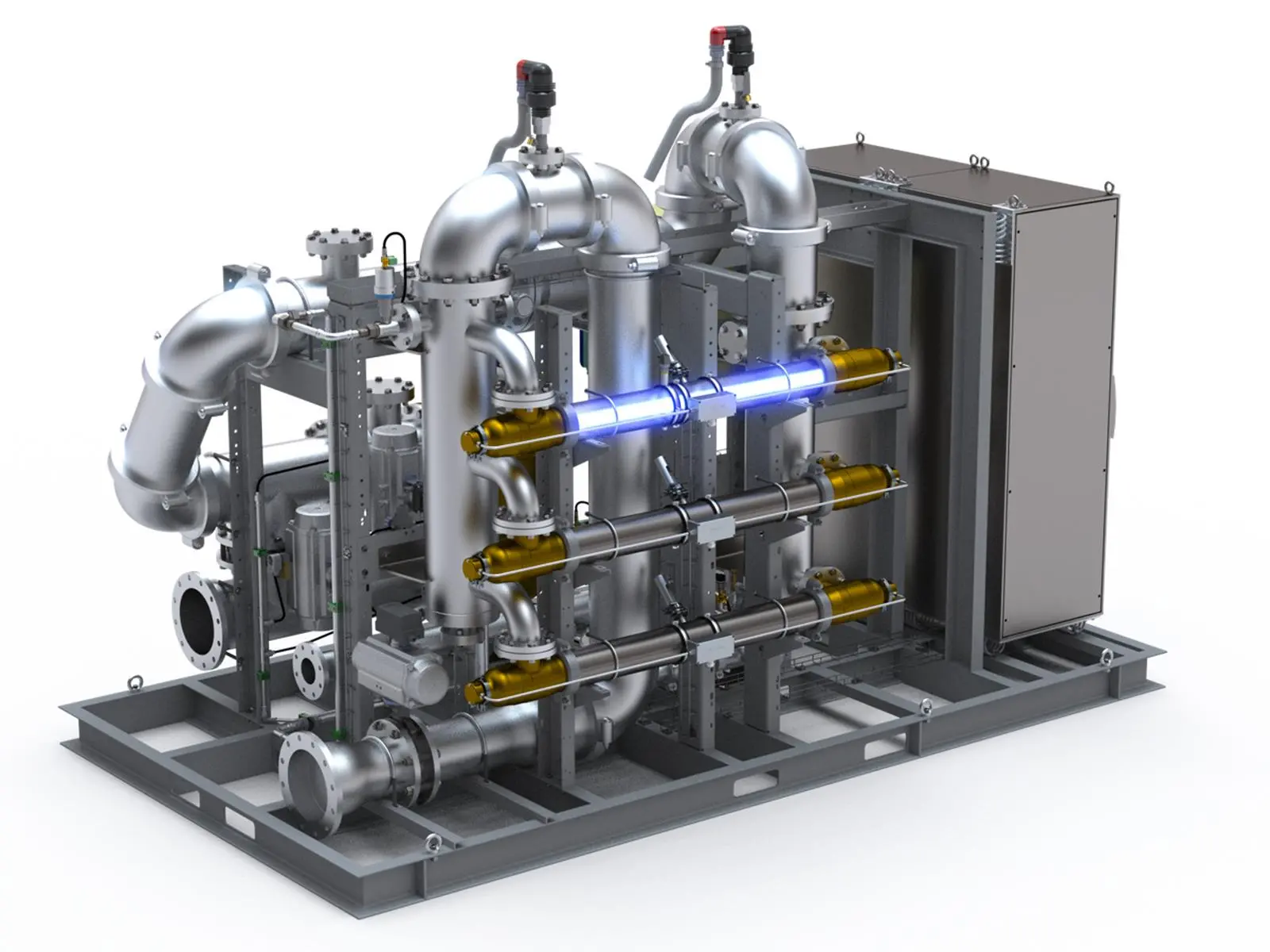
In a presentation at the company’s headquarters, BIO-UV chairman Benoit Gillmann identified sales to vessels with lower ballasting flow requirements, such as container carriers, OSV and PSV vessels, megayachts, cruise vessels and passenger vessels, RoRo and RoPax vessels and naval logistical vessel as the key to achieving this share of the global market.
BIO-UV has sold about 150 units of its UV-C and filtration BWMS system, BIO-SEA, with the majority of its sales going to lower flow vessels, which Gillmann describes as the company’s “core market”. While BIO-UV has developed close relationships with a number of French customers, including container operator CMA-CGM, Louis Dreyfus Armateurs, as well as the auxiliary vessels for the French Navy, around half of its sales have gone to customers in Germany, the Netherlands, Singapore, Canada and China.
BIO-UV has a track record in the cruise ship segment, and recently agreed a contract with international cruise operator MSC Cruise to fit 300m3/hour BIO-SEA units to Meraviglia and World Class cruise ship series to be constructed at the Chantiers de l’Atlantique’s St Nazaire shipyard.
Gillmann expected UV BWMS providers to account for over 50 percent of the global BWMS market by 2024. BIO-UV expects the UV share of the market to reach USD15 billion, equally divided between BWMS manufacturers and the retrofitting costs for shipyards.
Technological advances are likely to change the economics of UV BWMS systems compared with other methods of meeting IMO and USCG requirements in the future, including developments in LED UV treatments, but these are unlikely to affect the market significantly before the window for the retrofitting of BWMS systems to existing vessels closes in 2024.
Gillmann noted that UV treatments are effective treating micro-organisms that other methods struggle to deactivate, such as cryptosporidium and giardia, while treatments that do not include a second pass through a UV system ignore the so-called repair phenomenon inside the ballast tank. However, shipowner fatigue with evolving regulatory standards was a factor in the backlog of orders in the market and Gillmann called for a period of regulatory calm in order to give shipowners certainty.
“Shipowners need to understand that no “silver bullet” solutions are going to reach the market before 2024 – standing still isn’t going to be an option. In fact, given the fact that we have 10,000 vessels per year chasing retrofitting berths at 250 odd yards, and that each retrofit requires ship design availability in addition to the yard, and the BWMS suppliers have their own supply chains, delays are likely to be all but inevitable for late adopters,” Gillmann said.
BIO-UV has its own relationships with a number of shipyards, including a close relationship with Damen Group, and several shipyards in Asia. It remains open to establishing a deeper strategic relationship with partners.
The company was founded in 2000 and originally specialised in the manufacture of ultraviolet light water treatment equipment. It remains France’s leading supplier in a number of water purification niches, but expects the BWMS segment to dominate the group’s sales in the coming years.
The company entered the BWMS market in 2012, and it has received USCG Type Approval and IMO G8 approval for its UV-C and filtration based BWMS system, BIO-SEA. Currently BIO-Sea has a 0-hour holding time for fresh water, 24 hours for saltwater, and 72 hours for brackish water at full flow, although it plans to apply to remove its USCG holding times in the second half of 2019.
The system features a parallel feed to the lamp, which is set within 1.8m long titanium tubes. The tube diameter means that just two lamps of up to 22kW can accommodate a full flow of 300 m3/hour at a similar energy consumption as other market-leading models. The vessels are designed to be resistant to vibration, minimising the shock effect on lamps and extending the lamps’ operational lifetimes. The lamps are not physically cleaned by a wiper, reducing the risk of scratching, and similarly reducing opex. One feature of the system is the integral backwash filter, which eliminates the risk of clogging when pressure differences are inadequate.
Related Articles
 BALLAST WATER MANAGEMENT
 BALLAST WATER MANAGEMENT
 BALLAST WATER MANAGEMENT