



Ecochlor Adds Filterless Options To BWMS Solutions
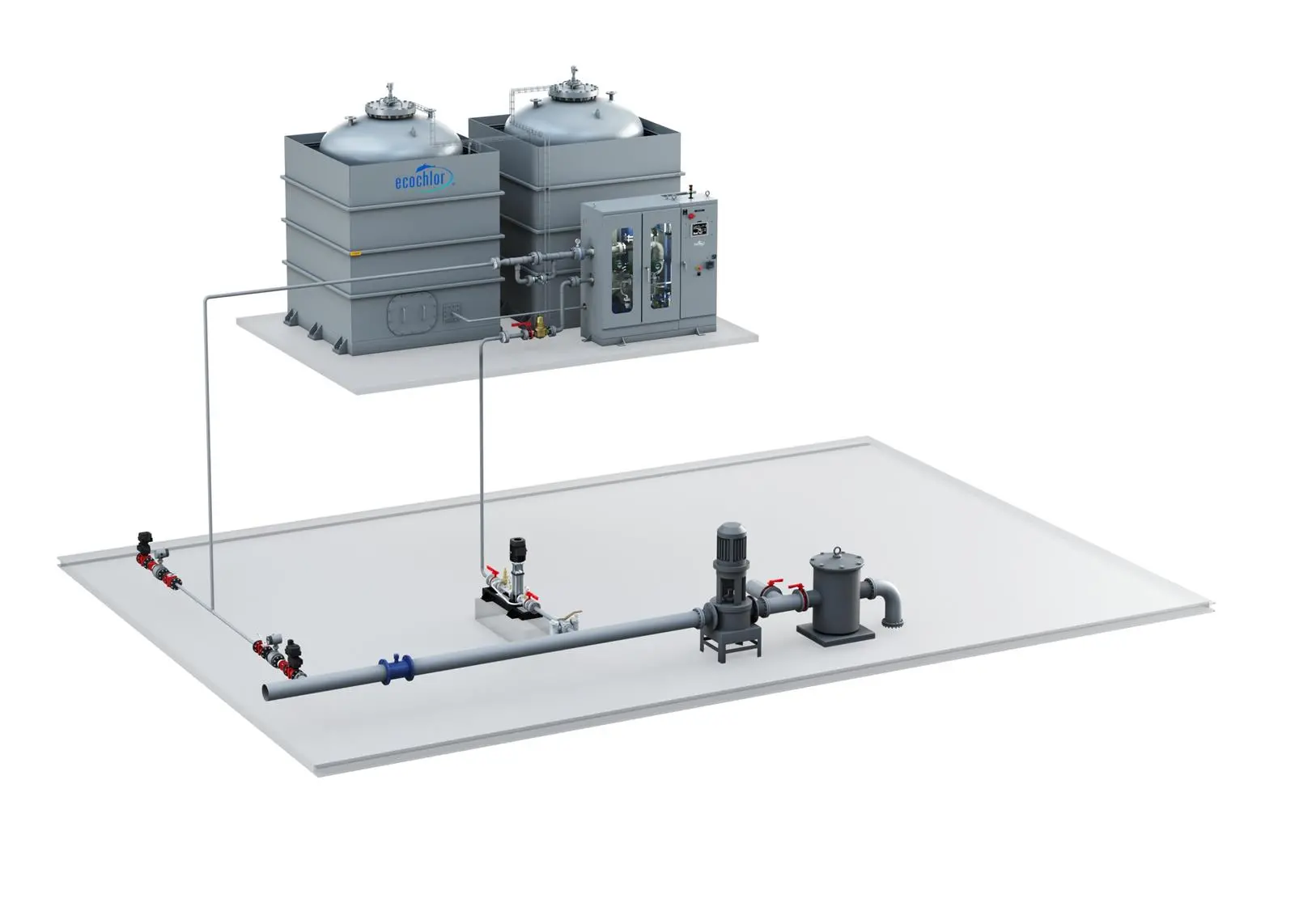
The new filterless single-step EcoOne solutions (EcoOne BWMS and EcoOne Hybrid) continue to use the same chlorine dioxide neutralisation process as its existing chlorine dioxide-based Ecochlor BWMS.
The new solution is expected to result in lower opex costs for ship operators, through reductions in maintenance requirements and a simplified design. However, the main driver in the development of the solution was customer demand, Steve Candito, CEO said, adding that existing ballast water treatment processes are inflexible and may not be suitable for all vessels under all circumstances.
A matter of chemistry
Unlike competing UV or EC-based systems, the particular neutralisation properties of ClO2 lend themselves to a filterless solution. The efficacy of competing EC-based systems decline in water with higher concentrations of organic matter, as hypochlorite (which is produced by EC-based systems) reacts with organic matter to a greater extent than Ecochlor’s ClO2 system.
“As a result, Ecochlor can achieve the same results without a filter with only a small increase in ClO2 concentration [from 4.25ppm to 4.6ppm], and without an increase in power consumption,” added Andrew Marshall.
However, Ecochlor claims that it can offer shipowners a product with the same efficiency and reliability as its existing product, while simplifying the product design by eliminating the requirement for a filter.
Testing
The solution has successfully completed land-based tests at DNV’s Golden Bear Research Center in California, where it was tested for efficacy in both brackish and saltwater, as well as for both 24 hour and 5-day holding times.
Ship-based tests aboard two separate Maran Tankers vessels, a 320,000dwt VLCC and a 160,000dwt Aframax tanker, began in September 2020. Testing for the IMO BWMS Code had been successfully concluded on 14 April 2021, Andrew Marshall, Ecochlor’s VP of business development confirmed.
By contrast, ship-based tests for the USCG type approval were likely to be concluded in May 2021. As a result, type approval for the IMO BWMS Code was expected in Q3 2021, while USCG type approval was expected in Q4 2021.
Type approval from ABS, Bureau Veritas, Lloyd’s Register and KR were expected to be awarded in Q1 2022, Mr. Marshall added.
The company noted that the system would have a salinity limitation of >1 PSU, but added that a hybrid solution would offer shipowners the choice between a one and two stage process.
Capex advantages
While the primary consideration for shipowners and operators was that the solution would be reliable and compliant, the solution would also greatly simplify the engineering and design requirements of installing or retrofitting an Ecochlor BWMS.
“The solution eliminates the requirement for filters to be installed in the pump room or engine room, or deckhouse, and also streamlines the installation’s piping and cabling requirement, reducing cabling and piping requirements significantly, and shortening the time required for an installation,” said Andreas Zontanos, a partner at Argo Navis.
The solution would also be available for retrofit for existing Ecochlor systems, Andrew Marshall concluded.
Related Articles
 BALLAST WATER MANAGEMENT
 BALLAST WATER MANAGEMENT
 BALLAST WATER MANAGEMENT