Industry tackles methane slip issues with LNG engines
Furthermore, LNG produces negligible sulphur oxide (SOx) and particulate matter (PM) emissions and emissions of nitrogen oxides (NOx) are considerably below other fossil fuels. In addition, industry collective Sea-LNG points out that: “There are no waste disposal or discharge issues associated with the use of LNG in contrast to exhaust gas treatment systems, or scrubbers used by shipping companies which continue to burn high sulphur, heavy fuel oil. Finally, LNG poses no pollution risk to ocean environments through fuel spills in contrast to traditional marine fuels.”
LNG, however, is not a drop-in replacement for conventional fuels. Gas-fuelled or, more commonly in maritime applications, dual-fuel engines are more expensive, though many operators feel the initial cost is offset by increased compliance with environmental regulations. According to Sea-LNG, LNG dual fuel engines offer a relative payback period of between 4.5 and 5 years compared with VLSFO because of lower compliance costs due to LNG’s lower greenhouse gas fuel intensity (GFI). Methanol and ammonia fuelled vessels will not, according to Sea-LNG’s research, pay back over the 15-year investment horizon.
Retrofitting existing ships for LNG operation has been proved possible – although it is a costly exercise.
LNG has to be stored at a very low temperature – typically -162 deg C – which poses challenges both onboard and onshore. This means tanks have to be highly insulated to help maintain the low temperature, with inner surfaces constructed from specialised steel alloys or composites able to withstand the conditions.
Volumetric energy density is another important point – compared with fuel oils, LNG has a lower energy density, meaning larger tank volumes or more frequent bunkering. The larger tanks, and associated insulation and refrigeration equipment can take up space that could otherwise earn revenue – although it has to be said that LNG enjoys a more favourable volumetric energy density than other alternative fuels such as hydrogen or liquid ammonia. In applications like ro-pax ferries, the additional bunkering requirement is far less of an issue.
Hazardous handling
The low temperatures represent a danger to personnel, so LNG requires specialised handling. Bunkering at shore side from road tankers is perfectly possible, and was common as LNG gained acceptance as a marine fuel. Many ports now offer LNG bunkering, either from permanent shoreside installations or ship-to-ship transfers from small LNG tankers. However, there are still large gaps in the LNG supply infrastructure which can adversely affect some operating patterns.
LNG may not always offer the expected benefits in local emissions compliance. See the much-quoted example of the troubled LNG-fuelled Scottish ferry Glen Sannox that is said to emit 10,391 equivalent tonnes of CO2 a year compared with 7,732 from its diesel-powered predecessor. However, this does not take into account the larger size of the ship – although its larger engines consume more fuel, its capacity is considerably greater so a ‘CO2 per unit carried’ comparison might be more meaningful. It does still sound a note of caution over LNG’s greenhouse gas advantages.
The major drawback for LNG as a low-carbon fuel – and which has skewed the Glen Sannox figures – is methane slip, i.e. emissions of unburned methane from the engine exhaust. When LNG was gaining popularity, this went relatively unnoticed. However, methane ship is now seen as a major factor counting against the wider adoption of LNG as a ‘bridge’ fuel, that is a pathway between oil-based fuels and true low- or zero-carbon future fuels (which could include bio-LNG, or synthetic methane).
The problem is that methane is considered a far more damaging greenhouse gas than carbon dioxide – some figures suggest over 80 times worse, though this is based on short-term measurements. A more considered estimate comes from DNV, suggesting a greenhouse effect around 28 times that of CO2 over a 100-year period – still a major difficulty.
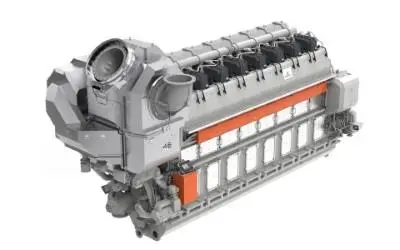
These figures apply to engines running on the Otto cycle, which include four-stroke engines and two-strokes with low pressure fuel injection systems. The more complex, more costly, high pressure two-stroke dual fuel engines running on the Diesel cycle inherently emit lower levels of unburned methane. According to Everllence, as MAN Energy Systems is now known, the levels of unburned methane from its direct high pressure injection MAN B&W dual-fuel two-stroke engines are around 0.2 to 0.3g/kWh. The company considers this to be negligible in comparison with Otto cycle engines, though there is still some scope for improvement.
Engine makers respond to challenge
Everllence notes that using direct injection techniques – where the gaseous fuel is injected directly into the cylinder as opposed to being pre-mixed with air – is technically possible for four-stroke engines but cost and complexity considerations rule this out. Engine designers therefore have been working at optimising the combustion process, which has enabled methane slip to be more than halved in newer engine variants. However, further action is required to further reduce, or even eliminate, methane slip.
Everllence is developing a catalytic system, Imokat II, with a pre-turbo methane oxidation catalyst, that is expected to cut methane emissions by a further 50%. The proposed catalyst material is sulphur-resistant and contains no precious metals, keeping down costs. The sulphur resistance allows the catalyst to be pre-heated in diesel mode before switching to gas fuel once the catalyst reaches operating temperature. Running in gas mode with a cold catalyst would be unable to remove methane emissions.
Hans-Philipp Walther, Head of Exhaust Gas Aftertreatment, said: “The greatest challenge to developing this catalyst is reaching the highest conversion rates since engine and catalyst must be optimised together. Another significant hurdle is optimising the dynamic behaviour of the engine with a catalyst applied, especially if the catalyst is cold. Therefore, a bypass flap and additional software functions will be necessary. We are confident we will overcome these challenges and that the catalyst will become available for retrofit and newbuild applications in due course.”
Wärtsilä’s NextDF technology is said to reduce methane emissions to less than 1.4% of fuel use across all load points, achieving as low as 1.1% over a wide load range. The company points out that this is nearly three times lower than the default methane slip factor of 3.1% specified in the FuelEU Maritime and IMO Lifecycle Guidelines for Otto-cycle four-stroke dual-fuel engines. Through improvements made to combustion control, and through optimising engine performance, the feature is additionally able to minimise NOx and CO2 emissions.
Stefan Nysjö, Vice President Power Supply, Wärtsilä Marine, said: “NextDF technology reduces the environmental impact of vessels that use LNG as fuel, without compromising on performance or operational stability. Importantly, this makes it easier for ship owners to comply with increasingly stringent decarbonisation targets and legislation.”
NextDF, which was co-funded through the EU Green Ray Project, is available on the Wärtsilä 25DF, 31DF and 46TS-DF engines.
For the two-stroke Otto cycle X-DF engines developed by Swiss engine designer WinGD, one answer to methane slip comes from VCR, or variable compression ratio. VCR technology allows the engine compression ratio to be adjusted automatically to optimise combustion based on engine load, fuel type and ambient conditions. The company says that the technology can be applied to all new X-DF engines, while a retrofit package will be available. A trial retrofit installation is said to be yielding promising results.
Dominik Schneiter, CEO, WinGD, said: “Engine technology has come a long way in just a few years, and it’s moving fast. We’ve made major strides in reducing methane slip from WinGD engines—from 1.7% of gas volume a decade ago to lower than 0.8% in today’s engines, with a target of 0.5% or below. But to effectively reduce methane slip we need to advance in areas beyond engine technology, including measurement, certification and effective regulation.”
New entrants to MAMII
With a view to promoting standardisation of methane slip measurement, and harmonising regulations, WinGD has become a member of Methane Abatement in Maritime Innovation Initiative (MAMII), an body originally founded by Lloyd’s Register SafetyTech Accelerator for the abatement of methane emissions from shipping.
Away from the engine designers, one company which has been working hard to quantify and reduce methane slip is Daphne Technology of Switzerland. Its PureMetrics offers a solution that is said to accurately measure and report exhaust gas emissions, including methane, from ships. UECC and AET are among the shipping companies using PureMetrics to accurately record methane and CO2 emissions from dual-fuel vessels.
The Daphne SlipPure system, using a plasma-catalytic process, is claimed to enable very high methane slip reductions at exhaust temperatures below those required for catalyst-only solutions. The system has received approval in principle from DNV and Lloyd’s Register. SlipPure integrates a patented wavelet pulse power (WPP) supply technology to generate plasma and uses a proprietary catalyst, to ensure performance and efficiency. Following successful use on land, the system is being made available for maritime applications.