



US gears up for first BWMS type approvals
The US Coast Guard (USCG) has been undeniably careful in its process to award type approvals to ballast water management systems. Even as entry into force nears for the long overdue IMO convention – to which the US is not party, making its own regulations the second pillar of a global regulatory framework – there is evidence that the authority will not be rushed.
In October, USCG reported that is had received final type approval applications from three system manufacturers – Alfa Laval, OceanSaver and Optimarin. Later that same month, the authority notified the public, through its ‘Maritime Commons’ blog, that it was seeking further information on all three systems before granting approvals.
“We have been in contact with the manufacturers and independent laboratories throughout the course of our review,” stated John Mauger, the commanding officer of the Coast Guard Marine Safety Center. “For each of the systems, we have requested additional information from the manufacturer and/or the independent laboratory. While we are committed to completing our review as quickly as possible, our primary focus is verifying that each submission meets the USCG requirements.”
At a recent ballast water management technology conference in Miami, the Coast Guard Marine Safety Center’s Jason Kling cast light on the approval process. The Coast Guard uses four separate offices to manage the different areas of responsibility under its ballast water management programme. The Office of Operating and Environmental Standards is the group that developed the regulation and is responsible for current policy determinations relating to interpretation of the regulations. This office is also responsible for Alternate Management System (AMS) reviews and vessel compliance extensions.
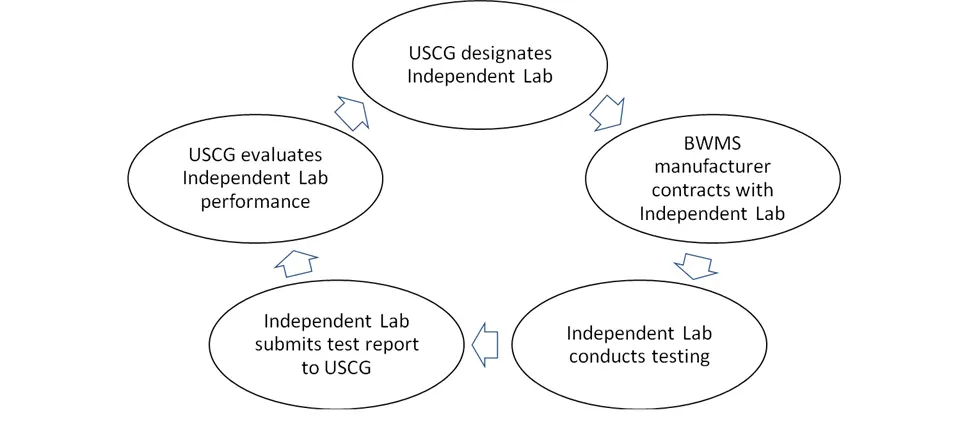
The Office of Design and Engineering Standards reviews independent laboratory (IL) applications to evaluate whether they are capable of carrying out the test protocols required by the regulations. This office is responsible for designating ILs and associated sub-laboratories. The Marine Safety Center is responsible for reviewing type approval applications and issuing type approval certificates. And the Office of Commercial Vessel Compliance is responsible for the vessel compliance issues, including the ballast water management plans and ballast water management systems (BWMS) once they are installed on ships.
BWMS design and testing requirements are contained in the US Code of Federal Regulations and the Environmental Protection Agency’s Environmental Technology Verification Protocol. USCG- designated ILs must conduct the test programme. A three-part test programme takes place at shore-side tank facilities, at sea, and at engineering test labs to verify that treatment systems meet the design and testing requirements. The Marine Safety Center then reviews the IL test reports and BWMS manufacturer’s application to evaluate compliance, and will issue a type approval certificate if the system is found to be compliant.
The first approvals will at least bring some harmonisation between the IMO and USCG processes, with ship owners finally able to identify systems that are approved for global operations. When the IMO’s revised G8 guidelines on type approval, passed by the IMO’s Marine Environment Protection Committee last month, become effective, there will be even closer alignment between the two standards.
But the USCG approval process has not been a simple one for many of the testing facilities involved, said Kling. ILs must create test plans for every manufacturer. They have the plans that were used to test for IMO, but for the time being the standards are different so they must develop a new test plan for each phase of this test programme.
There are only a quite limited number of designated ILs compared to the queue of the manufacturers that want to get approval, Kling noted. Further, ship selection is a challenge because of needs to match the technology with the operational conditions, and finding the right trade route to support the test program and analysis is difficult. In other cases the environment has presented insufficient challenge conditions, which has led to invalid test cycles, so ILs must continue to perform more land-based and shipboard tests to get valid tests to complete the test series.
Related Articles
 BALLAST WATER MANAGEMENT
 BALLAST WATER MANAGEMENT
 BALLAST WATER MANAGEMENT