



Chaos brewing in ballast water
Unfortunately for various shipowners, that appears to be exactly what has happened. From around 120 systems which initially gained IMO G8 Type-Approval, more than half have turned out to be insufficient in US Coastguard (USCG) tests.
“In a couple of cases we have physically taken off a competitor’s system,” said EVP of sales at Norway’s Optimarin, Tore Andersen recently. “This is very costly for the [shipowner] that has to do it.”
A few years ago, the USCG Type-Approval process was thought to guarantee that a ballast water system would work as intended, but experience has shown that to be far from the case. Optimarin’s compatriot, OceanSaver, appeared to have a winning formula with its electrochemical system, until it went bankrupt after a protracted disagreement with a filter supplier.
In fact, those old systems requiring replacement have become a major contributor to Optimarin’s revenues, Andersen explained. “The front runners had bought systems back in 2012 and didn’t have US Coastguard Type Approval because that came later on. They never spent the money on testing, and so it cannot be operated. The options are to buy a new system from the same maker or choose to do something else.”
For Optimarin, which has sold 1500 systems, this is not so much of a setback. Having proven its mettle in various settings and to the most exacting of testing standards, it is now not uncommon for Optimarin to “Retrofit to the retrofit,” something which “gives us a second chance” at market share, said Andersen.
This is vitally important for ballast water OEMs, Andersen explained, because ballast water manufacturers rely on spare parts for their earnings. The system itself remains a loss-leader. “The margin is not in selling the system itself, but the revenue is on the spare parts side. For us to be able to compete on newbuildings, it is purely down to price,” he said.
An added challenge is that shipyards with standard specs do not trouble themselves with installing the most advanced ballast water treatment systems if they can help it, but rather the cheapest. This means that a significant number of new vessels are being launched with systems that do not work properly.
“The yard is running the show, and their purchaser is deciding who is the lowest bidder,” Andersen said. “You need to be on the maker’s list from the owner’s side, and from there it is a matter of who wins the race of price.”
Heading East
In response to this, Optimarin has moved to establish new production capacity in China, in the hope of bringing costs down as well as garnering closer involvement with the shipyards. “The political situation in the world is not super stable for the moment, but we still believe that the Chinese market will continue to be the biggest shipbuilder,” Andersen said.
Optimarin’s system is one of the more successful ultraviolet irradiation (UV) systems, based on using ultraviolet light to sterilise microorganisms in sea water. Manufacturers of UV systems have run into problems of light penetration in water of high turbidity; when a system runs into difficulty with this, it tends to increase power requirements, thereby increasing the energy cost on the ship.
While flow rates of up to around 1000m3/hour are where UV predominates, electro-chlorination (EC) systems are favoured for higher-uptake applications.
“LNG [carriers] need bigger systems where the electrolysers – Sunrui – dominate,” Andersen explains, referring to the Chinese ballast maker. “We see that electrolysers make up 50% of all systems installed. If we look at how to run this system, for the operator UV is simpler to run. But for the electrolysers you have the advantage that you have always treated the water on the way in, which means if you need to get rid of that water in a hurry, full flow from the pumps, you can do that.”
Flag states, unsatisfied with the efficacy of current ballast water systems, are granting numerous extensions to allow more time for shipowners to install. Although the ballast water bottleneck was supposed to have happened already, this makes it likely that another one will happen at the end of 2024. According to some estimates, around 30,000 vessels have yet to be fitted with a system at all – let alone those which will need a “retrofit of retrofits”.
“What we have seen in the last year, a lot of ships have an extension to the end of 2024,” Andersen said. “We believe there will be some circus at the end, to meet the October deadline.”
The deadline to which Andersen is referring is the IMO D-2 standard implementation, in September 2024. This incorporates stringent guidelines over the permissible number of large and small ‘viable’ organisms in treated ballast water.
The prospects are not good. Compiling information from 828 system tests conducted between 2017 and 2021, not-for-profit members association Global TestNet found that around 20% of BWM systems did not meet the IMO D-2 discharge standard for which they were designed. In over 80% of such cases, more than 10 viable organisms of ≥50μm were found per m3; and in several cases, E-Coli were found.
IMO G8 guidelines specify that a system must operate properly at a Total Suspended Solids (TSS) concentration of over 50ppm, and the more stringent USCG controls specify an-over 24ppm limit. However, in reality, TSS levels can reach over 50 times this limit.
So exasperated are manufacturers over the perceived inadequacy of these tests that they have invented new ones to distinguish themselves. One is the Shanghai Test, for filters. Administered by Control Union at its facility in the Port of Texel, Netherlands, this test uses water with the same TSS concentrations at the Port of Shanghai, where 1000mg/l is not unusual.
The IMO seems to be examining ways to get ahead of this issue too. At the recent Meeting of the Environmental Protection Committee (MEPC) 79, IMO discussed guidance for ships encountering “challenging water quality” in ports. This included open communication with the port receiving the water to be treated and discharged. Bypassing the ballast water system should only be used as a last resort, MEPC 79 determined, but the industry would have to wait for MEPC 80 in July for further discussion.
Ballast-as-a-service
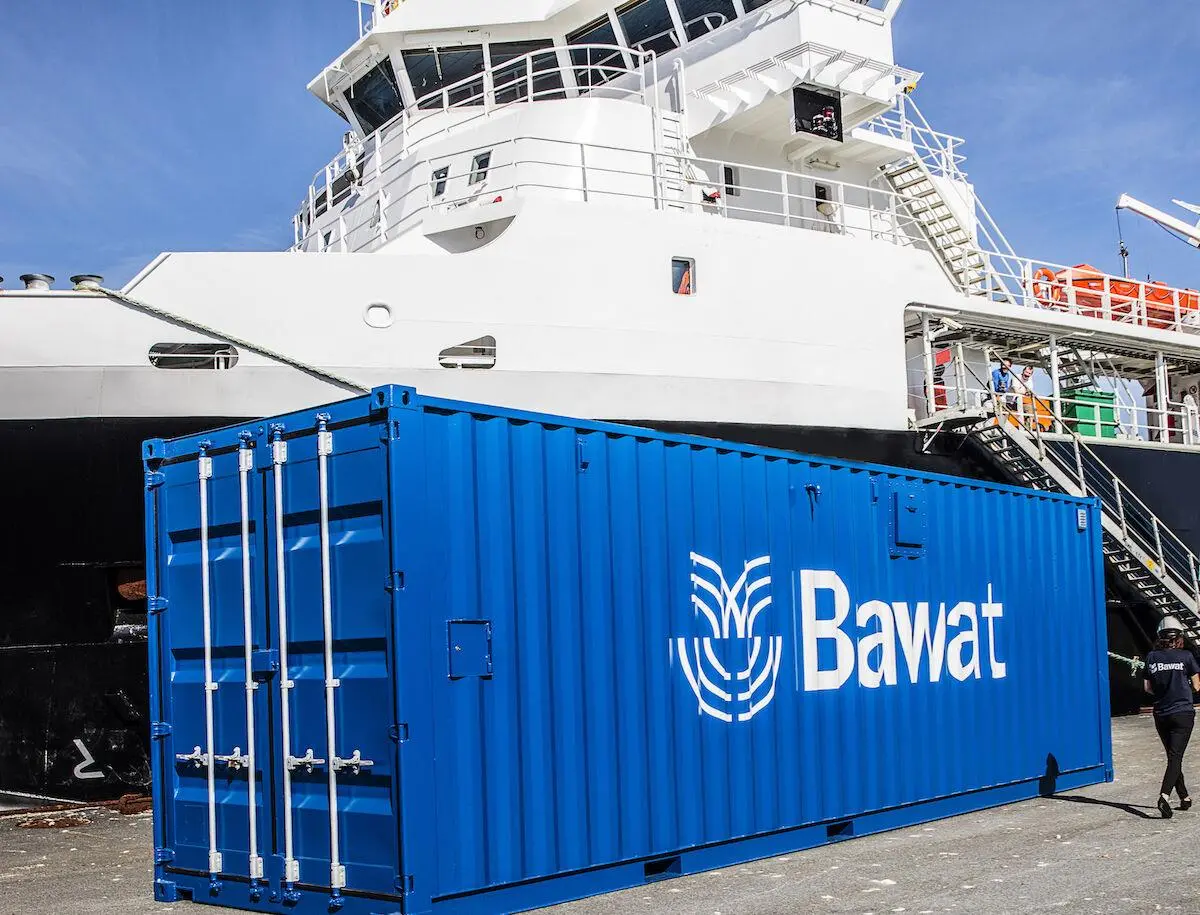
Quayside ballast water systems provide one possible solution to the problem. In 2023, Bawat Water Technologies and Damen Green Solutions joined forces, subsuming the latter’s InvaSave technology into “InvaSave powered by Bawat”.
Bawat was a latecomer to the ballast water management field, departing from the usual dichotomy of UV or EC with a system operated using heat exchangers and pasteurisation principles. The setup provided a helpful answer to the question of energy usage, which has become a concern for BWM systems. Instead of demanding yet ever greater amounts of electricity, the system would use heat energy, which can be extracted from exhaust gases and engine jacket water much more efficiently.
Now though, Bawat’s pasteurisation technology has been containerised by Damen and is being used by ballast vessels at berth. Far from expecting business to drop off once every ship is compelled to install a system after 2024, manufacturers of containerised BWM systems seem to be expecting shipowners to prefer their systems and treat their own on-board models as components only to be used if necessary. According to Bawat CEO Marcus Hummer, the system is necessary to address shortcomings in ballast water systems installed on board ships.
“There is a growing interest in Bawat’s mobile ballast water treatment system from ports and harbours … this is in particular arising from a contingency need for ballast water treatment due to existing faulty on-board BWMS,” he said. “But we are also seeing a business demand from planned ballast water treatment in ports typically for those with multiple vessels that don’t need to treat ballast water frequently.”
Bawat’s system arguably lends itself to mobile treatment better than UV or EC, since generation of heat in-situ using a boiler is much more straightforward, and more efficient by orders of magnitude, than generating large amounts of electricity. It does not use a filter, sidestepping the need for the Shanghai Test entirely, and also circumvents the need for other costly-to-replace components such as lamps and electrodes, with only pipes, pumps and heating elements to maintain.
“We see that the mobile solutions for ballast water treatment have generated a lot of interest from ports and operators, primarily for two reasons,” said Rutger van Dam, sales manager Damen Green Solutions, in April. “First, we are approaching the deadline set by the International Maritime Organization (IMO) to implement a ballast water treatment system by September 2024.
“Secondly many vessels currently have faulty systems on board that need to be replaced before the deadline. Bawat and Damen are ready to provide and offer the greenest high-end mobile solution in the market to treat ballast water. With joining forces Damen and Bawat can offer a mobile solution which is suited for all markets worldwide.”
In another recent partnership for Bawat, US ‘ballast-as-a-service’ provider Freedom Ballast has developed a new system based on combining UV with Bawat’s pasteurisation system. In a case report in which Freedom Ballast brought in a containerised Bawat system for third-party work in Louisiana, the former company was similarly scathing about installations on board vessels. “It is evident, based on published reports, that 30-50% of [on-board] systems fall into disrepair and non-compliance that can cause delays and interruptions in the vessel schedule that are costly for the involved parties and will cascade costly effects throughout the related supply chains,” noted Freedom Ballast.
Optimarin’s Tore Andersen believes that once the crush at the end of 2024 becomes evident, even more extensions will be granted, well into 2025. “There is always an extension for these owners who have forgotten to install a system,” he said.
If this is true, it will add to an already lengthy period during which little of consequence has been done to stem invasive species. It does not bode well as shipping now squares up to the era-defining question of how to deal with climate change.
Related Articles
 BALLAST WATER MANAGEMENT
 BALLAST WATER MANAGEMENT
 BALLAST WATER MANAGEMENT